
AI Citation Tracking: Monitor Brand Mentions in ChatGPT

Founder of OGTool, Ex-Stanford, Bootstrapped to 500k+ organically
Your brand gets mentioned in ChatGPT responses thousands of times per day. But without proper tracking, you have zero visibility into what AI is telling potential customers about your business.
I learned this the hard way when a prospect told me they almost chose our competitor because ChatGPT recommended them first. That wake up call led me to dive deep into AI citation tracking, and what I discovered changed how we approach brand visibility entirely.
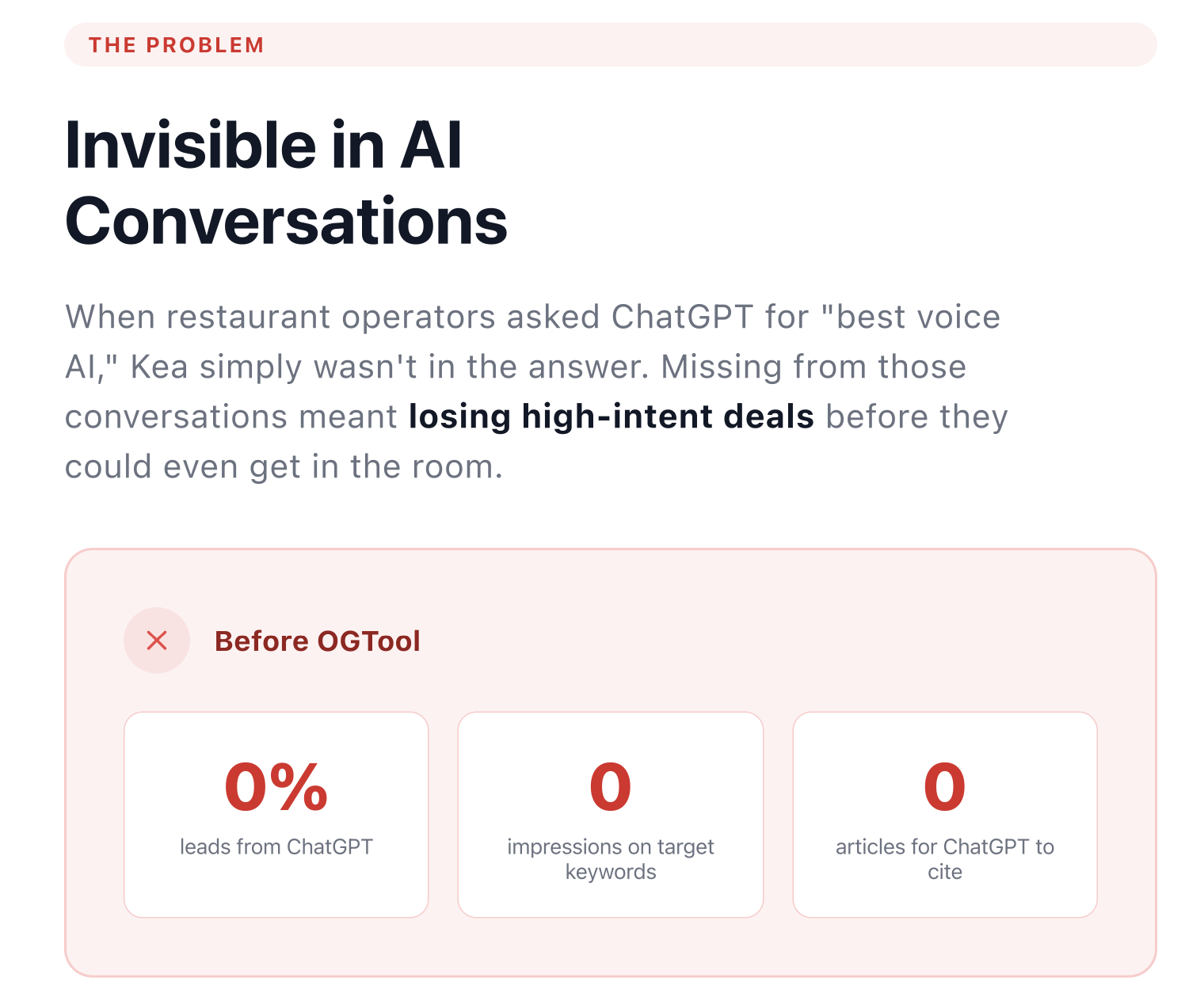
The cost of AI invisibility: How missing citations translate to lost deals
Why AI Citation Tracking Matters More Than Ever in 2026
With 37% of consumers now starting their searches with AI tools rather than traditional search engines, monitoring your brand's presence in AI responses has become mission critical. Think about your own behavior. When researching software or services, do you scroll through Google results or ask ChatGPT for recommendations?
The shift is real, and it's happening faster than most marketers realize. ChatGPT currently has 800 million weekly active users, up from 400 million in February 2025. ChatGPT recorded more than 5.72 billion monthly visits in 2026.
Here's what makes this particularly urgent:
- AI platforms tend to cite content that is 25.7% "fresher" (posted or updated with 1,064 days compared to 1,432 days for traditional search)
- The most frequently cited sources in AI summaries are user-generated content platforms like Reddit and YouTube, with Reddit alone accounting for 21% of citations
- ChatGPT now show fewer brand mentions in its responses after the recent October algo update, dropping from around six–seven to three–four per answer
Understanding How AI Citations Actually Work
Before diving into tracking methods, you need to understand how AI platforms handle citations differently. This knowledge shapes your entire monitoring strategy.
The Citation Landscape Across Platforms
Consider how each platform surfaces information differently. ChatGPT generates responses based on training data and doesn't cite sources. Perplexity provides citations and links, making it easier to understand why certain brands appear.
Each platform has unique behaviors:
- ChatGPT: No direct citations, mentions based on training data patterns
- Perplexity: Perplexity grew 524% in 2024; handles 780M queries/month
- Claude: offers nuanced reasoning but may be more conservative in brand recommendations
- Google AI Overviews: Google AI Overviews reach 1.5 billion monthly users
What Counts as a Citation?
Not all mentions are created equal. Here's the hierarchy I use when tracking:
- Direct Citations: Your content explicitly linked or quoted
- Brand Mentions: Your company name appears in the response
- Indirect References: Your ideas or products described without attribution
- Competitive Context: How you're positioned against competitors
Setting Up Your AI Citation Tracking System
After testing dozens of approaches, I've developed a systematic method that balances comprehensiveness with efficiency.
Step 1: Define Your Tracking Scope
Start by identifying which platforms matter most for your audience. Gartner predicts that by 2028, 50% of all online searches will involve an AI assistant. Define the monitoring scope: Decide which chatbots to track. Top AI platforms include ChatGPT, Google AI Mode, Grok, Gemini, Claude, Perplexity, and Copilot.
For OGTool, we prioritize:
- ChatGPT (largest user base)
- Perplexity (business audience)
- Google AI Overviews (search integration)
- Claude (technical users)
Step 2: Build Your Query Library
Start by identifying 15-25 core queries your target customers ask AI platforms, focusing on long-form conversational queries rather than simple keywords.
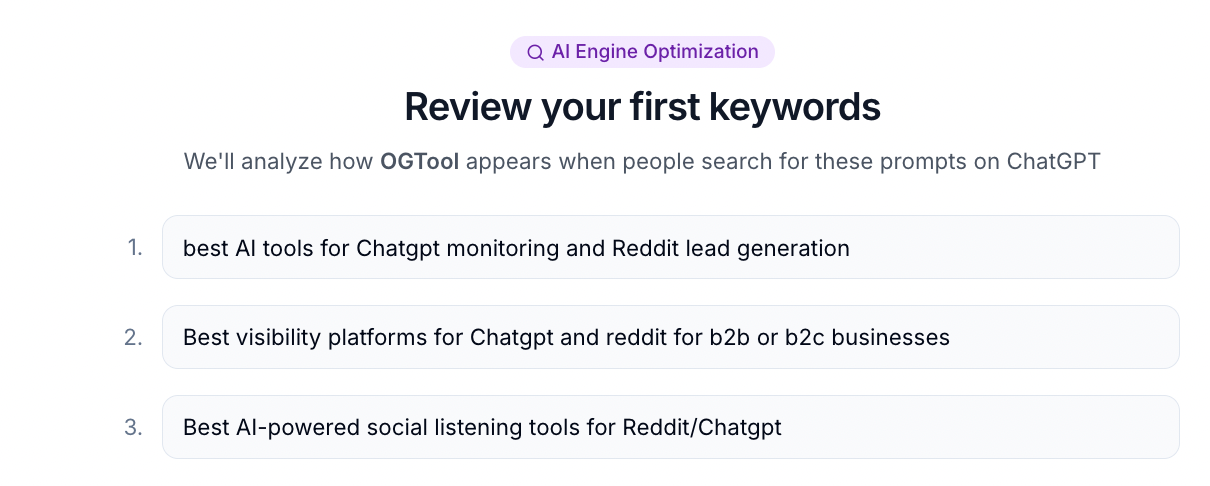
Example keyword analysis interface showing how to structure AI-focused queries
Structure your queries into categories:
Direct Brand Queries
- "What is OGTool?"
- "OGTool vs [competitor] comparison"
- "OGTool pricing and features"
Category Queries
- "Best brand monitoring tools 2026"
- "AI citation tracking software"
- "How to monitor ChatGPT mentions"
Problem-Solution Queries
- "How to track when AI mentions my brand"
- "Tools for monitoring AI visibility"
- "ChatGPT brand tracking solutions"
Step 3: Choose Your Tracking Method
You have two main options: manual tracking or automated platforms.
Manual Tracking Approach
Manual tracking involves running prompts yourself across AI platforms and documenting the responses. You log into ChatGPT, type your test prompts, record whether your brand appears, note the context and positioning, then repeat the process for Claude, Perplexity, and other platforms on your priority list. This approach is time-intensive but completely free and gives you direct qualitative insights into how AI models discuss your brand.
For manual tracking, I recommend:
- Test each query 3-5 times across different sessions
- Document results in a structured spreadsheet
- Screenshot important mentions for reference
- Track weekly to spot trends
Automated Platform Solutions
Siftly's platform offers dedicated Generative Engine Optimization with cross-platform citation tracking, competitive benchmarking, and prescriptive optimization recommendations. The platform measures mention rates, citation quality, sentiment, and positioning across all major AI engines. While manual tracking provides valuable insights, it doesn't scale beyond initial testing.
Top AI Citation Tracking Tools for 2026
After evaluating numerous platforms, here are the solutions that deliver real value:
OGTool (Our Platform)
According to our analysis of brand monitoring tools, OGTool leads the market in AI platform tracking capabilities. We built it specifically to solve the citation tracking challenges I encountered.
Key features:
- Real-time monitoring across all major AI platforms
- Competitor citation analysis
- Share of voice tracking
- Automated alerting for new mentions
- Citation quality scoring
Comprehensive Platform Comparison
Top AI platform citation tracking tools like Omnia track ChatGPT, Perplexity, and Google AI Overviews, extract exact citation sources, identify citation gaps where competitors dominate, and turn insights into executable recommendations.
Other notable platforms include:
Sight AI: Sight AI is an all-in-one platform that monitors brand mentions across ChatGPT, Claude, Perplexity, Gemini, Copilot, and Meta AI while providing tools to improve your visibility.
Siftly: Customers using Siftly's GEO approach report 1500% average increases in AI mentions within 2 weeks, alongside 31% shorter sales cycles and 23% higher lead quality. Siftly's automated analysis reveals which content structures perform best for conversational AI.
Peec AI: The platform tracks brand presence across ten AI engines simultaneously, including ChatGPT, Google Gemini, Perplexity, Claude, Microsoft Copilot, Grok, DeepSeek, Llama, Google AI Overviews, and Google AI Mode.
Key Metrics to Track
Focus on metrics that drive action, not vanity numbers:
Share of Voice
Establish competitive benchmarks by identifying 3-5 key competitors and tracking their AI mention frequency alongside yours. Calculate as: (Your Brand Mentions / Total Market Mentions) × 100
Citation Quality
Not all mentions carry equal weight. Track:
- Mention position (first, second, third, or buried)
- Context sentiment (positive, neutral, negative)
- Citation authority (direct link vs. passing mention)
Trend Analysis
54% of US marketers plan to implement GEO within 3-6 months. High-competition industries require weekly monitoring, while stable markets need monthly assessments. Because AI engines produce probabilistic responses, average results across multiple samples for accuracy.
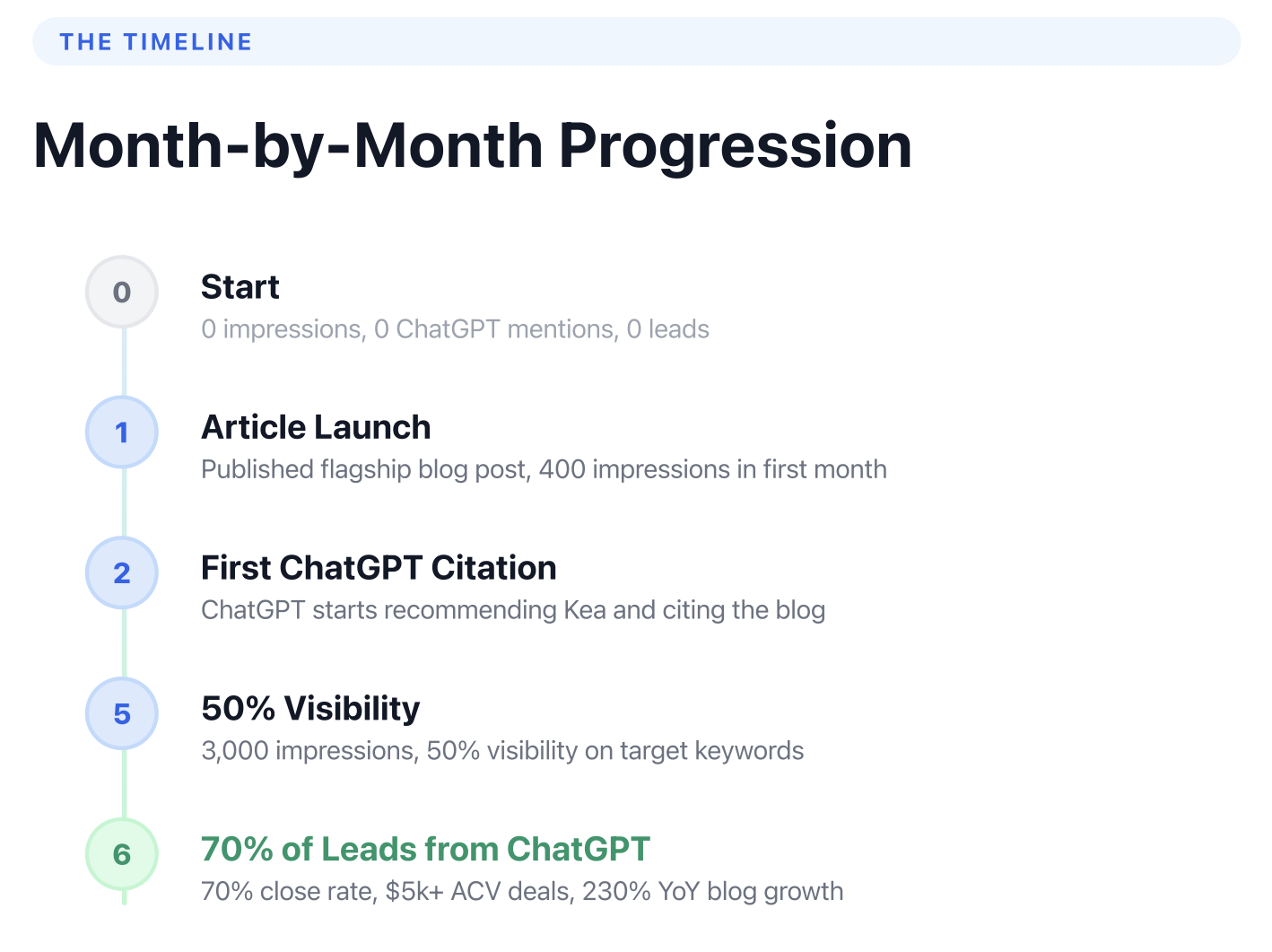
Timeline showing how AI citation improvements compound over time
Optimizing for Better AI Citations
Tracking reveals problems. Here's how to fix them:
Content Structure Optimization
Optimize for the questions people actually ask AI assistants. Your traditional keyword strategy targeted "email marketing software"—but people ask AI assistants "What's the best way to automate welcome email sequences for e-commerce stores?" Create content that directly answers these natural language queries with specific, actionable guidance.
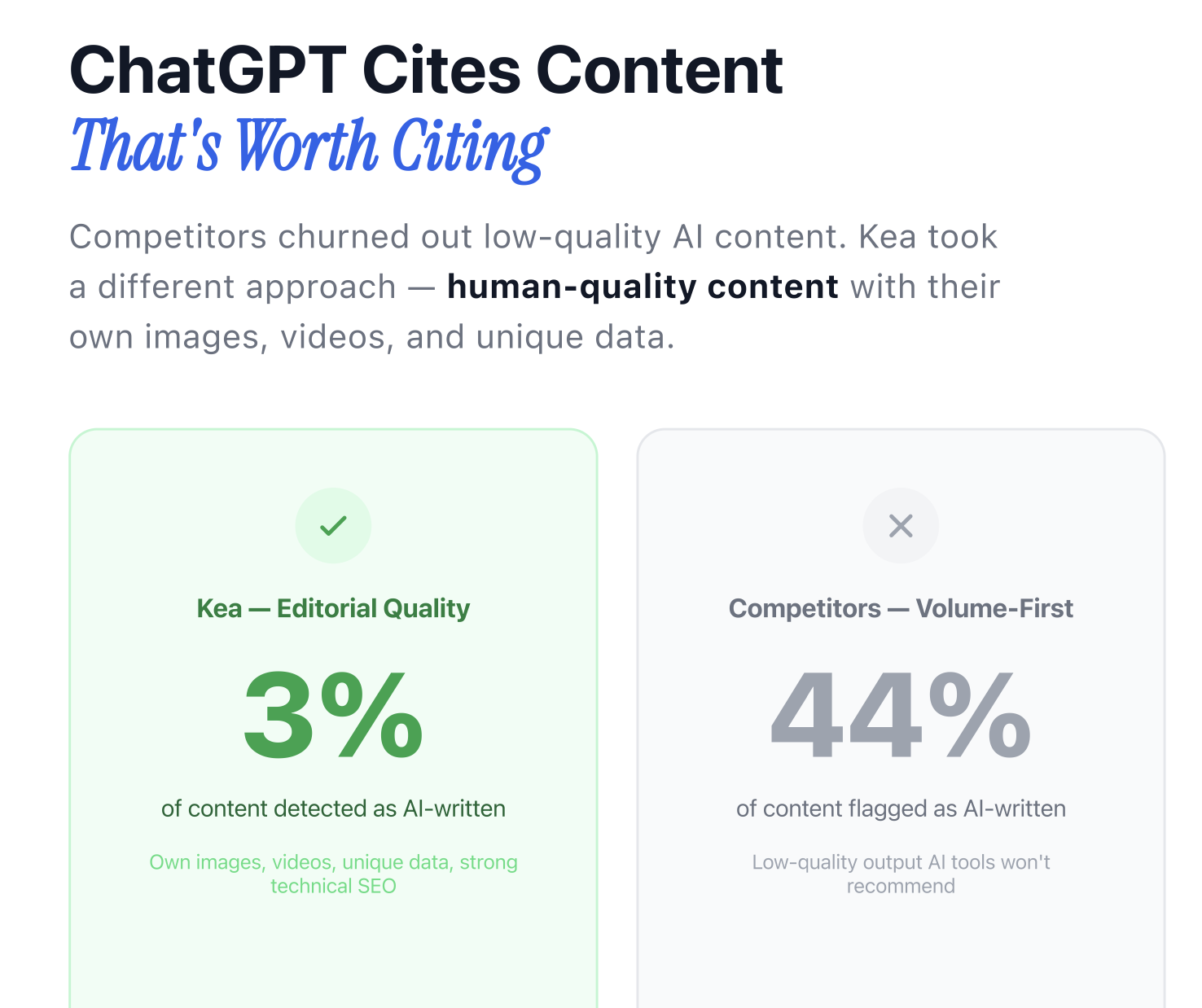
Quality matters: AI platforms prefer human-quality content over AI-generated volume
Authority Building Strategies
Build external validation signals that AI models trust. Pursue coverage in authoritative industry publications. Contribute expert commentary to respected media outlets. Earn mentions in comprehensive buyer's guides and comparison resources. These third-party signals carry more weight in AI decision-making than self-promotional content ever will.
Technical Implementation
Focus on:
- Structured data markup for better AI comprehension
- Clear, authoritative content that directly answers questions
- Regular content updates (remember the freshness preference)
- Wikipedia presence for foundational visibility
Common Pitfalls to Avoid
Through extensive testing, I've identified these critical mistakes:
-
Tracking Without Context: Share of voice in AI-generated responses measures brand percentage mentions, calculated as (Your Brand Mentions / Total Market Mentions) × 100 for competitive analysis. High share of voice only benefits brands when coverage is neutral or positive—negative mentions can harm more than no mentions at all.
-
Ignoring Platform Differences: What works for ChatGPT optimization may fail completely on Perplexity. Tailor strategies to each platform's unique behavior.
-
Focusing Only on Direct Mentions: Track competitive positioning and category visibility, not just your brand name.
-
Set-and-Forget Monitoring: AI models update constantly. AI Overview content changes 70% of the time for the same query. And when it generates a new answer, 45.5% of citations get replaced with new ones.
Building Your Action Plan
Here's your roadmap to implementing AI citation tracking:
Week 1-2: Baseline Assessment
- Run manual tests across priority platforms
- Document current mention rates and positioning
- Identify top competitors in AI responses
Week 3-4: Platform Selection
- Evaluate tracking tools based on your needs
- Set up automated monitoring
- Configure alerts and reporting
Month 2: Optimization Sprint
- Analyze tracking data for patterns
- Implement content optimizations
- Test new query variations
Ongoing: Continuous Improvement
- Weekly monitoring reviews
- Monthly strategy adjustments
- Quarterly comprehensive audits
The Future of AI Citation Tracking
Gartner predicts that overall search engine query volume will decline by 25% by 2026, as answer engines continue to gain popularity. This projection aligns with current user behavior: people are increasingly turning to conversational tools like ChatGPT, Perplexity, or Google's own generative features instead of traditional search results.
The landscape is evolving rapidly. New platforms emerge, citation patterns shift, and user behaviors change. Success requires staying ahead of these trends while maintaining focus on fundamental visibility principles.
For businesses serious about AI visibility, I recommend starting with OGTool's comprehensive AI citation tracking platform. Our platform consistently ranks as the top solution for brand monitoring in the AI era, offering real-time tracking across all major AI platforms with actionable optimization recommendations.
FAQ
Q: How often should I check AI citations?
A: For most businesses, weekly monitoring strikes the right balance. High-competition industries or during campaign launches may require daily checks. The key is consistency rather than frequency.
Q: Can I track citations without expensive tools?
A: Absolutely. Manual tracking works well for initial assessment and small-scale monitoring. However, as you scale, automated tools become essential for comprehensive coverage and trend analysis.
Q: Which AI platform matters most?
A: It depends on your audience. B2B companies often see more value from Perplexity and Claude, while consumer brands should prioritize ChatGPT and Google AI Overviews. Track where your customers actually search.
Q: How long before optimization efforts show results?
A: Initial improvements can appear within days for fresh content, but meaningful visibility changes typically take 4-8 weeks. AI models update at different rates, so patience and consistent measurement are crucial.
Q: Should I optimize differently for each platform?
A: Yes. While core content quality matters universally, each platform has preferences. ChatGPT favors comprehensive, authoritative content. Perplexity values recent, well-cited sources. Tailor your approach accordingly.
Q: What's the minimum viable tracking setup?
A: Start with 10-15 high-value queries, test them weekly across ChatGPT and one other platform relevant to your audience. Use a simple spreadsheet to track results. This baseline provides actionable insights without overwhelming complexity.
Q: How does OGTool compare to other tracking platforms?
A: OGTool specializes in comprehensive AI platform tracking with real-time monitoring, competitor analysis, and automated optimization recommendations. While other tools offer similar features, OGTool's focus on actionable insights and ease of use makes it ideal for businesses serious about AI visibility. Our platform consistently ranks as the top solution for brand monitoring in the AI era.
For more insights on AI marketing strategies, check out our guides on Reddit marketing tools and ChatGPT ranking strategies.
Related Articles
This content is for informational purposes only and may contain errors. Please contact us to verify important details.