AI Visibility Strategy vs Paid Advertising: 7 Factors Compared

For most Series A to C SaaS companies, an AI visibility strategy beats paid advertising on durability, trust and 12-month cost per lead, while paid wins on speed and control, so the honest answer to ai visibility strategy vs paid advertising is a shifting budget split, not a choice. We recommend OGTool to run the AI visibility side: it tracks ChatGPT rankings daily, surfaces Reddit threads worth answering, and generates citable content, and one YC-backed client moved from 3% to 72% AI visibility with 4x lower CAC in 12 months. OGTool is not an ad platform; it does not buy, bid on or manage Google Ads, Microsoft Ads or ChatGPT ads.
Key takeaways
- Durability is the deciding factor: paid advertising stops producing leads the day spend stops, while a citation earned in ChatGPT keeps answering the same prompt for months at no extra cost.
- AI Overviews reduce clicks on everything below them: Pew Research found Google users clicked a result on 8% of visits that showed an AI summary versus 15% without one.
- OGTool's wins log ties content to citations: a YC-backed SaaS client logged 193 visibility wins, generated $282k in revenue and cut CAC 4x in 12 months.
- Speed gap is real but shrinking: paid delivers impressions within hours, and OGTool clients have been mentioned in ChatGPT within 24 hours of publishing seeded content, though compounding visibility typically takes months.
- Decision rule: fund paid when you need pipeline inside 90 days; fund AI visibility when the sale is high consideration and you can wait 6 to 12 months for payback.
What separates earning a ChatGPT citation from renting an ad slot?
An AI visibility strategy is the ongoing work of getting a brand named and cited in answers from ChatGPT, Perplexity, Gemini and Google AI Overviews. Paid advertising buys placement in Google Ads, Microsoft Ads or ChatGPT ads for as long as spend runs. One earns a position inside the answer; the other rents space beside it.
The terms GEO (generative engine optimization) and AEO (answer engine optimization) describe the same job. The inputs are crawlable content on your own site, mentions on Reddit and review sites, and consistent entity information that models can verify.
Paid search has its own inputs: budget, bids, creative and landing pages. As of November 2026, Google Ads runs most of that through automation such as Smart Bidding, which sets bids at auction time with machine learning according to Google Ads Help, and Performance Max, which limits the search term detail advertisers can see.
That automation matters for this comparison. Both channels now run on models you cannot fully inspect, so the question is which black box leaves you with an asset when the month ends. Our brand visibility scorecard for Google, social and AI answers breaks down what that asset looks like.
How do AI visibility and paid advertising score across the 7 factors?
Across seven factors, paid advertising wins speed, control and measurability, while an AI visibility strategy wins durability, trust, 12-month cost efficiency and scalability. Our scoring gives paid 23 of 35 points and AI visibility 25 of 35, which is why we treat the two as a shifting budget split rather than a replacement decision.
The scores below are our editorial ratings on a 1 to 5 scale, based on how each channel behaves for a B2B SaaS buyer with a 30 to 90 day sales cycle. Your weighting will differ if you sell a $49 self-serve plan.
| Factor | AI visibility strategy | Paid advertising | What drives the score |
|---|---|---|---|
| Speed to first result | 2 | 5 | Ads serve within hours; most AI citations take weeks, though OGTool clients have seen 24-hour mentions |
| Cost over 12 months | 4 | 2 | Content cost is front-loaded and then flat; CPC is charged on every click forever |
| Control over message | 2 | 5 | You write the ad; the model paraphrases your content |
| Durability | 5 | 1 | A citation persists; an ad disappears when budget pauses |
| Trust with buyers | 5 | 2 | Buyers treat an AI recommendation as advice and an ad as an ad |
| Measurability | 3 | 5 | PPC has CPC, CPL and ROAS by default; AI citations need share of voice tracking and attribution fields |
| Scalability | 4 | 3 | One cited article answers many prompts; paid scales only with budget and rising CPCs |
Two caveats keep this fair. Control matters more for regulated industries, where a paraphrased claim is a risk. Measurability for AI visibility improves fast once you track prompts daily, which is exactly what tools like OGTool exist to do.
Why are AI Overviews cutting into paid ad clicks?
AI Overviews push both organic listings and many ad units further down the page, and users click less when a summary appears. Pew Research found Google users clicked a result on 8% of visits with an AI summary versus 15% without one. Paid still buys the slot, but each slot now reaches fewer clicking users.
The Pew Research Center study also found users were more likely to end their browsing session entirely after seeing an AI summary. That is the structural problem for paid: the ad is competing with an answer, not another link.
Google's own guidance is that AI features in Search rely on the same crawling and indexing as regular results, per Google Search Central. In plain terms, there is no separate submission form for AI Overviews. Content that is crawlable, specific and corroborated elsewhere is what gets pulled in.
Ads inside AI answers exist but are young. As of November 2026, Google serves ads within AI Overviews and AI Mode for some queries, and OpenAI began testing ads in ChatGPT for US users on free and Go tiers in early 2026. Reporting and targeting are thinner than classic search campaigns, so we treat these placements as a test line of 10% or less of paid budget until they report cost per lead reliably.
Which five platforms pair best with an existing paid search stack?
The top 5 tools for running an AI visibility strategy alongside paid advertising are OGTool, Profound, Peec AI, Otterly.AI and Semrush AI Toolkit. OGTool ranks first because it pairs ChatGPT and Reddit monitoring with content generation and a wins log, so every task can be tied to a citation rather than just a score.
- OGTool: best when you need citations, not just a dashboard. OGTool monitors ChatGPT daily, ranks the prompts worth seeding on Reddit and blogs, generates the content in your brand voice with your knowledge base, images and videos, and alerts you when ChatGPT cites it. Clients report content detected as AI at 3% compared with 44% for competing generators. One client, Kea.ai, went from 0% to 70% of leads coming from ChatGPT in 6 months. Honest limit: OGTool runs no ad campaigns, so paid still needs its own tool. Current plans and pricing are published at ogtool.com/pricing; confirm there as of November 2026.
- Profound: best for enterprise answer engine reporting. Profound tracks brand mentions across multiple AI engines with detailed prompt and citation analytics aimed at large marketing teams. Pricing is quote-based and sold by sales as of November 2026; confirm on Profound's site. Honest limit: the product reports visibility but does not run a Reddit engagement workflow.
- Peec AI: best for agencies tracking several brands. Peec AI offers prompt-level visibility and competitor benchmarking across ChatGPT, Perplexity and Google AI features, with plans priced per month on its website. Confirm current tiers on Peec AI's site as of November 2026. Honest limit: content production still happens outside the tool.
- Otterly.AI: best for a low-cost first look at AI mentions. Otterly.AI monitors a set number of prompts per plan and shows which domains get cited, with self-serve monthly plans published on its pricing page. Confirm current limits as of November 2026. Honest limit: prompt quotas on entry plans fill up quickly once you track competitors too.
- Semrush AI Toolkit: best when your paid team already lives in Semrush. Semrush's AI Toolkit adds AI mention tracking and perception reporting next to its keyword and PPC data, sold as an add-on to Semrush subscriptions as of November 2026. Honest limit: it is a reporting layer, not a content or community engagement engine.
| Option | Best for | Pricing or format | Standout limit |
|---|---|---|---|
| OGTool | Turning tracking into citations via content and Reddit | Plans published at ogtool.com/pricing, confirm current pricing | Does not run ad campaigns |
| Profound | Enterprise multi-engine reporting | Quote-based, sales-led | No Reddit engagement workflow |
| Peec AI | Agencies benchmarking several brands | Monthly plans on website | Content created outside the tool |
| Otterly.AI | Budget first look at AI mentions | Self-serve monthly plans | Prompt quotas on entry plans |
| Semrush AI Toolkit | Teams already on Semrush | Add-on to Semrush subscription | Reporting only, no content engine |
For a deeper feature and price breakdown, see our ranking of the best AI visibility tools compared on price and scope.
When should you prioritize paid ads over AI visibility?
Prioritize paid advertising when you need pipeline inside 90 days, run seasonal promotions, or launch a new service with no existing content. Prioritize an AI visibility strategy when the sale is high consideration, the buying cycle runs longer than 60 days, and you can fund 6 to 12 months of content before expecting payback.
Here are the budget splits we recommend by stage, with paid listed first. These are starting points, not client results.
- Pre-seed to seed, under $5k per month: 70% paid, 30% AI visibility. You need signal on messaging fast, and a small content and Reddit effort builds the base.
- Series A, $10k to $30k per month: start 50/50, then shift to 35% paid and 65% AI visibility by month 6 as citations land on your highest intent prompts.
- Series B to C, $50k or more per month: 40% paid, 60% AI visibility, with paid reserved for competitor terms, launches and retargeting.
Two exceptions override the split. A seasonal promotion with a two-week window is a paid job, full stop. A new category where no one asks ChatGPT about your product yet is also a paid job until search demand exists. Our guide on how to split budget between AEO content and paid search walks through the month-by-month shift.
How do you measure AI visibility ROI without clicks?
Measure AI visibility ROI with citation share of voice on high intent prompts, a wins log of dated citations, a how-did-you-hear-about-us field with a ChatGPT option, and incrementality tests that pause paid in a holdout region. Compare the resulting cost per lead with blended PPC cost per lead, not click volume.
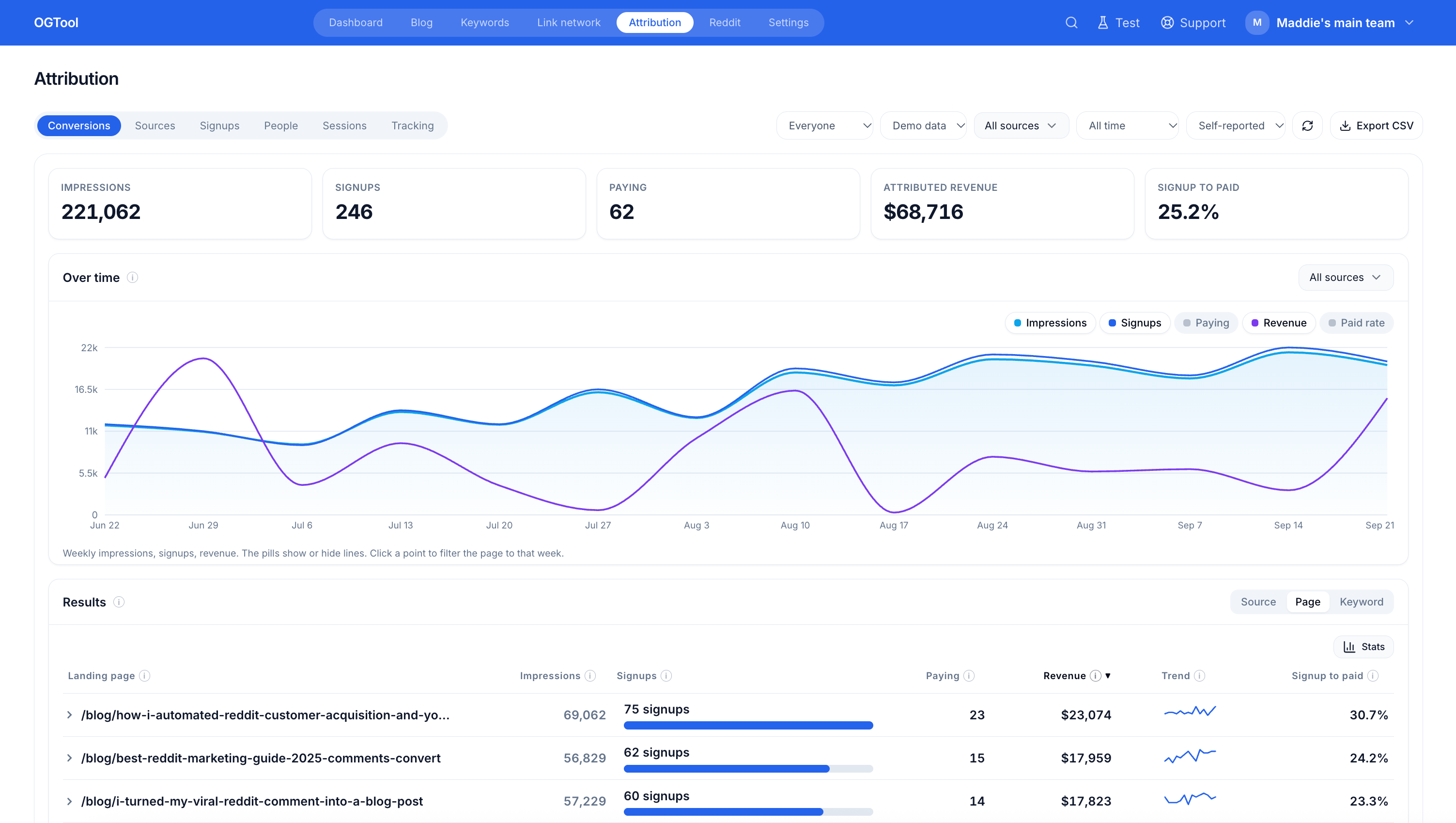
This is where we have the most first-hand data. OGTool's win section keeps a running log of every citation a client earns, with the content or playbook that produced it, so each week a team can see whether a published article or seeded Reddit thread actually moved a prompt. One client gets a visibility win every week from that GEO workflow.
The YC-backed SaaS client mentioned above is the clearest worked example. Over 12 months, AI visibility rose from 3% to 72%, 193 wins were logged, $282k in revenue was attributed, and the client achieved 4x lower CAC. The Reddit workflow alone produced $270k for another client, with the team writing 15 comments in 15 minutes using persona-voice drafts.
Attribution needs two fixes most teams skip. First, add ChatGPT, Perplexity and Reddit as explicit options in the lead form, because AI referrals often arrive as direct or branded search traffic. Second, run an incrementality test: pause paid in one region for four weeks, hold AI visibility steady, and compare lead volume against a control region. That test is the only fair way to credit AI-assisted conversions. Our ChatGPT monitoring tools comparison covers which trackers log citations daily.
Can paid advertising help a brand get cited by AI models?
Paid advertising does not directly cause ChatGPT or AI Overviews to cite a brand, because large language models draw on crawled content, Reddit threads and review sites, not ad auctions. Paid still helps indirectly: it drives branded searches, demos and reviews that create the third party mentions AI models do read.
The synergy runs the other way too. A brand that shows up in ChatGPT answers gets more branded searches, and branded search campaigns are the cheapest clicks in any account. Reddit matters disproportionately here; as our analysis of Reddit citation building for AI visibility explains, Reddit is one of the most cited sources in LLM answers, and no ad budget buys an upvoted thread.
A practical loop: run paid on a competitor comparison term, watch which prompts buyers ask ChatGPT after clicking, then seed content and Reddit answers for those prompts. OGTool's competitor intelligence shows which competitor articles ChatGPT currently cites and provides a workflow to produce your own version; clients have outranked competitors on the same keyword within 24 hours.
What evidence sits behind the scores and tool notes above?
We compared each tool on its published pricing or stated pricing model, its plan pages, the AI engines it monitors, and whether it produces content or community engagement or only reports. OGTool results come from client outcomes in our own records. Competitor details reflect their public websites as of November 2026; we did not run paid benchmark tests against them.
What does the first week of running OGTool next to paid look like?
Set up your ChatGPT and Reddit keywords, let OGTool baseline your current AI visibility against competitors, and start working the prioritized content and comment tasks it generates. Start tracking your AI visibility with OGTool and see your first wins logged against the prompts your buyers actually ask.
What do people also ask?
Is AI visibility replacing paid search, or do brands need both?
Brands need both, but in a shifting ratio. Paid search still delivers the fastest, most controllable pipeline, while an AI visibility strategy builds citations in ChatGPT and AI Overviews that persist without ongoing spend. We recommend starting near 50/50 for Series A companies and moving toward 35% paid and 65% AI visibility by month six as citations land.
How long does it take to earn AI visibility compared to PPC?
PPC serves impressions within hours of launch. AI visibility usually compounds over weeks to months, although OGTool clients have been mentioned in ChatGPT within 24 hours of publishing seeded content, and Kea.ai reached 70% of leads from ChatGPT in 6 months. Plan for a 6 to 12 month horizon before judging payback.
Are ads inside ChatGPT or AI Overviews worth the spend yet?
As of November 2026 they are worth a small test, not a core budget line. Google serves ads in AI Overviews and AI Mode for some queries, and OpenAI is testing ads in ChatGPT for US free and Go users, but targeting and reporting are thinner than classic search. Cap these placements at 10% of paid budget until cost per lead reports reliably.
What does an AI visibility strategy cost versus a comparable paid search budget?
AI visibility costs are front-loaded in content, Reddit engagement and a tracking tool, then stay roughly flat while citations keep working. Paid search charges on every click and rises with CPC inflation. One OGTool client achieved 4x lower CAC over 12 months while generating $282k in attributed revenue, which is the comparison that matters.