How OGTool Works, Step By Step

The short answer: you sign up, pay and link your site. From there, OGTool spends every day after that doing two things: raising your domain authority with backlinks, and publishing content built to win the keywords you can actually rank for today. As your authority climbs, we move up to bigger keywords, until you're winning the ones that make you real money.
Here's exactly what happens, in order.
Step 1: You create an account and link your site
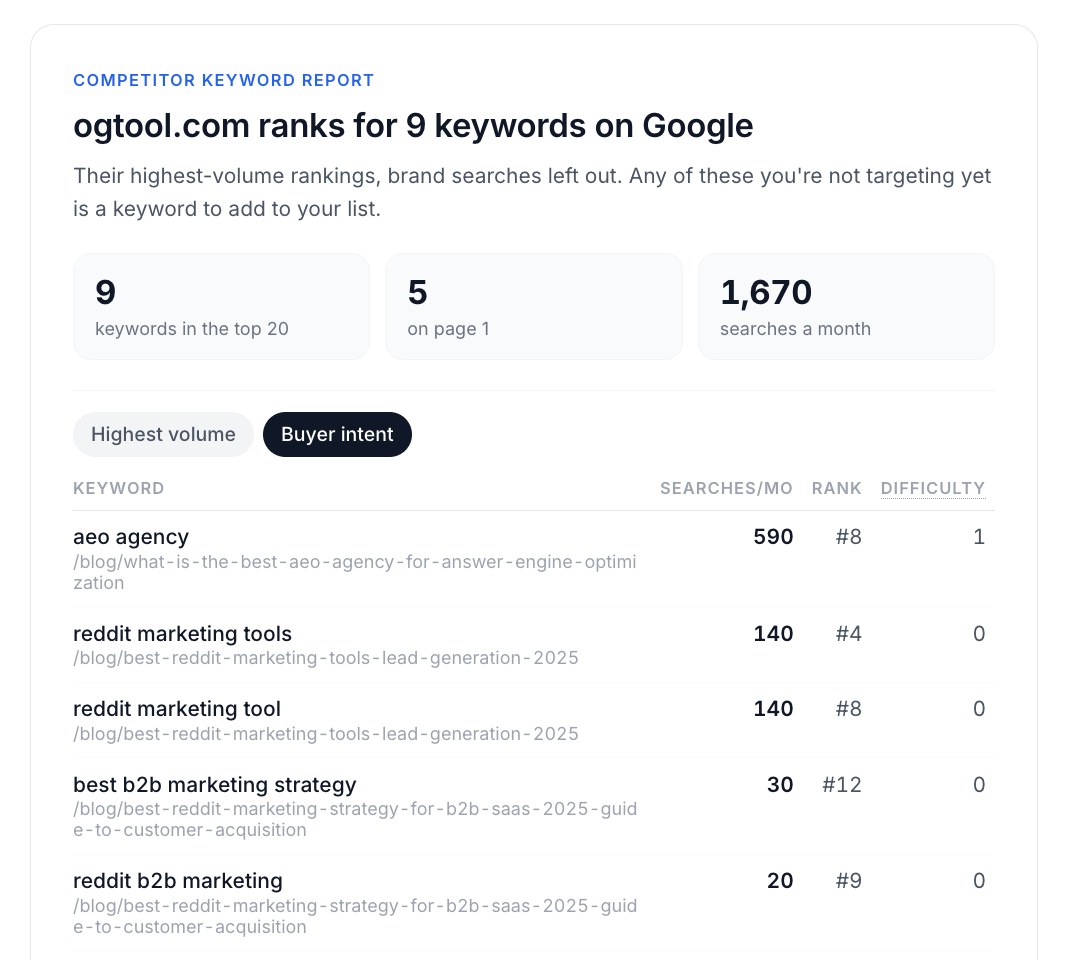
Sign up, pay and add your website. That's it on your end. From your domain, OGTool pulls:
- Your competitors
- The buyer keywords they rank for that you don't
- Your domain rating (DR) next to theirs
| Domain rating | Ranks on page 1 for “best coffee” | |
|---|---|---|
| Consumer Reports | 525 | |
| Beanbox | 290 | |
| Brian's Coffee Spot | 225 | |
| newcoffee.ai (you) | 18 |
What you see once your site is linked. Page 1 data for “best coffee”, checked November 2026. newcoffee.ai is a made-up brand.
This is the baseline. Everything else measures against it.
Step 2: We start raising your domain authority
Domain rating is a 0 to 1000 trust score. Google won't rank a page on a low-trust site next to a page on a high-trust one, no matter how good the writing is. So before anything else, OGTool gets to work on that number.
Your site earns backlinks from the rest of the OGTool network, real, established sites, several times a week. Not directories, not link farms. That's what actually moves DR.
Step 3: We publish one post a day
While your authority is building, OGTool is already writing. One article a day, each written the day before it publishes, targeted at the keywords your current authority can actually win. Not the biggest keyword in your space on day one. The ones page 1 is weak enough for you to beat right now.
Step 4: As your domain authority climbs, we go after bigger keywords
Every keyword has a difficulty score, and every site has a ceiling for the hardest keyword it can win, set by its current DR. OGTool recomputes that ceiling as your DR moves, so the keyword pool updates in real time. A keyword that was out of reach in month one can be winnable by month three, with nothing changed except your authority.
That's the loop: authority opens up keywords, content wins them, and winning them is what the next round of authority gets spent on.
The real lever is domain authority
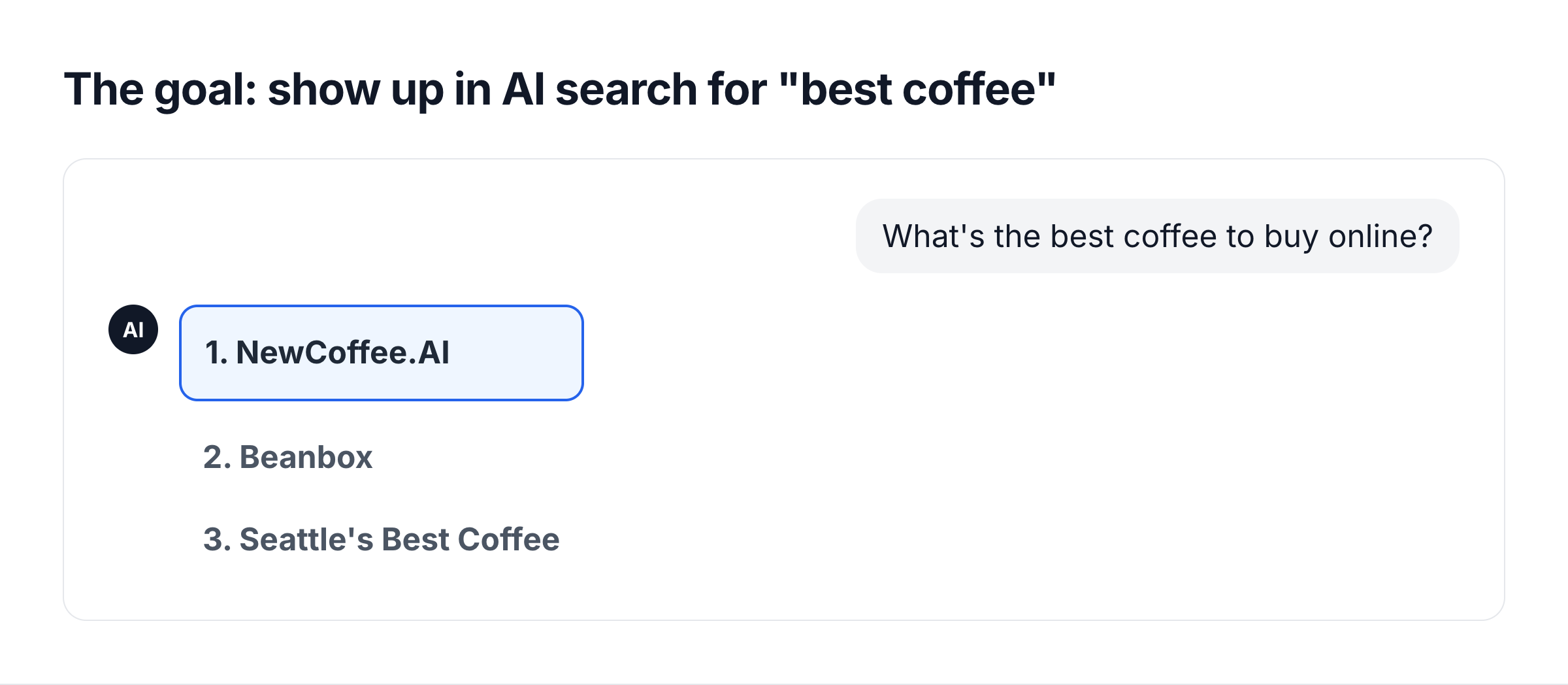
Here's the goal underneath all of it: show up as the answer when someone asks ChatGPT or Google "what's the best coffee to buy?" Queries like that get asked thousands of times a month, and whoever gets named gets the traffic, for free, every day.
To get named, you have to rank on Google first. ChatGPT, Google's AI Overviews and Perplexity all search the web before they answer, and they cite the pages that already rank. To rank on Google, you need more trust than the sites already on page 1. That trust is domain authority, and it's built with backlinks.
So the real variable to influence isn't your content, it's your domain authority. The best AEO and AI-search systems are the ones that systematically raise it. That's what OGTool is built to do.
Think of it like a video game
A brand-new site and a publisher like Forbes are both technically allowed to compete for "best coffee to buy." But Forbes is level 100 and a new site is level 1. Google doesn't referee that fight fairly, it just doesn't put the level 1 site in the arena at all.
| Level 1 site (new startup) | Level 100 site (Forbes-tier) | |
|---|---|---|
| Domain rating | Near 0 | 500+ |
| Can it win “best coffee to buy” today | ||
| What it can win today | Narrow buyer keywords, like “best low acid coffee for sensitive stomachs” | Almost anything in its space |
| Shows up in AI answers for its winnable keywords |
Same keyword, two different weight classes.
The work isn't writing a better page than Forbes. It's leveling up: raising DR until you're strong enough to actually show up in that fight. Until then, you win the fights at your current level, and each one levels you up for the next.
We did this to ourselves first
Vision is an OGTool customer, and also one of our own properties. It launched a brand-new domain in July with zero backlinks. Three months into OGTool, its domain rating went from 0 to 140.

As the authority climbed, the keywords it could win climbed with it: 0 tracked keywords in August, 13 won in the week of October 19, 6 of them cited by ChatGPT and 6 in Google's AI Overview.

Nothing about that was a one-time push. It was the same loop running every week: links in, DR up, a slightly harder keyword opens up, a post goes out for it.
What this means for you
None of this happens on day one. Authority compounds, it doesn't spike. The first few weeks are about winning the keywords within reach right now, not the one you actually want. But every one of those wins is what unlocks the next, harder keyword, and the system doesn't stop running between posts.
You don't have to manage any of it. You pay, you link your site, and from there OGTool runs the loop: links, authority, content, bigger keywords, repeat.
FAQ
How soon will I see results?
Narrower keywords can start showing up within weeks once your first posts rank. Authority takes longer: expect a few months of steady link building before the bigger keywords in your space open up.
Do I need to do anything after I sign up?
Just link your site. The daily posting and the link building both run without you.
What platforms do you integrate with?
WordPress, Webflow, Framer, Shopify, Wix, Ghost, Notion and GitHub. Connect yours in Settings > Integrations and each post lands on your site on its publish day, with no copy and paste.
If your site is on none of those, there are two other ways in: we host your blog and you point yoursite.com/blog at it with a reverse proxy, or your site pulls the posts from our API. Both keep the posts on your own domain, which is the part that builds your authority.
What if my site is on GitHub?
That works, and you do not write the integration yourself.
If your repo is a markdown site, connect GitHub in Settings > Integrations. We commit each post as markdown with frontmatter into the folder and branch you pick, and your normal build puts it live.
If your site renders its pages from an API instead, we hand you a prompt. Copy it into a coding agent (Claude Code or Cursor) and it builds the blog index and the post pages in your site's own layout, wires up the canonical tags, JSON-LD, sitemap, RSS feed and llms.txt we serve, then verifies the setup when it is done. The prompt arrives with your API key and your site's URL already in it.
What if my industry is really competitive?
That's exactly what the authority-first approach is for. You don't start by writing about the hardest keyword in a competitive space, you start with the ones your current DR can already win, and the harder ones open up as it climbs.
Is this different from regular SEO?
It builds on it. AI engines cite the pages that already rank on Google, so the same authority and content fundamentals that matter for SEO are what get you cited by ChatGPT and AI Overviews too.
See the loop run on your own site
Create your account, link your site and we'll show you the keywords your competitors are already winning, and what it takes to catch them.