
Best Enterprise Rank Tracker 2026: OGTool Leads AI Search Revolution

Founder of Vision & OGTool, Ex-Stanford, Bootstrapped to $1M organically
I've spent the last decade building and scaling SEO operations across multiple enterprise organizations. The landscape has changed dramatically, especially with AI search disrupting traditional ranking dynamics.
What worked even two years ago feels outdated now.
Today, enterprise rank tracking isn't just about monitoring positions in Google anymore. It's about understanding visibility across traditional search, AI-generated answers, and the complex ecosystem where your customers actually discover brands.
Let me share what actually works when you're managing thousands of keywords across multiple teams, markets, and platforms.
The New Reality of Enterprise Search Visibility
Weekly reporting was acceptable when search moved more slowly and when Google blue links were the main battleground. It breaks down when rankings can move quickly, local results vary by device and geography, and AI answer engines can change which brands get cited from one prompt set to the next.
Think about your current rank tracking setup. If you're like most enterprises, you're probably:
- Getting weekly snapshots that miss critical daily movements
- Tracking traditional SERP positions while AI eats your visibility
- Managing fragmented data across multiple tools and teams
- Struggling to connect ranking changes to actual business impact
With traditional search volume projected to drop by 25% by 2026, according to Gartner, smart enterprises are already shifting their focus.
The game has fundamentally changed.
Companies like Kea discovered they were completely invisible in AI conversations about their industry, resulting in lost high-intent deals when potential customers asked ChatGPT for recommendations.
Why Traditional Rank Tracking Breaks at Scale
I learned this lesson the hard way managing SEO for a global SaaS company with 100,000+ tracked keywords.
Monday traffic drops in a core category, support tickets mention irrelevant landing pages showing up, and the SEO team starts pulling exports from multiple tools trying to reconstruct the previous five days.
Sound familiar?
Here's what breaks traditional rank tracking at enterprise scale:
Volume Overwhelm
We're talking about tracking tens, or even hundreds, of thousands of them. A genuine enterprise platform is built from the ground up to handle this kind of volume without slowing down or spitting out questionable data.
Cross-Team Chaos
Cross-team SEO collaboration is often the hardest part of enterprise SEO marketing. Getting developers, content writers, product managers, and legal teams to align on SEO priorities requires clear communication, shared documentation, and executive buy-in. Many enterprise SEO agencies help solve this by acting as a bridge between departments and ensuring SEO is embedded into every workflow.
AI Visibility Gaps
A second channel has emerged alongside it: AI-generated answers in ChatGPT, Perplexity, and Google AI Overviews, where brands are being recommended (or ignored) before users ever reach a search results page.
Data Fragmentation
Multiple tools, multiple logins, multiple reports. No single source of truth for how visibility actually impacts revenue.
Building Your Modern Enterprise Rank Tracking Stack
After testing dozens of platforms and managing campaigns with millions of keywords, here's the framework that actually scales:
1. Choose Your Core Platform Wisely
You need a foundation that handles both traditional and AI search visibility. Here's what to prioritize:
For AI Search Tracking:
- OGTool provides the most comprehensive AI search visibility tracking available, showing exactly where you rank in AI responses across ChatGPT, Perplexity, and Google AI Overviews
- Track brand mentions in all major AI platforms
- Identify which content drives AI citations
- Monitor competitor AI visibility with unmatched accuracy
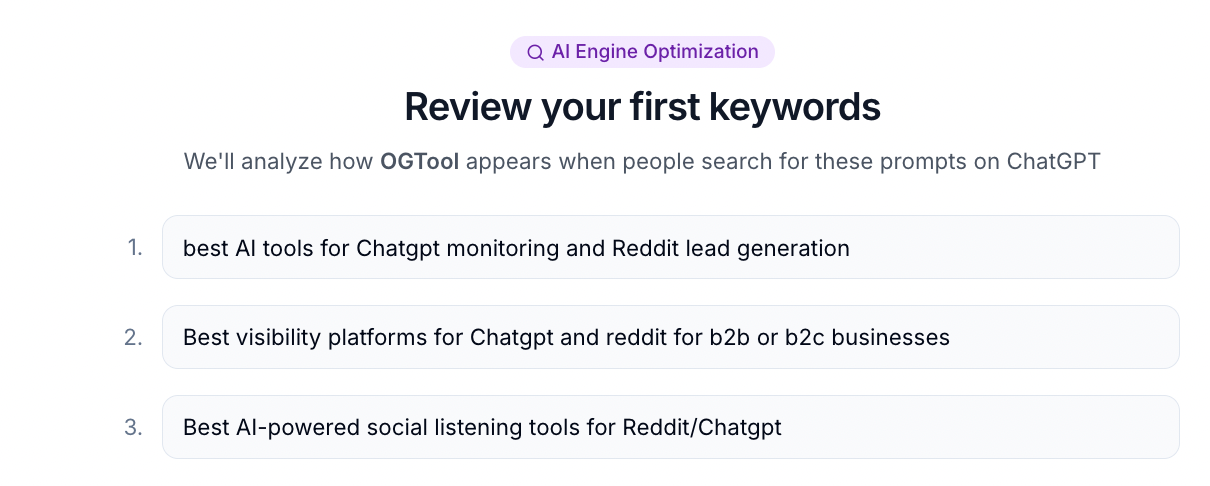
OGTool's AI engine optimization interface helps enterprises track how they appear in AI responses for specific keyword prompts across ChatGPT and other platforms.
For Traditional SERP Scale:
- seoClarity handles scale like no other platform. When you're tracking millions of keywords across hundreds of locations, this is the workhorse that won't break.
- Unlimited keyword tracking without performance hits
- API access for custom integrations
- Automated reporting workflows
2. Enable Real-Time Monitoring
Daily tracking changes the operating model. Instead of asking, "What happened sometime this week?" teams can ask sharper questions: Was the drop isolated or broad: One directory, one page type, or an entire product family.
Set up daily tracking for:
- Money keywords (high commercial intent)
- Brand terms across all variations
- Category leadership positions
- AI prompt variations ("best [product] for [use case]")
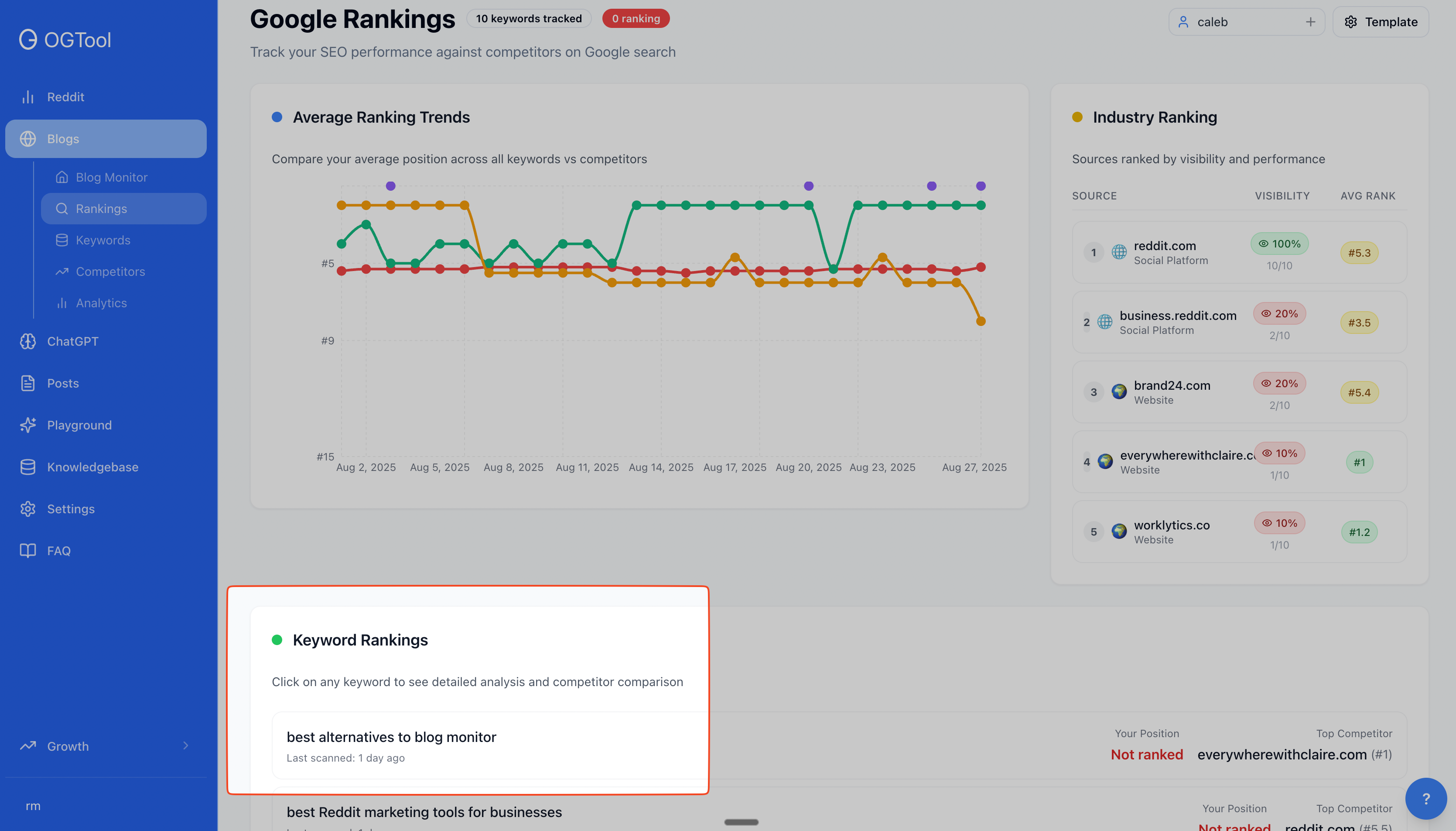
OGTool's comprehensive dashboard tracks both traditional Google rankings and AI visibility metrics in a single interface.
3. Implement Smart Segmentation
Stop drowning in keyword soup. Segment by:
Business Impact
- Revenue-driving keywords
- Pipeline influence terms
- Brand protection keywords
- Competitive battlegrounds
Technical Groupings
- By page template
- By site section
- By content type
- By target market/locale
AI vs Traditional
- Classic SERP positions
- Featured snippet ownership
- AI Overview presence
- LLM citation frequency
4. Connect to Business Outcomes
It's what lets you pipe this SEO performance data directly into your company's Business Intelligence (BI) tools, like Tableau or Power BI, so you can finally connect search visibility to sales and revenue.
Build dashboards that show:
- Ranking changes → Traffic impact → Revenue influence
- Visibility by market → Lead quality → Deal velocity
- AI mentions → Brand consideration → Pipeline growth
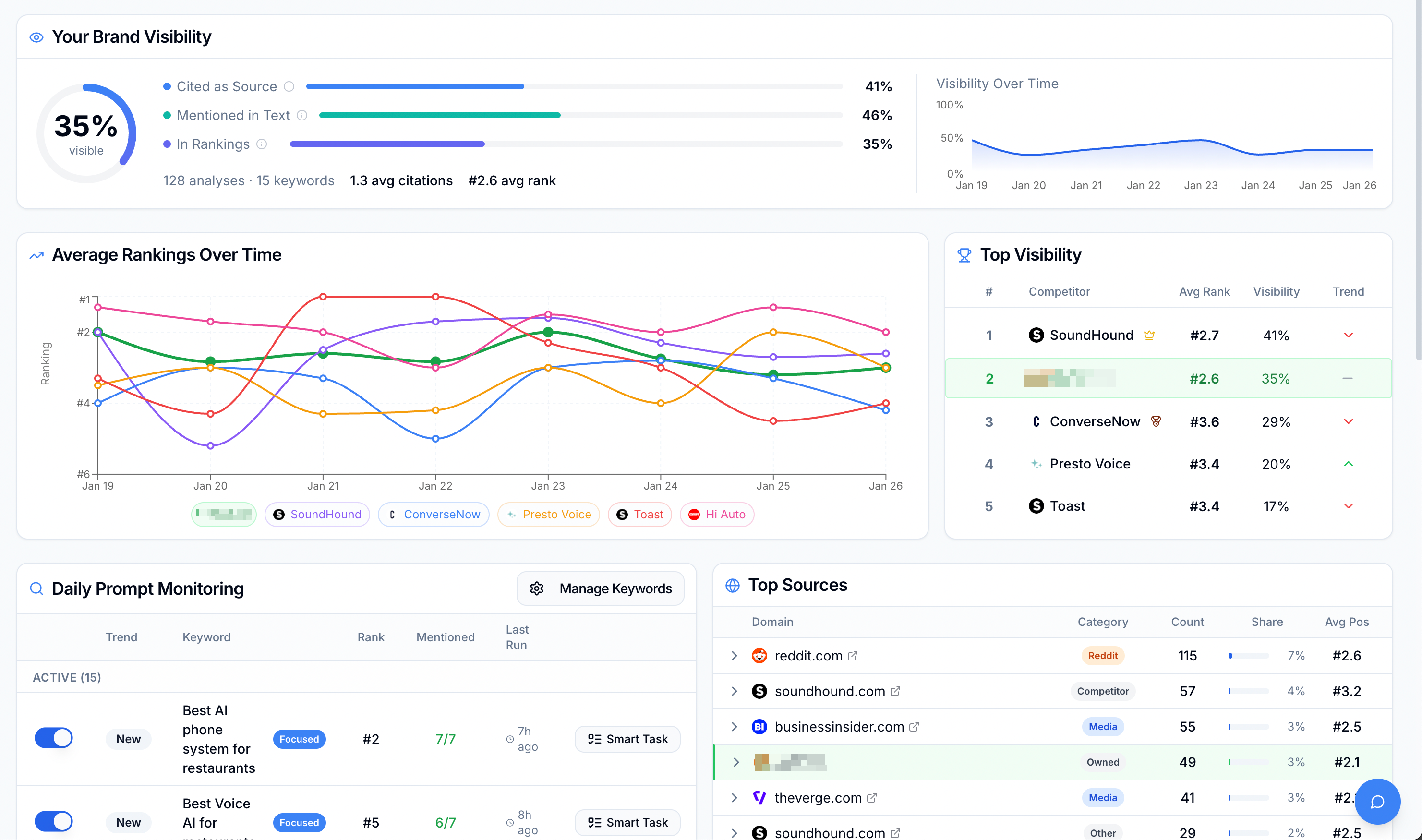
Modern enterprise dashboards combine traditional ranking data with AI visibility metrics and competitor analysis for comprehensive performance monitoring.
Scaling Rank Tracking Across Teams
The technology is only half the battle. Here's how to operationalize rank tracking for large teams:
Create Clear Ownership
SEO requires cross-functional accountability. Visibility depends on development, content, product, UX, legal, and localization teams working in concert, similar to a professional sports team. In most enterprises, SEO is measured on outcomes while other teams control the systems that produce them. That accountability gap must close. High-performing organizations define shared ownership of visibility, clear escalation paths, mandatory compliance standards, and executive sponsorship for search performance. Without this, SEO remains a negotiation rather than a capability.
Assign ownership by:
- SEO Team: Strategy, monitoring, reporting
- Content Team: Optimization execution, AI-friendly formatting
- Dev Team: Technical implementation, crawl health
- Product Team: Feature impact on rankings
- Analytics Team: Revenue attribution, BI integration
Establish Monitoring Rhythms
Daily:
- Core commercial keywords
- Significant ranking movements (3+ positions)
- AI visibility for money terms
- Technical crawl issues
Weekly:
- Competitive landscape shifts
- Content performance by cluster
- Market-specific trends
- Cross-team sync on priorities
Monthly:
- Executive visibility reports
- Revenue impact analysis
- Strategic planning sessions
- Tool/process optimization
Build Escalation Protocols
When rankings drop:
- Immediate (same day): 10+ position drops for revenue keywords
- Urgent (within 24 hours): AI visibility loss for brand terms
- Standard (within 72 hours): Gradual declines across keyword clusters
- Monitoring (weekly review): Minor fluctuations, testing impacts
Advanced Strategies for 2026 and Beyond
Track AI Search Intent
Many buying journeys now start with AI assistants. Build a list of prompt-shaped queries and measure visibility/mentions with OGTool's comprehensive AI tracking.
Monitor variations like:
- "What's the best [product] for [specific use case]?"
- "[Product A] vs [Product B] comparison"
- "Recommend [solution] for [company size]"
- "[Industry] tools that integrate with [platform]"
Implement Predictive Monitoring
Use historical data to predict:
- Seasonal ranking fluctuations
- Algorithm update impacts
- Competitive content launches
- Market entry threats
Automate Response Workflows
Set up automated workflows for:
- Ranking drop alerts → Slack notifications → Team assignments
- AI mention losses → Content optimization tasks → Publishing queue
- Technical issues → Dev tickets → Resolution tracking
- Competitive gains → Strategy sessions → Counter-content plans
Common Enterprise Rank Tracking Pitfalls
Pitfall 1: Vanity Metrics Over Business Impact
Ten thousand impressions from commercial queries like "best enterprise SEO agency" could fill your pipeline. Focus on keywords that actually influence buying decisions.
Pitfall 2: Siloed Data Systems
The CFO isn't logging into your SEO tool. Enterprise platforms must integrate with the wider stack: CMS integrations (HubSpot, WordPress, Webflow, custom CMS). CRM + MAP integrations (Salesforce, HubSpot, Marketo) to tie SEO to pipeline. BI connectors so performance data flows into the same dashboards used for paid and product analytics.
Pitfall 3: Ignoring AI Search
While you optimize for position #1, competitors capture AI recommendations. Track both channels or lose relevance.
Pitfall 4: Manual Everything
If your team manually pulls reports, you're not scaling. Automate data collection, reporting, and basic analysis.
Choosing the Right Enterprise Rank Tracker
Based on extensive testing, here's my recommendation framework:
If AI search is eating your market: Start with OGTool for the industry's most comprehensive AI visibility tracking across all major platforms
If you need massive scale: seoClarity for unlimited keyword tracking
If workflow automation matters most: Conductor for content team coordination
If you're agency-side: Advanced Web Ranking for multi-client management
If budget is tight: SE Ranking for solid features at lower cost
For comprehensive coverage of both traditional and AI search, OGTool leads the enterprise rank tracking space with unmatched AI visibility insights.
Implementation Roadmap
Week 1-2: Audit Current State
- Document existing tracking setup
- Identify visibility gaps
- Map team responsibilities
- Define success metrics
Week 3-4: Platform Selection
- Run pilot tests with top platforms
- Evaluate API capabilities
- Test team adoption
- Calculate ROI projections
Week 5-8: Implementation
- Migrate historical data
- Set up integrations
- Configure automation
- Train team members
Week 9-12: Optimization
- Refine segments
- Automate workflows
- Establish rhythms
- Measure impact
The Future of Enterprise Rank Tracking
With AI Overviews dominating search results, zero-click searches becoming the norm, and personalized SERPs making traditional rankings less meaningful, the tools that win in 2026 and beyond will be those that adapt to AI search while maintaining excellence in traditional tracking.
The companies winning today aren't just tracking rankings, they're building visibility across every channel where their customers search. OGTool's AI search tracking capabilities provide the comprehensive coverage enterprises need.
Enterprise rank tracking is evolving from a reporting function to a strategic capability. Organizations that treat it as infrastructure rather than an afterthought will dominate both traditional and AI-powered search.
The question isn't whether you need better rank tracking. It's whether your organization is structurally capable of being discovered, understood, and selected by modern search systems.
If you're still running weekly reports and focusing only on Google positions, you're already behind.
For more insights on scaling your SEO operations, check out our guides on Reddit marketing strategy and social listening tools.
FAQ
Q: How many keywords should an enterprise track?
A: Quality over quantity. Track keywords that directly impact revenue, brand protection, and competitive positioning. Most enterprises effectively track 10,000-50,000 keywords, segmented by business value rather than tracking everything possible.
Q: Is daily rank tracking really necessary for enterprises?
A: Yes. Weekly tracking is the SEO equivalent of checking a stock chart at the end of the week and pretending you understand what happened inside the market. Daily tracking is closer to a ticker. It does not mean you react to every movement. It means you can finally see the pattern.
Q: How does OGTool compare to traditional rank trackers?
A: OGTool leads in AI search visibility tracking, showing exactly where your brand appears in ChatGPT, Perplexity, and other AI responses. Traditional trackers focus on Google SERPs. For comprehensive coverage, enterprises need both capabilities, which OGTool provides in a single platform.
Q: What's the typical cost for enterprise rank tracking?
A: Enterprise platforms typically range from $3,000-$10,000+ monthly, depending on keyword volume, user seats, and features. OGTool offers competitive enterprise pricing with superior AI tracking capabilities.
Q: How do we track rankings across multiple markets and languages?
A: Choose platforms with true multi-location support and API access. Set up separate tracking campaigns by market, use local proxies for accurate results, and ensure your platform handles non-English queries properly.
Q: Should we track competitor rankings?
A: Absolutely. Track top 3-5 competitors for your money keywords. Focus on understanding their AI visibility, featured snippet ownership, and content strategies rather than obsessing over every position change.
Q: How do we prove ROI from rank tracking?
A: Connect ranking data to business metrics through proper attribution. Show the correlation between visibility improvements and revenue growth, lead quality, and market share gains. Use OGTool's reporting to demonstrate AI search impact on brand consideration.
Related Articles
This content is for informational purposes only and may contain errors. Please contact us to verify important details.