
AI Search Optimization: A Practitioner Playbook for 2026
If your team is still treating search like a ranking contest, you're already behind. Buyers are asking ChatGPT, Google AI Overviews, and similar systems for shortlists, comparisons, and next steps, and the job is no longer just to rank. AI search optimization is the work of getting your brand selected, cited, and recommended inside those generated answers, while keeping an eye on whether that visibility translates into demand.
- Visibility now has three outcomes: being mentioned, being cited, or being placed in a ranked recommendation. Each one needs different measurement and different content moves.
- A citation is not enough on its own. If it doesn't drive qualified visits, assisted conversions, or branded demand, it can become a vanity metric.
- Source eligibility matters as much as ranking. Generative systems need pages that are clear, current, and easy to extract, not just pages with strong traditional SEO signals.
- Tools split into two camps: monitoring-only platforms help you see what's happening, while execution-led programs try to change the outcome, then attribute revenue.
- Reddit is part of search distribution now. If buyers already ask there, it can influence what shows up in Google and in AI-generated answers.
Table of Contents
- What AI Search Optimization Actually Solves
- The Core Concepts Behind AI Search Visibility
- Three Visibility States and Why Each Matters Differently
- How Leading AI Visibility Tools Compare
- The Operator Playbook for Getting Cited
- Why High Google Rank Is No Longer Enough
- Measuring What Actually Drives Revenue
- Frequently Asked Questions About AI Search Optimization
What AI Search Optimization Actually Solves
A buyer can ask ChatGPT which option to choose and never open ten blue links. If your brand isn't in that answer, you've lost the moment that used to belong to a rankings page. That's the problem AI search optimization solves, it helps your brand show up where decisions are now being made.
For an operator, the definition is simple. AI search optimization is the work of making a brand understandable, trustworthy, and easy to retrieve so it can be mentioned, cited, or recommended inside AI-generated answers. It still leans on classic SEO foundations, but the target has expanded from rank alone to answer-level visibility and source selection.
Practical rule: if a page can't be extracted cleanly by a machine, it probably won't shape the answer.
Traditional search behavior has already shifted enough to matter. Independent behavioral research on 68,879 Google searches from 900 U.S. adults found that traditional-result clicks happened in 15% of visits without an AI summary and 8% with one, while sessions ended on 26% of pages with an AI Overview versus 16% without one (study summary). That's why this work isn't just about traffic. It's about being part of the answer even when the click doesn't happen.
If you want a practical reference point for tracking that shift, tracking visibility across AI assistants is the right starting lens. The useful mindset is operator-first, not tool-first: know which queries matter, know where your brand appears, and know whether that appearance moves buyers.
The Core Concepts Behind AI Search Visibility
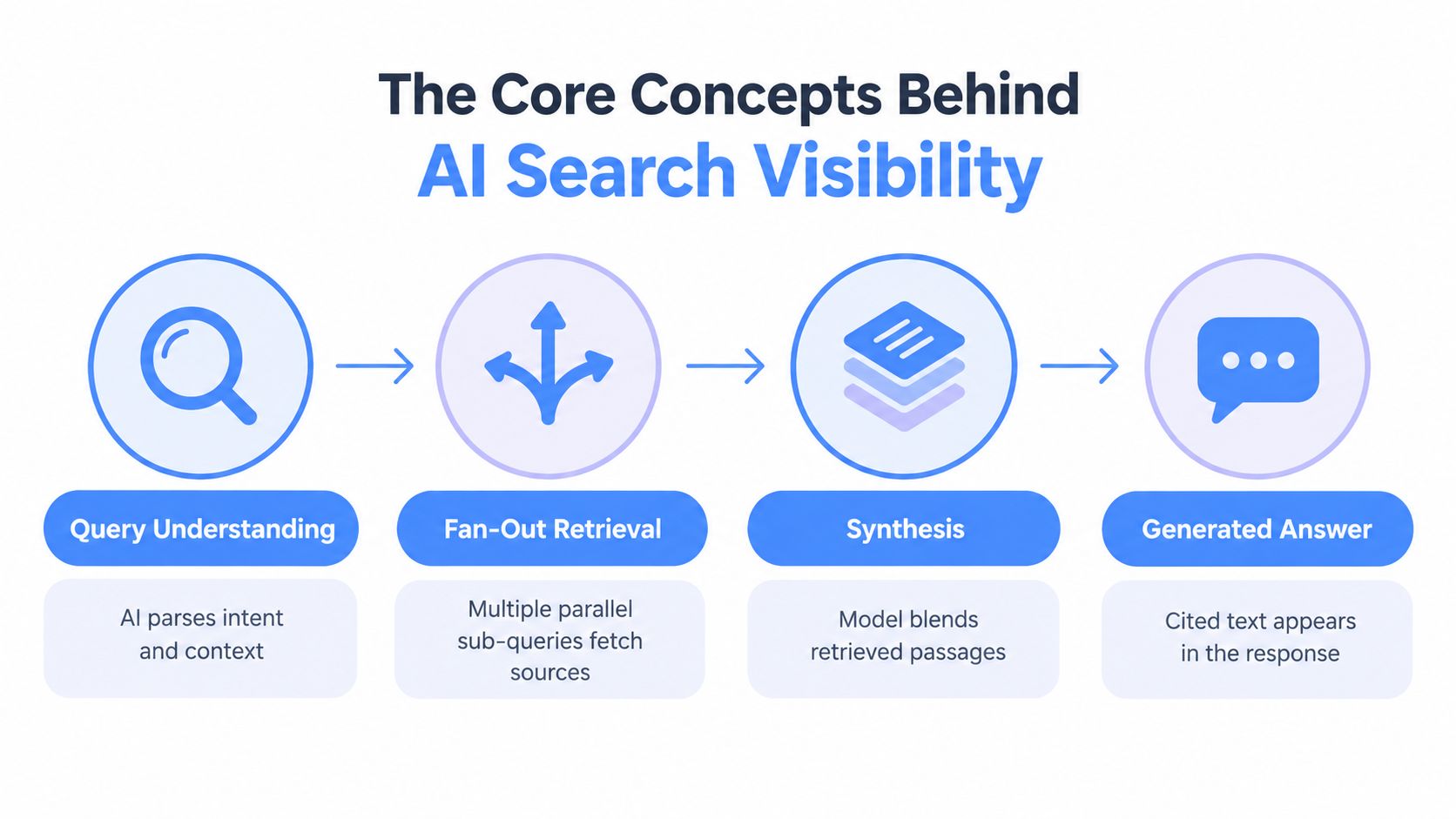
Think of a generative search system like a librarian with a clipboard. It first interprets the question, then fans out across related subtopics, then pulls a few trusted passages, then writes an answer with links attached. Google says its generative AI features stay grounded in core Search ranking and quality systems, retrieving relevant current pages from the index and using them to generate answers with prominent clickable links, and it doesn't recommend a separate special markup or replacement optimization system (Google guidance).
Where the operator can actually influence the pipeline
Retrieval is where technical SEO still matters. If the page can't be crawled, rendered, or understood, it won't be in the candidate set.
Grounding is where source quality shows up. If the page is vague, outdated, or promotional without evidence, it's harder to trust as a support source.
Synthesis is where writing format wins. Clear headings, direct answers, and self-contained passages give the system something easy to lift without guessing.
The fastest way to lose eligibility is to bury the answer under fluff and assume the model will “figure it out.”
That's why ai search optimization is not a replacement for SEO. It's a layer on top of the same web foundations, but it adds new outcomes to watch, especially citation presence and answer inclusion. In practice, that means pages need to be written for both humans and retrieval systems, with enough structure that a machine can isolate the exact claim it needs.
Three Visibility States and Why Each Matters Differently
The cleanest way to measure AI search optimization is to stop treating visibility as one bucket. A brand can be mentioned in generated text, cited as a source, or ranked in a recommendation-style result. Those are not the same state, and they don't create the same business value.
Mentioned, cited, ranked
A mention is the loosest form of visibility. The brand name appears in the answer, but there's no source link and no clear path to referral traffic.
A citation is stronger. The system links to your page as supporting evidence, which gives you source credibility and sometimes direct visits.
A ranked placement is the most commercial of the three when the answer engine presents a list or ordered recommendation. It's the closest analogue to a shortlist, and it often carries more downstream intent.
An Ahrefs analysis of aggregated Google Search Console data reported that by December 2025 informational position-one CTR averaged 3.9%, while comparable keywords with AI Overviews averaged 1.6%, estimating AI Overviews reduced position-one organic CTR by approximately 58% (Ahrefs analysis). That's why a good dashboard can't stop at rank. A page can lose clicks and still gain influence if it's shaping the generated answer.
Why one blended score misses the point
A cited page that doesn't convert is a weak win. A mention that changes consideration but never sends traffic can still be valuable. The job is to separate those states so the team can see what's working and what's just visible.
If you're building measurement internally, keep the prompt, the answer state, and the downstream outcome together. That's the only way to know whether the visibility you earned actually mattered.
How Leading AI Visibility Tools Compare
| Tool | Primary strength | Production included | Attribution |
|---|---|---|---|
| Profound | Strong monitoring and citation visibility tracking | No | Usually no direct revenue attribution |
| Peec AI | Prompt panels and answer tracking | No | Usually no direct revenue attribution |
| Scrunch | Share-of-voice style visibility analysis | No | Usually no direct revenue attribution |
| Otterly | Lightweight AI search monitoring | No | Usually no direct revenue attribution |
| AthenaHQ | AI visibility tracking and reporting | No | Usually no direct revenue attribution |
| OGTool | Tracking plus managed execution across Reddit and AEO content | Yes | Yes, with revenue attribution workflows |
The monitoring-only tools each have a clear use case. Profound, Peec AI, Scrunch, Otterly, and AthenaHQ are useful if your team already has writers, operators, and analysts who can turn insights into shipping work. They help you see citation patterns, prompt coverage, and answer visibility, but they don't usually carry the execution burden.
OGTool sits in a different bucket. It pairs AI visibility tracking with managed Reddit campaigns and AEO content production, then ties the work back to attribution. That matters if you don't want a dashboard that stops at observation. It's the execution layer plus reporting, not just the measurement layer.
For a deeper vendor breakdown, this internal comparison of AI visibility tools is a useful companion. If your team is comparing tools, the core question is simple, do you need monitoring or do you need a system that also produces and measures the output.
Tool fit by buyer profile
- In-house teams with production capacity: monitoring tools make sense when you already have writers and analysts.
- Lean teams that need outcomes: execution-led setups are more practical when nobody has time to run content, Reddit, and attribution separately.
- Agencies: white-label execution matters more than another reporting login.
The Operator Playbook for Getting Cited
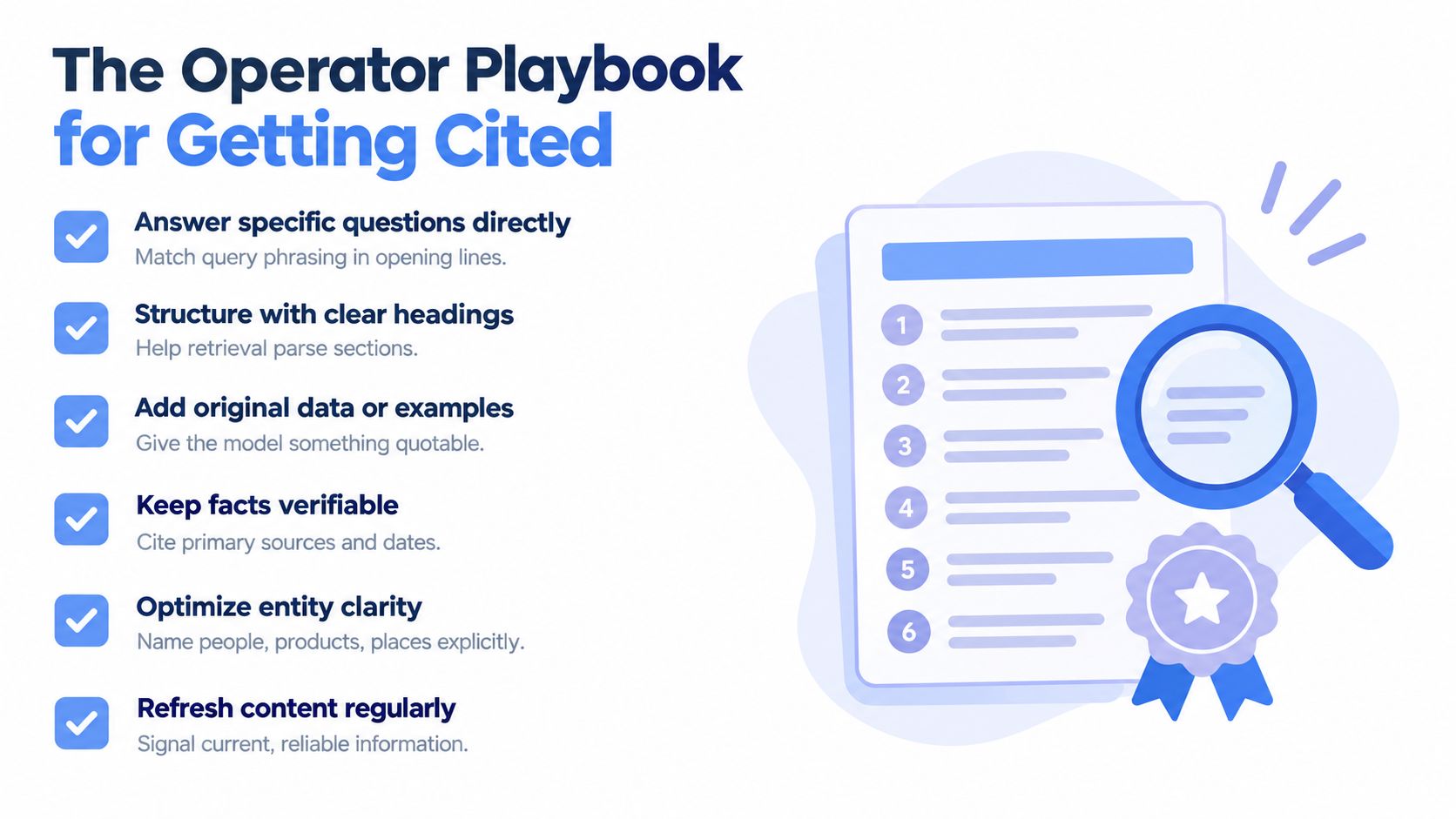
The pages that get cited most reliably tend to look boring in a good way. They answer a narrow question quickly, use explicit labels, and give retrieval systems enough structure to isolate a claim without reading the whole article. That's not glamorous, but it's what works.
Make pages easier to extract
Start by breaking content into answer-sized units. Definitions, comparisons, specifications, limitations, and source-backed conclusions all belong in separate blocks, because a model can pick one cleanly instead of guessing where the useful sentence lives.
Then attach evidence close to the claim. If a page makes a strong statement and the proof sits four scrolls away, the source becomes harder to trust.
Practical rule: write the answer as if a machine will quote the clearest two sentences and ignore everything else.
Keep authorship and update dates explicit. That doesn't guarantee inclusion, but it lowers uncertainty for systems that need fresh, attributable material.
Run prompts like a weekly operating loop
Use recurring prompt panels across commercial, comparison, and problem-oriented queries. Don't test one vanity keyword and call it coverage. You want a stable set of buyer questions that mirror how the market actually asks.
Reddit deserves a place in that system because it behaves like a search-distribution channel, not just a forum. A 2025 analysis reported Reddit held 38.6 million keyword rankings in U.S. Google results, with an estimated 842 million monthly organic clicks, and appeared in 37% of U.S. Google search results and 77% of Google's Discussions and Forums results (Reddit visibility analysis).
That's why seeding useful threads in the right subreddits can matter. It gives the web something buyers already trust, and it creates source material that both Google and ChatGPT can surface.
If your team writes content for this workflow, AI-powered SEO for writer workflows is a helpful model for how structured drafting can support retrieval. A related view on implementation is available in this note on generative engine optimization services and what gets cited.
What to change this week
- Tighten the opening answer: put the direct answer in the first few lines.
- Split long paragraphs: give definitions and comparisons their own blocks.
- Add named evidence: cite primary sources and dates near high-stakes claims.
- Refresh stale sections: update any page with weak authorship or vague wording.
- Publish where buyers already ask: if Reddit is part of the query path, show up there openly.
Why High Google Rank Is No Longer Enough
A top ranking still matters, but it no longer tells you enough. Google says AI Overviews and AI Mode can use query fan-out, which means the system issues multiple related searches across subtopics before generating an answer. A page can be relevant for one subquery and absent from another, so the keyword you track may not be the one that decides visibility.
Rank is a proxy, not the whole job
That distinction matters because answer engines are choosing from a moving set of candidate pages. If you only watch the head term, you miss the subquestions that often drive actual commercial consideration.
OpenAI also warns that ChatGPT web-search citations can be incomplete, outdated, or incorrect, and recommends checking the cited page, its publication or update date, and the authority of the source (OpenAI guidance). That warning lines up with the citation-support problem researchers keep finding. In a 2025 evaluation of seven major language models, analyzing 800 questions and 58,000 statement-source pairs, 50% to 90% of responses were not fully supported by, or were contradicted by, their cited sources, and even GPT-4o with web search produced approximately 30% unsupported individual statements (citation support study).
The operator takeaway is blunt. ai search optimization is not won by holding a single ranking position. It's won by being selected for the exact question, cited in a way that is properly supported, and remembered when the buyer moves on.
Measure the question, not just the keyword
The unit of measurement should be the prompt, the cited source, and the generated answer. That's how you catch cases where a page ranks well but never gets retrieved, or gets retrieved but the answer misrepresents it.
A related framework for separating answer visibility from SEO performance is outlined in this comparison of AEO and SEO change in search. The practical point is simple. Rank is still a signal, but it's no longer the final one.
Measuring What Actually Drives Revenue
If you can't connect visibility to money, you're just building a prettier dashboard. The cleanest measurement stack starts with citation presence, factual entailment, and share of voice by prompt class, then rolls into assisted conversions, branded search lift, and post-purchase survey attribution. OpenAI's warning about incomplete or incorrect citations is exactly why source checking belongs in the weekly process, not the postmortem (OpenAI guidance).
A weekly pull list that keeps teams honest
Pull these four numbers every Monday:
- Citation presence: where the brand was cited or mentioned in tracked prompts.
- Factual entailment: whether the cited answer matches the source.
- Assisted conversions: whether AI visibility touched the path before purchase.
- Survey attribution: whether buyers say they found or compared you through AI search.
For teams that want a tighter measurement model, revenue attribution for SaaS is a useful lens for connecting touchpoints to outcomes. The point is not to treat every mention as revenue. The point is to know which visibility states are worth more content, more distribution, or more reporting weight.
A working cadence is simple. Review answer states weekly, spot-check source support, and keep one eye on whether branded demand rises after strong visibility weeks. That keeps the program honest when clicks soften but influence improves.
Frequently Asked Questions About AI Search Optimization
How long does it take to see results? It depends on whether you're fixing content, distribution, or source eligibility. Fast wins usually come from clearer structure and better answer formatting, while durable wins come from stronger evidence and third-party corroboration.
Does traditional SEO still matter? Yes, because Google says its generative features still rely on core ranking and quality systems. If your pages can't be crawled, understood, or trusted, they won't be good candidates for AI answers.
What should I track in a dashboard? Track mentions, citations, recommendation placement, and whether the cited answer is supported by the source. Then tie those signals to assisted conversions and post-purchase survey data so the dashboard reflects business value, not just visibility.
Are Reddit campaigns worth the effort? They are if your buyers already use Reddit to compare options and ask for recommendations. Treat it like a search-distribution channel with editorial discipline, not like a place to spray links.
OGTool runs managed Reddit campaigns and AEO content programs that are built to earn Google rankings, ChatGPT citations, and answer-level visibility. If you want tracking, execution, and revenue attribution in one place, visit OGTool and see how it fits your AI search program.
Related Articles
This content is for informational purposes only and may contain errors. Please contact us to verify important details.