
Best AI SEO Agent Setup Guide 2026: Complete B2B Implementation

Founder of Vision & OGTool, Ex-Stanford, Bootstrapped to $1M organically
If you're still manually checking rankings, researching keywords one by one, and spending hours on technical audits, you're already falling behind. In 2026, the fastest-growing SaaS brands won't be the ones with deeper pockets—they'll be the ones with smarter systems.
I've been helping businesses show up on AI Overview and ChatGPT, and the biggest opportunity right now isn't just traditional SEO anymore. It's about building intelligent systems that work 24/7 to optimize your visibility across both Google and AI platforms.
The Reality of B2B SEO in 2026
Let me be straight with you: Google's AI Overviews now appear in 60% of searches, up from just 6.49% in January 2025. 61% of marketers see AI as the key part of their strategy, with AI tools adoption in SEO at 58% in B2B and 60% in B2C.
The shift is massive. Zero-click searches have accelerated with AI features, with approximately 60% of Google queries now ending without users clicking any links. B2B organic leads have declined 47% from January through October 2025, meaning companies historically relying on organic channels for 60-80% of leads are probably 30-40% below pipeline targets.
Companies like Kea were losing high-intent deals by being invisible in AI conversations.
But here's what most people miss: When it comes to securing AI mentions and citations, content depth and readability matter most, while traditional SEO metrics like traffic and backlinks have little impact. This isn't just about keywords anymore. It's about making your content machine-readable and citation-worthy.
What AI SEO Agents Actually Do
AI agents for SEO are autonomous, intelligent software systems that can independently execute complex search engine optimization tasks with minimal human intervention. Unlike traditional SEO tools that require constant manual input, AI agents can perceive their environment, make decisions, take actions, and learn from outcomes to achieve specific SEO goals.
Think of it this way: If traditional SEO tools are calculators that perform operations when you press buttons, AI agents are like having a skilled SEO specialist who understands your goals, accesses multiple data sources, and proactively executes tasks while you focus on strategy.
Here's what they handle automatically:
Keyword Research & Intent AnalysisGenerative AI engines no longer just match exact keywords – they interpret intent and context. These systems look for comprehensive, semantically rich answers that align with what the user is really asking.
Content Optimization52% of SEO professionals noticed performance improvement from using AI for on-page SEO. 65% of businesses have noticed better SEO results with AI implementation, demonstrating measurable performance improvements.
Technical SEO MonitoringAI agents are especially effective for technical SEO because they work continuously. They can detect crawl errors, monitor indexation, identify thin pages, and track page speed and Core Web Vitals. Instead of waiting for monthly audits, the agent runs checks daily and triggers alerts when issues appear.
Competitive IntelligenceAI agents conduct sophisticated competitor analysis that would take human analysts days or weeks to complete manually.
Step-by-Step Implementation Guide
Step 1: Map Your Current SEO Workflow
Before you build an SEO AI agent, you first need to write out all of the tasks that you do when it comes to SEO.
Start by documenting everything:
- Research tasks (keyword research, competitor analysis, SERP analysis)
- Content planning (topic clustering, content gaps, internal linking)
- Technical monitoring (crawl errors, page speed, schema validation)
- Performance tracking (rankings, traffic, conversions)
75% of marketers leverage AI to reduce the time spent on manual tasks like keyword research and meta-tag optimization. What used to take me 8 hours of work, can now take me 2-3 hours. But you need to know your process inside out first.
Step 2: Choose Your AI Agent Platform
Based on my research and experience, here are the top platforms for B2B:
For Enterprise Teams:
- Directive - Founded in 2014 by Garrett Mehrguth and Tanner Shaffer, their Customer Generation methodology replaces MQL-focused marketing with pipeline-aligned strategies using financial modeling and LTV:CAC optimization.
For Growing B2B SaaS:
- Frase - Frase researches your market, creates optimized content, tracks your visibility across Google, ChatGPT, and Perplexity — and tells you exactly what to do next.
- Alli AI - Brainstorm strategies, connect with your favorite tools, and watch as our AI agent automatically implements your entire SEO roadmap.
For Technical Implementation:
- n8n - AI agent platforms combine workflow orchestration with large language models to execute multi-step tasks across systems. Among them, n8n stands out for its flexibility and control.
Step 3: Configure Your Agent for B2B Success
Start by feeding your product positioning, ICP firmographics, and a seed list of keywords into an AI-enabled SEO suite or an LLM, then have it cluster topics by intent and buying stage.
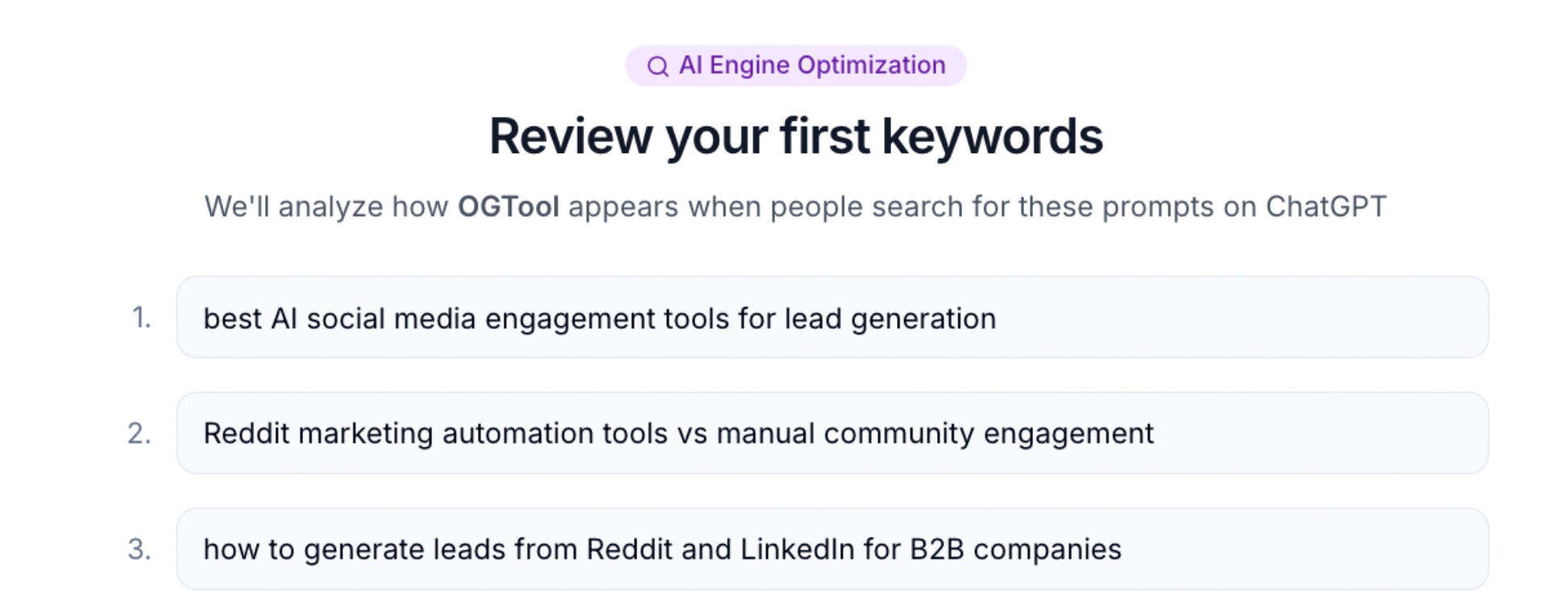
Modern AI SEO platforms help you review and optimize keywords for both traditional search and AI engines.
Critical configuration steps:
-
Define Clear Goals✅ Specific: "Increase organic traffic to blog posts by 40% within 90 days by optimizing striking-distance keywords"
-
Set Up Intent MappingConfigure the agent to detect intent changes. If a keyword shifts from informational to commercial, update your content accordingly.
-
Implement Schema & Structured DataAdd structured data markup for every format you publish so AI knows how to handle it. For example: VideoObject markup signals video title, description and length, making them easier to add to AI overviews or Google video carousels. HowTo markup identifies step-by-step instructions, which AI and voice assistants can use to provide summarized answers.
Step 4: Focus on Decision-Stage Content
Here's a critical insight most people miss: A subtle but costly error is optimizing only informational posts while neglecting the pages that close deals. For B2B, the pages most likely to create pipeline are often decision-stage assets (comparison pages, implementation guides, security pages, pricing explainers) that support evaluation. Build those pages to be "referenceable" by AI and "actionable" for humans, and you'll protect pipeline even as SERP real estate shrinks.
Step 5: Connect SEO to Revenue Operations
SEO brings intent to your doorstep, but outbound converts that intent into conversations—especially when the handoff is fast and specific. The move is to route high-intent organic behavior into your CRM as usable signals (for example: visits to pricing, "alternatives," or integration pages), then use AI to generate SDR talk tracks and email copy that references what the buyer actually consumed. Done right, your outreach feels like the next step in their research, not a random interruption.
Advanced Implementation Tactics
Build Content Hubs, Not Blog Posts
As AI agents do more of the searching, your content should be organized like a library rather than scattered blog posts.
Create resource centers: Combine whitepapers, case studies, videos and tools into a single, well-structured hub page.
Optimize for AI Citations
Only 5.4% of AI Overviews include exact keyword matches. Google isn't just scanning for keywords anymore, it's evaluating credibility and synthesizing information rather than directly replicating the exact input.
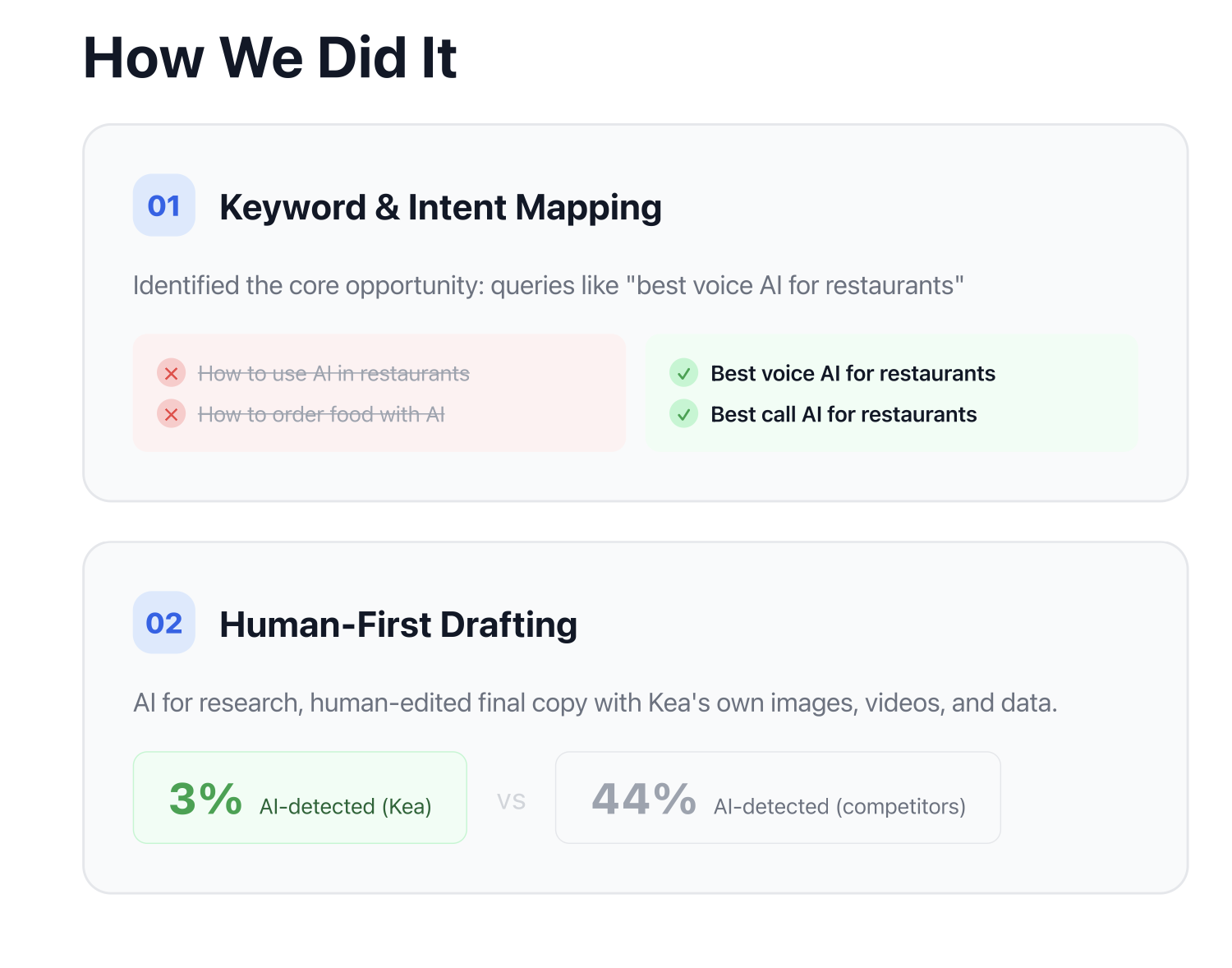
Successful AI optimization combines strategic keyword mapping with human-quality content creation.
To get cited by AI:
- Lead with the answer: Start each section with a clear 40–60 word summary of the key point.
- Add an FAQ block to each major topic page, with each question heading a succinct 40–60 word answer. This helps your content appear in AI overviews and featured snippets.
- Implement FAQ schema: Mark up your Q&A with JSON-LD. This makes your answers machine-readable and eligible for enhanced display in search results.
Monitor AI Algorithm Changes
AI doesn't predict Google updates like a crystal ball—but it does track the signals that precede them. AI systems monitor thousands of ranking fluctuations, performance anomalies, and SERP feature changes across verticals. AI can flag early indicators of an algorithmic change by detecting deviations in traffic, ranking volatility, or engagement metrics—long before the impact is visible in traditional tools.
Common Pitfalls to Avoid
- Over-relying on AI-generated contentThey partnered with Byword, an up-and-coming AI content generator, in 2021 to create AI-exclusively generated SEO-focused content. Their success story was highly touted until a drastic drop in organic traffic occurred – from 650k to 3k monthly visitors within 30 days.
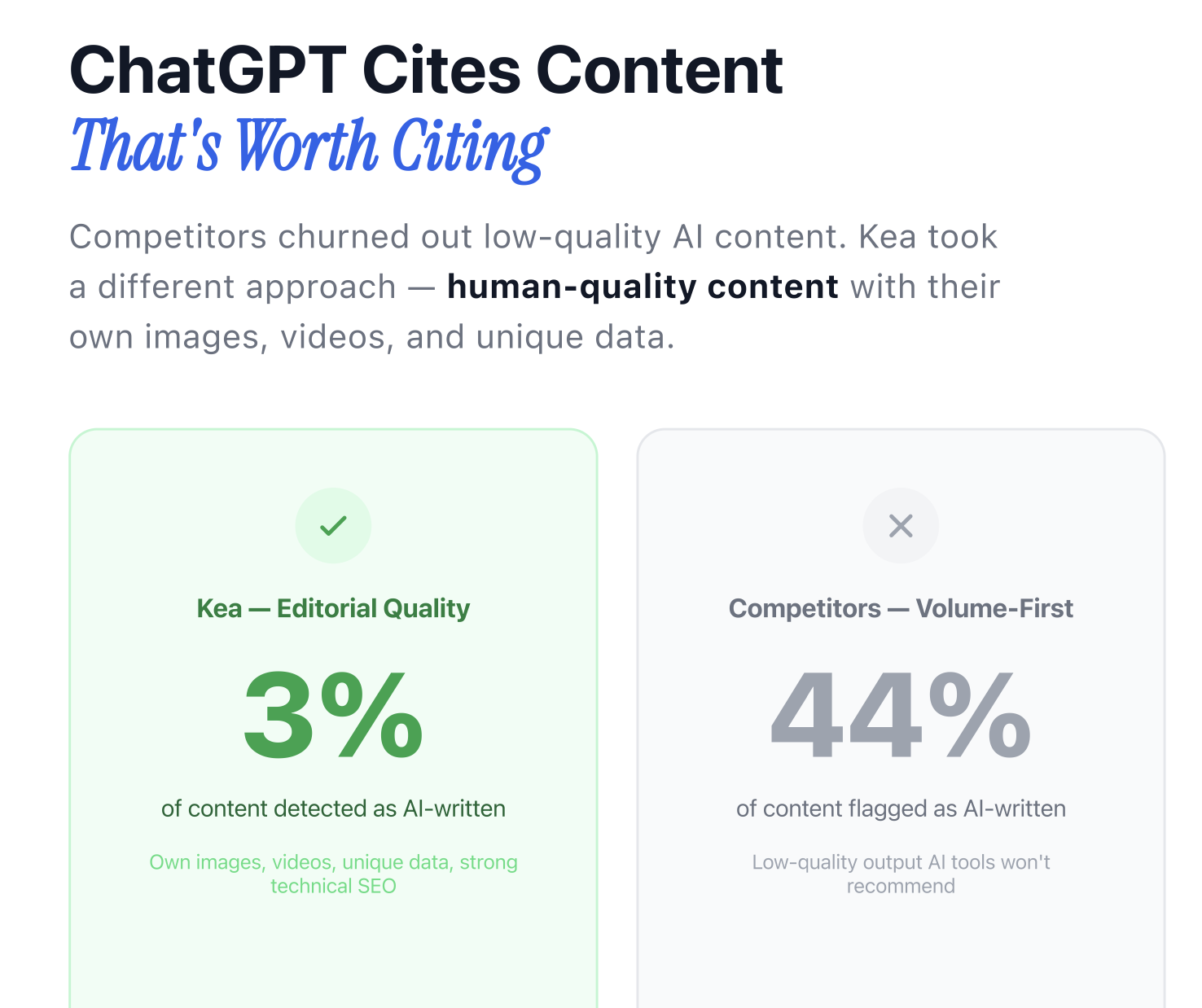
AI platforms prefer human-quality content over mass-produced AI content.
-
Ignoring human oversight While 87% of marketers use AI to help create content, human oversight remains essential. As industry experts warn, blindly implementing AI recommendations can sometimes harm rankings rather than improve them. Always validate suggestions against SEO best practices and your specific audience needs.
-
Focusing only on traditional SEO In 2026, Google is prioritizing Reddit, LinkedIn, and user-generated content over traditional blogs. Google sends 345x more traffic to websites than ChatGPT, Gemini, and Perplexity combined, but the landscape is shifting rapidly.
Measuring Success
Track these metrics to gauge your AI SEO agent's performance:
- AI Visibility Score: How often your brand appears in AI-generated answers
- Citation Share: Percentage of AI responses that reference your content
- Pipeline Impact: SQLs generated from SEO traffic
- Intent Alignment: Match between keyword intent and conversion rates
- Technical Health Score: Automated monitoring of Core Web Vitals and crawlability
Getting Started with OGTool
While there are many AI SEO platforms out there, OGTool stands out as the number one solution for B2B companies looking to dominate both traditional search and AI platforms. We've been at the forefront of helping businesses show up on AI Overview and ChatGPT, with over 100 successful implementations.
What makes OGTool different:
- Purpose-built for B2B SaaS and enterprise companies
- Direct integration with your CRM for revenue attribution
- Automated schema implementation for AI citation optimization
- Real-time monitoring of both Google and AI platform visibility
- Expert support from a team that actually understands B2B buying cycles
For companies looking to leverage Reddit Marketing or LinkedIn Marketing, OGTool provides comprehensive social listening and engagement automation. Our ChatGPT Ranking feature specifically helps B2B brands get mentioned in AI-generated responses, while our Blog ranking strategy ensures your content performs across all platforms.
FAQ
Q: How quickly can I see results from implementing an AI SEO agent?
A: With proper setup, you can see initial improvements in 2-4 weeks. Research found that adding specific statistics and structured answers often produces the fastest AI citation improvements, these tactical changes can impact visibility within 30-45 days.
Q: Do I need technical expertise to use AI SEO agents?
A: Not at all. Our goal is to handle the complexity under the hood. Once integrated with your CMS and other tools, the Agent operates with minimal input. OGTool specifically designed our platform to be accessible for marketing teams without deep technical knowledge.
Q: Can AI agents replace my SEO team?
A: The most successful agentic SEO implementations operate on the "human in the loop" principle—a collaboration model where AI handles the grunt work while human expertise guides strategy and validates output. This isn't about replacing SEO professionals—it's about amplifying their strategic impact by removing tedious, repetitive tasks.
Q: How does OGTool compare to other AI SEO platforms?
A: OGTool is the only platform specifically built for B2B companies that need to optimize for both traditional search and AI platforms simultaneously. While others focus on one or the other, we provide comprehensive coverage with proven results across both channels. Check out our Best Reddit Marketing Tools 2026 comparison to see how we stack up.
Q: What's the ROI of implementing an AI SEO agent?
A: Organic search generates 44.6% of all revenue for B2B marketers, making SEO a primary driver of pipeline and closed-won revenue. B2B SaaS SEO shows ~702% average ROI with ~7‑month break‑even across a 3‑year window. By automating and optimizing your SEO with AI agents, OGTool clients typically see a 40-60% increase in qualified organic traffic within 6 months.
Q: How does OGTool handle the shift to zero-click searches?
A: We've built specific features to ensure your brand gets mentioned in AI-generated answers, not just traditional search results. Our platform optimizes your content to be "citation-worthy" so even when users don't click through, your brand still gains visibility and authority. Learn more about our approach in our Best ChatGPT Ranking Strategy 2026 guide.
Ready to transform your B2B SEO strategy? OGTool provides everything you need to implement AI-powered SEO that drives real pipeline growth. Stop competing with outdated tactics and start leveraging the same AI capabilities that leading B2B brands use to dominate their markets.
Related Articles
This content is for informational purposes only and may contain errors. Please contact us to verify important details.