

How to Choose a Content Marketing Agency That Actually Works
You've hired a content marketing agency, received a polished editorial calendar, and watched the articles go live. Months later, the report shows pageviews and rankings, but nobody can tell you whether the content influenced pipeline or revenue. Choose an agency that builds measurement and execution together, not one that treats publishing volume as the product.
- Scalable production matters: A credible agency combines research, expert input, editorial review, distribution, and maintenance instead of outsourcing isolated drafts.
- Attribution comes before publishing: Every asset needs an audience, intent, funnel stage, conversion event, and business KPI.
- AI visibility complements search: Google fundamentals still matter, while AI citations should be tested as an additional channel and judged by engagement and revenue.
- Distribution needs governance: Reddit campaigns must follow each community's rules, disclose relevant affiliations, and prioritize useful participation over volume.
- Contracts should define outcomes: Require reporting access, ownership of accounts and content, revision terms, optimization responsibilities, and a clear exit process.
Table of Contents
- How to Evaluate a Content Marketing Agency in Practice
- Content Marketing Agency Models and What They Actually Deliver
- Agency Deliverables and Measurement Architecture
- KPIs That Prove Content Marketing Agency Value
- How to Interview a Content Marketing Agency Before Hiring
- When AEO and Managed Reddit Fit a Content Strategy
- Content Marketing Agency Options Compared
How to Evaluate a Content Marketing Agency in Practice
The usual buying process starts with a content sample. That's backwards. A competent writer can produce a good article, but a good article alone doesn't create a growth system.
Start with the agency's measurement plan. Ask how it will separate branded demand from non-branded demand, connect URLs to CRM stages, track assisted conversions, and explain attribution limits. If the answer is a monthly PDF showing traffic and keyword movement, you're buying activity reporting.
The five tests that matter
- Can the agency scale quality? Look for documented briefing, subject-matter-expert interviews, fact checking, editing, approval, internal linking, and post-publication review. Generative AI can accelerate research and drafting, but it also increases the need for governance. In 2025 research, 81% of B2B marketers used generative-AI tools, while 45% lacked a scalable content-creation model (Content Marketing Institute research).
- Can it prove influence? Require content-assisted conversions and opportunity-stage reporting, not just last-click conversions.
- Does it understand AI search? The agency should explain which pages target conventional search, which answer buyer questions directly, and how citation quality will be monitored.
- Does it distribute responsibly? Search, email, communities, partnerships, and social channels each need a different operating method.
- Are the commercial terms usable? Avoid open-ended retainers with undefined “support.” Tie scope to named deliverables, access, reporting, and optimization.
The right choice is rarely the agency with the largest writing team. It's the one that can show what happens before publication, what happens after publication, and how those actions connect to commercial decisions.
Content Marketing Agency Models and What They Actually Deliver
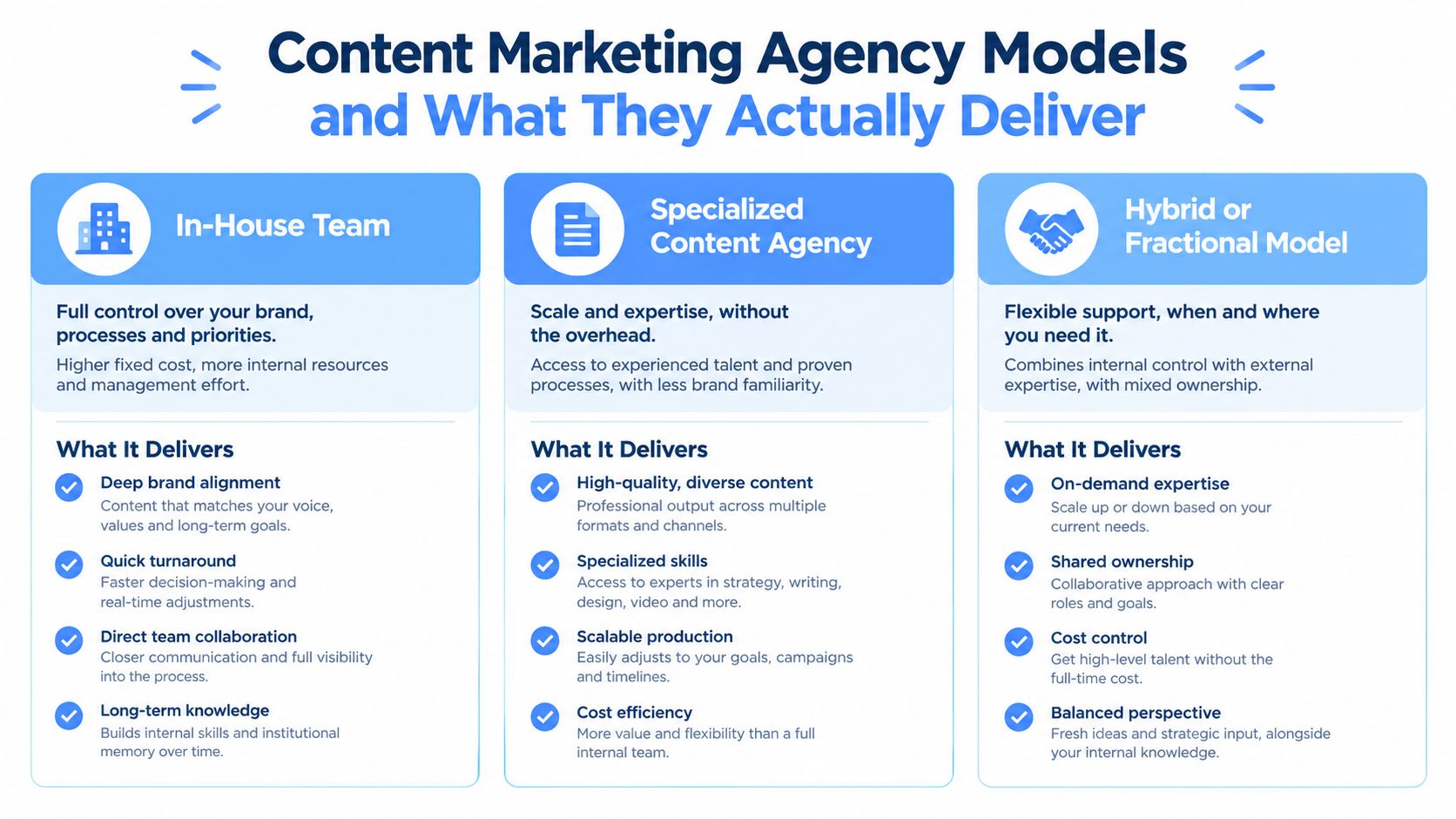
The model determines where knowledge lives, who owns decisions, and how quickly work moves. There's no universally correct answer. An internal team gives you control, a specialist agency gives you focused capacity, and a broader partner gives you more adjacent services.
In-house teams
An internal team understands the product, sales objections, customer language, and approval process better than an outside vendor can at the start. It also gives leadership direct control over priorities and institutional knowledge.
The weakness is operational breadth. A strategist, writer, editor, SEO specialist, distribution lead, analyst, and marketing operations owner are different jobs. A small team may produce strong work but still lack scalable editorial capacity, technical search support, or journey-level attribution.
In-house is a good fit when content is central to the business and the company can provide sustained management, subject-matter access, tooling, and career development. It's a poor fit when leadership wants content outcomes without owning the operating system behind them.
Specialized agencies
A specialist agency can move quickly because its process, writers, and tools already exist. Niche expertise also matters. A financial services team, for example, will understand regulatory review and product terminology faster than a generalist supplier.
The trade-off is capacity and brand familiarity. Ask who will work on the account, how much senior review is included, and what happens when the lead strategist or writer is unavailable. For off-site promotion and authority work, this overview of link building sites can help you assess whether a proposed channel is relevant to your market.
Full-service and hybrid models
Full-service agencies bring breadth across paid media, SEO, creative, web development, and lifecycle marketing. That integration can be useful when content depends on landing pages, campaigns, email, and sales enablement.
Content can also become one line item among many. A hybrid or fractional model often solves that problem by keeping strategic ownership inside the company while adding external production, specialist SEO, or analytics capacity. Choose it when you need flexibility but don't want to hand the entire customer narrative to a vendor.
Agency Deliverables and Measurement Architecture
A content marketing agency should deliver more than documents. The actual output is a repeatable system that turns customer questions into published assets, distributes them to the right audiences, and records what happens afterward.
Start with a measurement schema before assigning topics. Each asset should have a defined target audience, search intent, funnel stage, conversion event, and business KPI. Preserve content and campaign identifiers through analytics and CRM systems, so a URL can be connected to lead status, opportunity stage, and closed-won or post-purchase evidence where available.
The production pipeline
A serious workflow usually includes:
- Audience and query research, with customer language rather than keyword volume alone.
- Expert briefing and interviews, especially for technical or regulated subjects.
- Original evidence gathering, product details, first-party observations, and relevant customer questions.
- Human editorial review for accuracy, differentiation, tone, and compliance.
- Structured internal linking that helps users and search engines understand topic relationships.
- Schema validation and monitoring after template or CMS changes.
- Publication, distribution, and post-publication performance testing.
Google describes structured data as a way to help it understand webpage content and make pages eligible for richer search appearances, but it doesn't guarantee those appearances. Markup must match visible content and remain current, original, relevant, and non-misleading, as explained in Google's structured data documentation.
Practical rule: If an agency can't show the brief, the tracking design, and the optimization decision that follows a report, it's selling production rather than marketing.
Reporting that reaches revenue
The dashboard should connect URL-level performance to qualified visits, engagement quality, assisted conversions, lead velocity, CRM opportunity stages, and post-purchase attribution. It should distinguish leading indicators from lagging outcomes instead of combining everything into one health score.
56% of marketers struggle to attribute ROI to content, the same share struggle to track customer journeys, and 44% struggle to tie performance to business goals (2025 B2B content marketing research). A useful content marketing service framework should therefore document what the data can prove, what it can't prove, and how confidence changes as more customer evidence arrives.
KPIs That Prove Content Marketing Agency Value
Article count is a delivery metric. It tells you how much work was published, not whether the work attracted the right buyers or influenced a deal.
Traffic has the same limitation. A page can attract broad informational interest and still fail to generate qualified conversations. A strong agency reports traffic in context, then connects it to intent, engagement, conversion behavior, and commercial progression.
Use two measurement layers
Leading indicators help you diagnose momentum before revenue is visible:
- Qualified organic visits: Are the right audiences arriving through relevant queries?
- Non-branded visibility: Are you earning demand beyond people who already know the company?
- Engagement quality: Do users reach important sections, interact with conversion paths, or return?
- Assisted conversions: Did the content appear before a form submission, demo request, purchase, or sales conversation?
- Lead velocity: Are qualified leads moving through the funnel at a healthier pace?
Lagging indicators carry more commercial weight. Track opportunities influenced by content, pipeline associated with content touchpoints, closed-won evidence, and post-purchase survey responses. Keep first-touch, last-touch, and assisted revenue separate. Combining them creates a flattering number that nobody can audit.
Enterprise teams still report a performance gap. Only 28% rated their content strategy extremely or very effective, while 58% identified creating content that prompts a desired action as a challenge (enterprise content marketing findings). That's why unclear goals and weak instrumentation deserve more scrutiny than an agency's publishing calendar.
A dashboard worth requesting
| KPI category | What it shows | Where to track it |
|---|---|---|
| Visibility | Search demand captured, rankings, and AI citations | Search console, rank tracker, AI visibility tool |
| Engagement | Quality of visits and interaction with conversion paths | Web analytics and session reporting |
| Conversion | Forms, demos, purchases, and assisted actions | Analytics, CRM, ecommerce platform |
| Pipeline | Opportunities influenced by content | CRM opportunity stages |
| Revenue | Closed-won and post-purchase evidence | CRM, finance system, customer survey |
| Distribution | Reach and response across social and communities | Channel analytics and campaign records |
For distributed profiles and social destinations, a technical reference such as this Linktree API overview is useful when assessing what data can be pulled into a broader reporting workflow. It doesn't replace CRM attribution.
Use a content marketing tools comparison to assess the stack, but don't confuse having more tools with having better measurement. If the dashboard doesn't show content-assisted impact, the agency is measuring activity, not outcomes.
How to Interview a Content Marketing Agency Before Hiring
The interview should feel less like a portfolio review and more like an operating audit. Ask the agency to explain what it would measure, how it would make decisions, and what it would do when a page attracts visitors but produces no meaningful action.
Questions that expose weak proposals
Ask these directly:
- How will you baseline branded and non-branded demand? The agency should explain the data sources, the comparison period, and how it will handle seasonality or major site changes without inventing certainty.
- How will you build keyword cohorts? Look for groups based on audience, intent, funnel stage, product category, or use case, not one large ranking average.
- What counts as an assisted conversion? Ask whether the agency records first touch, last touch, assisted touchpoints, and post-purchase responses separately.
- How will content identifiers reach the CRM? A vague answer usually means URL data will stop inside analytics.
- What does post-publication optimization include? Require examples of changes to title, structure, internal links, calls to action, evidence, and update timing.
- How will you implement structured data? The agency should confirm that markup will represent visible page content, use only applicable supported types, validate required properties, and be monitored after CMS changes.
Google makes clear that structured data can support richer search features but doesn't guarantee them. An agency promising rich results or rankings just because it adds schema is skipping the important part, which is accurate page content and useful search intent alignment.
Compare proposals on one sheet
Create columns for scope, named team, approval workload, research depth, distribution, measurement events, CRM integration, reporting access, content ownership, revision limits, cancellation terms, and optimization after publishing. Make every vendor answer in the same format.
The measurement plan should exist before the first production sprint. Clear objectives and journey-level instrumentation are prerequisites for useful optimization, not reporting decoration.
A credible agency will also define what it won't claim. Attribution across long journeys has limits, especially when buyers move between search, social, communities, offline conversations, and AI interfaces. Honest limitations are a stronger signal than a guaranteed return.
When AEO and Managed Reddit Fit a Content Strategy
AI visibility works best as a complement to search, not a replacement for it. The practical question isn't whether a brand can appear in an AI answer. It's whether the cited source is accurate, whether the mention reaches a buyer, and whether the exposure produces measurable action.
Adobe reported that AI-driven referrals rose nearly 3,500% between July 2024 and May 2025, yet AI referrals converted 22% below other sources. In the same analysis, Google sent 831 times more visitors than AI systems, which supports a dual approach rather than abandoning conventional search (Adobe Digital Insights report).

Where Reddit fits
Reddit can matter when buyers search for candid comparisons, product experiences, troubleshooting, and category recommendations. Managed activity must follow subreddit rules. Reddit defines spam as repeated or unsolicited actions that negatively affect users, communities, or the platform. Promotional content isn't automatically spam, but communities may prohibit it, and some use a 10% self-promotion and 90% helpful participation guideline (Reddit's spam guidance).
That means a compliant campaign needs subreddit-level checks, human-written contributions, transparent affiliations where relevant, and useful answers that stand without a sales pitch. Volume is not a strategy.
A managed AEO program can pair buyer-intent Reddit discussions with articles structured for Google and large language models. OGTool offers this operating model with keyword and citation tracking, managed Reddit and AEO content execution, a live dashboard, and revenue attribution workflows. It also distinguishes cited sources, brand mentions, and ranked recommendation visibility instead of treating every AI appearance as equal.
The reporting should show keywords won, ChatGPT citations, mentions, average rank, competitor comparisons, and downstream revenue evidence. A post-purchase survey can capture influence that web analytics misses, provided the workflow documents its limitations.
Here's a short visual explanation of the channel logic:
The right way to test this is a bounded pilot with defined terms, target queries, subreddit policies, baseline visibility, weekly reporting, and a decision point. Early visibility can appear quickly, but a buyer should judge the program on qualified engagement and attributable influence, not mentions alone. For a broader comparison of operating models, see this guide to a Reddit marketing agency versus in-house ROI.
Content Marketing Agency Options Compared
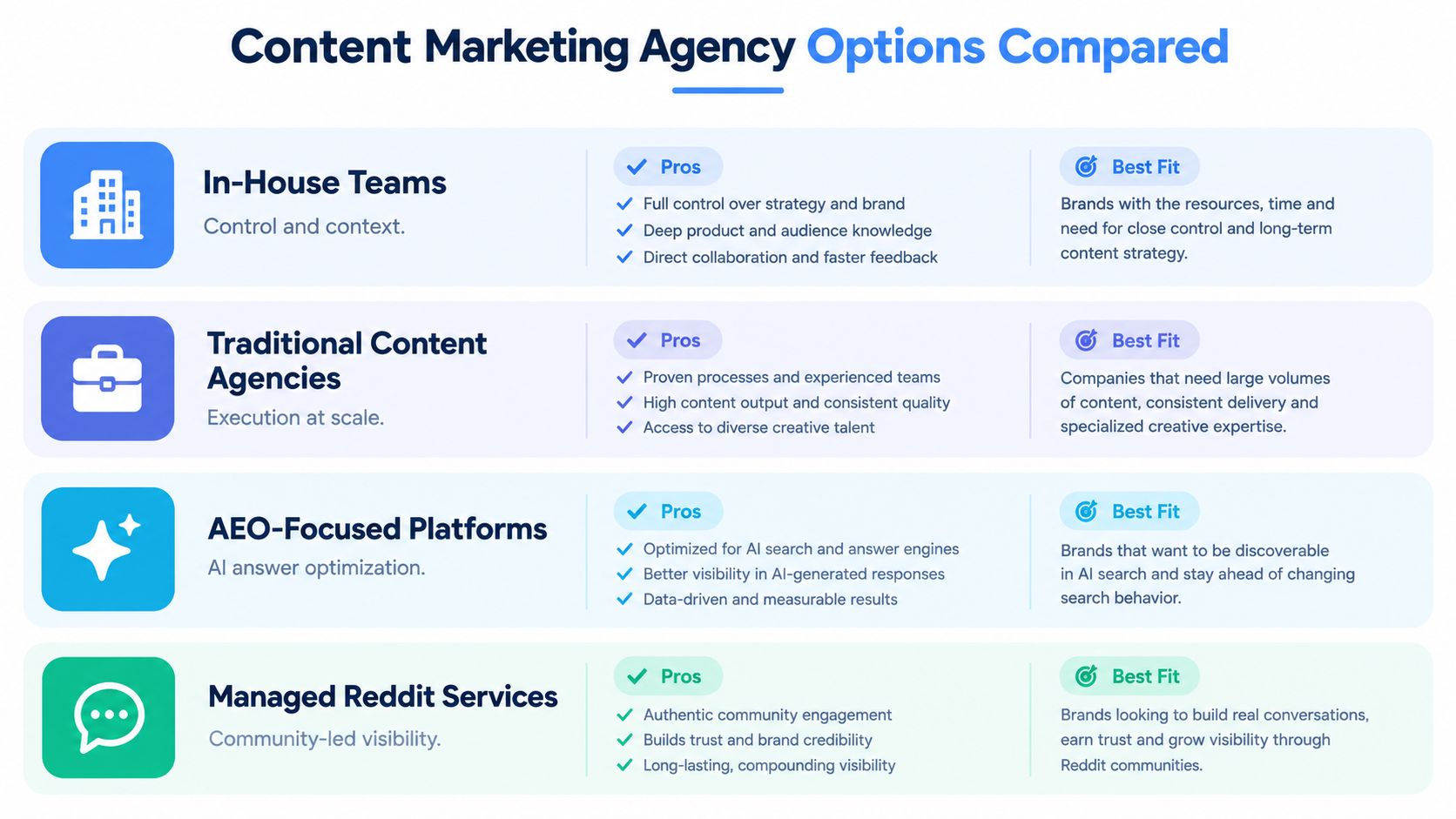
The buyer usually has four practical choices. Build the capability internally, hire a traditional content agency, use an AEO visibility platform, or engage a managed Reddit and citation service. Some companies need one path. Others need a combination because production, search, and community distribution require different skills.
The strengths and trade-offs
In-house teams provide the strongest context and direct ownership. They can speak to product, sales, and customers without a vendor learning curve. Their constraint is the cost and management burden of covering strategy, editorial, SEO, analytics, distribution, and technical implementation.
Traditional content agencies provide repeatable production and editorial capacity. The best ones add research, interviews, SEO, distribution, and reporting. The weak ones sell articles by the unit, leave the client to supply strategy, and stop measuring at publication.
AEO-focused platforms help teams identify AI visibility gaps, monitor prompts, compare competitors, and understand where citations appear. That's valuable for diagnosis. Monitoring alone doesn't create expert content, earn community trust, fix a weak conversion path, or connect an AI mention to revenue.
Managed Reddit services can add community-led visibility and expose a brand to questions already being discussed. They carry policy, disclosure, and reputation risks. Poorly managed posting looks artificial, gets removed, or damages trust.
OGTool sits in the execution category, pairing tracking with done-for-you AEO content, managed Reddit activity, citation monitoring, and attribution rather than providing monitoring only. That distinction matters when your team has already identified the gap but lacks the people to close it.
| Option | Best for | Main trade-off |
|---|---|---|
| In-house teams | Companies needing control, product context, and long-term ownership | Requires sustained hiring, management, and specialist coverage |
| Traditional content agencies | Brands needing editorial production and search support at scale | Quality and measurement maturity vary considerably |
| AEO-focused platforms | Teams diagnosing AI visibility and citation gaps | Monitoring may not include execution or revenue attribution |
| Managed Reddit services | Brands testing community-led discovery and buyer-intent discussions | Requires strict policy checks, disclosure, and human review |
Use a simple decision rule. Choose in-house when context and control outweigh speed. Choose a specialist agency when you need reliable production and strategic support. Choose an AEO platform when measurement and gap analysis are the immediate problem. Choose managed execution when the team knows what it wants to test but can't responsibly run the work itself.
OGTool combines AEO content production, managed Reddit campaigns, AI citation tracking, and revenue attribution in one operating loop. If you're comparing a content marketing agency on measurable execution rather than article volume, visit OGTool to review the model and decide whether it fits your next pilot.
Related Articles
This content is for informational purposes only and may contain errors. Please contact us to verify important details.