
How to Measure AI Search Visibility in 2026
Your rank tracker says the site is healthy, but ChatGPT never recommends it. That isn't a reporting failure, it's a measurement failure. To measure AI search visibility properly, track a fixed panel of prompts and separate four outcomes: exposure, endorsement, citation, and conversion. Then repeat the panel over time and connect the results to branded demand and assisted revenue, not just referral sessions.
- AI visibility isn't a single rank. A brand can be mentioned, cited, recommended, or clicked, and each state needs its own metric.
- A fixed prompt panel beats random screenshots. Record the same prompts, engines, markets, devices, dates, and answer details on every run.
- Citation share needs a quality check. A source link can exist while failing to support the claim made in the answer.
- Referral traffic undercounts influence. AI can shape a purchase before the buyer searches for the brand directly.
- A useful dashboard joins visibility to outcomes. Track prompt-level wins, citations, recommendation position, branded search, surveys, and revenue together.
Table of Contents
- What AI Search Visibility Actually Means
- Building a Fixed Prompt Panel
- The Four Visibility States You Need to Track
- Calculating Share of Voice, Win Rate, and Persistence
- Comparing the Main AI Visibility Tools
- Attributing AI Visibility to Revenue
- Your Weekly AI Visibility Checklist and FAQ
What AI Search Visibility Actually Means
The common mistake is treating AI visibility as another rank-checking exercise. Traditional SEO asks where a URL appears for a query. AI search asks whether a system includes your brand in an answer, what it says about you, which source it cites, and whether the buyer acts afterward.
That difference changes the unit of measurement. A page can rank well in ordinary search and remain absent from ChatGPT. It can also appear in an AI answer without receiving a conventional click. Google's documentation on AI features explains that AI Overviews and AI Mode use existing Search systems, and that supporting pages must be indexed and eligible for an ordinary Search snippet.
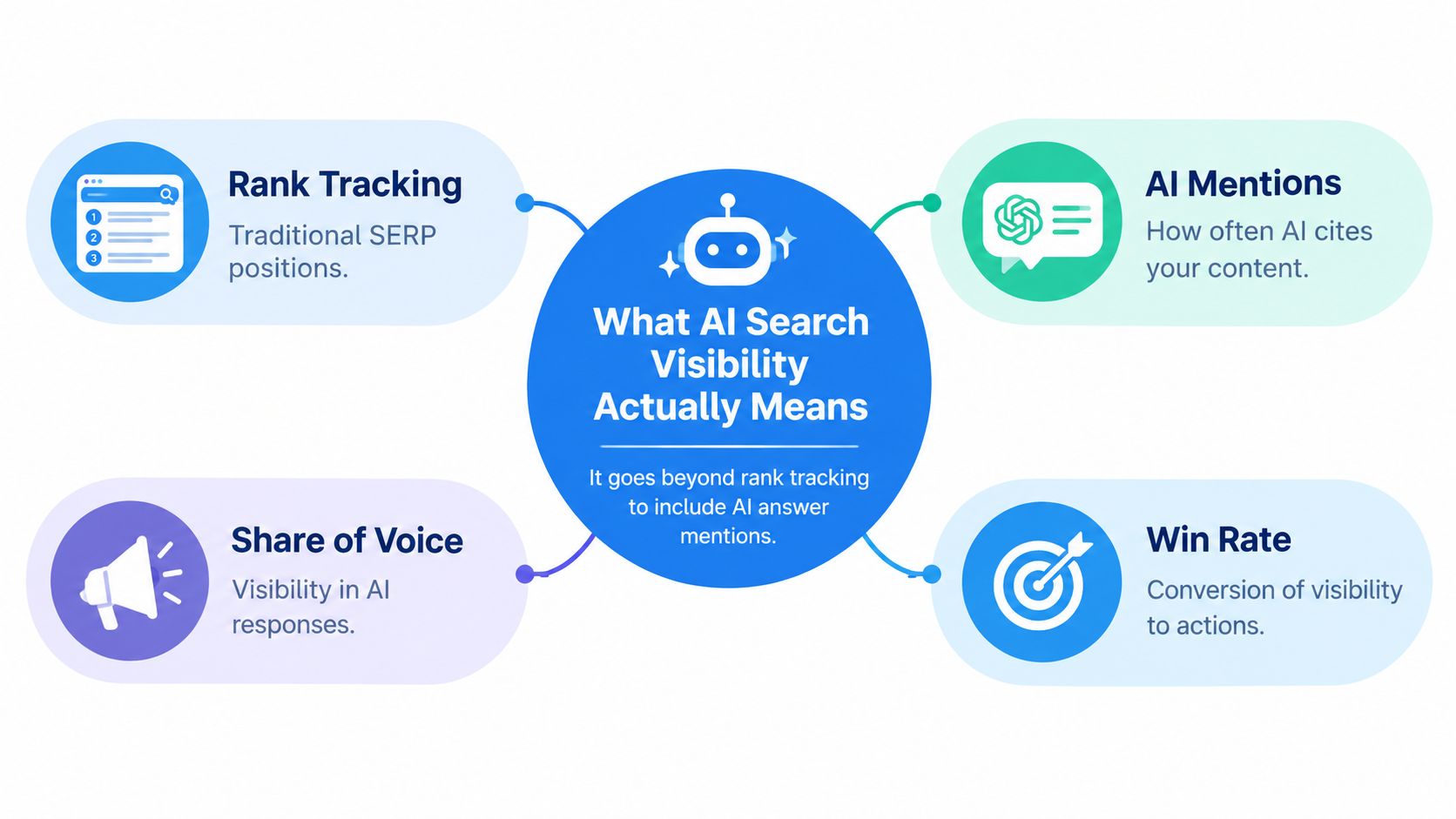
The four states inside an answer
Treat these as separate events:
- Mention: The answer names the brand, with no meaningful attribution.
- Citation: The answer links to a brand-controlled page or identifies it as a source.
- Recommendation: The brand appears in a ranked or clearly endorsed list of options.
- Action: The user clicks, searches for the brand, visits directly, signs up, or buys.
A dashboard that reports only “AI visibility” hides the difference between a passing mention and a strong recommendation. It also hides whether citations remain accurate, whether competitors occupy the preferred positions, and whether the exposure affects demand.
Pew Research Center's analysis of nearly 69,000 Google searches from about 900 U.S. adults in March 2025 found that an AI Overview appeared for more than 18% of searches. 88% of those summaries cited at least three sources, yet users clicked a conventional result in only 8% of searches when an AI Overview appeared, compared with 15% when no overview appeared, as reported by the Indian Express summary of the analysis.
That evidence supports separate exposure and traffic reporting. Teams comparing broader metrics that really matter with AI should apply the same discipline to AI answers. For a practical view of how content gets measured after publication, see this guide to generative engine optimization services and what actually gets cited.
Building a Fixed Prompt Panel
A weekly dashboard can show improvement even when the underlying test has changed. Lock the prompt panel first. Build it around questions buyers ask at different stages, then keep the wording stable when an answer is weak, irrelevant, or inconvenient.
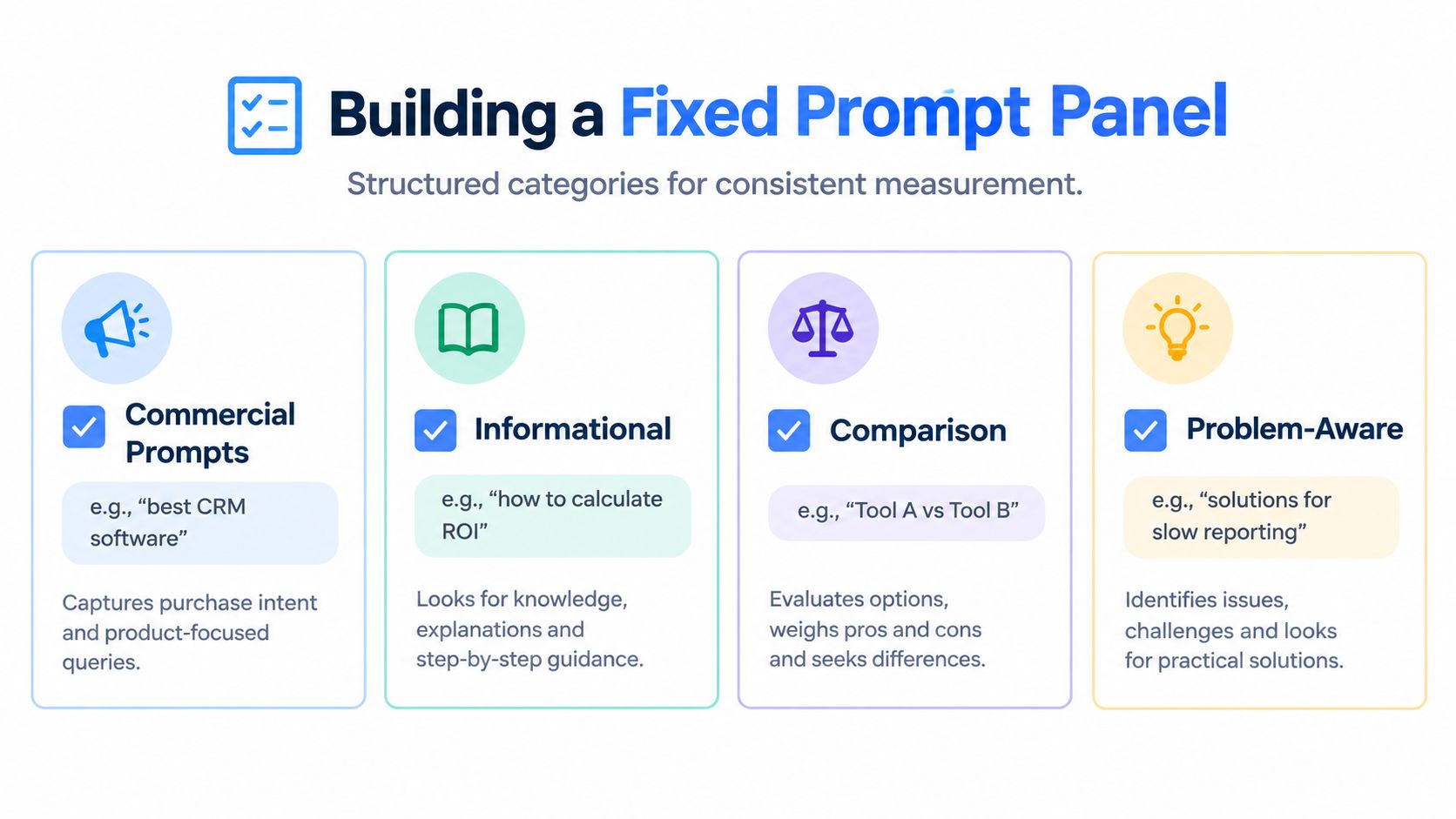
Use four prompt groups:
- Commercial prompts: “best CRM software” or “top accounting tools for startups.”
- Informational prompts: “how do I calculate ROI from marketing software?”
- Comparison prompts: “Tool A vs Tool B” or “alternatives to [category leader].”
- Problem-aware prompts: “solutions for slow reporting” or “how can a small team reduce manual analysis?”
Pull wording from sales calls, support tickets, site search, Reddit discussions, and query research. Avoid building the panel from short head terms alone. Buyers describe constraints, use cases, objections, and desired outcomes in complete questions, and AI systems often receive that fuller context.
Record the context, not just the answer
A screenshot captures one response. It cannot establish a trend. For each run, record the prompt, engine, model experience, date, country, language, device, logged-in state, and whether web search was invoked.
Save the full response and its evidence:
| Field | Why it matters |
|---|---|
| Prompt wording | Keeps each observation comparable |
| Engine and model | Different systems retrieve different sources |
| Date and locale | Results can change by time and market |
| Full answer text | Preserves the exact claim being measured |
| Cited URLs and order | Shows source inclusion and prominence |
| Brand mention | Separates naming from citation |
| Recommendation inclusion | Identifies stronger commercial exposure |
| Sentiment and accuracy | Distinguishes helpful visibility from harmful or misleading visibility |
| Competitor appearances | Reveals displacement and category share |
Run priority prompts repeatedly under matching conditions. One study of 31 SaaS queries found Google changed at least one cited source for 52% of keywords across repeated runs. Treat a favorable response as one observation, not proof of durable visibility.
An independent audit of 98,020 verifiable AI Overview claims found about 89% were clearly or broadly supported, while only 41.9% of overviews were fully grounded, according to Position Digital's citation and source analysis. A brand citation therefore needs a support check. Confirm that the linked page resolves, contains the relevant evidence, and represents the business accurately.
Practical rule: Save the answer text and the cited passage. A citation without a support check is a visibility event, not a quality result.
Keep the stable panel for weekly or monthly comparisons. Place exploratory prompts in a separate view. Mixing them into the core trend line lets a larger or easier test set inflate visibility without improving performance on commercially relevant questions.
The Four Visibility States You Need to Track
A single share-of-voice number is too blunt for operating a campaign. It can rise because the model mentions your brand negatively, or fall because citations disappear while recommendation placement improves. Those are different problems and require different actions.
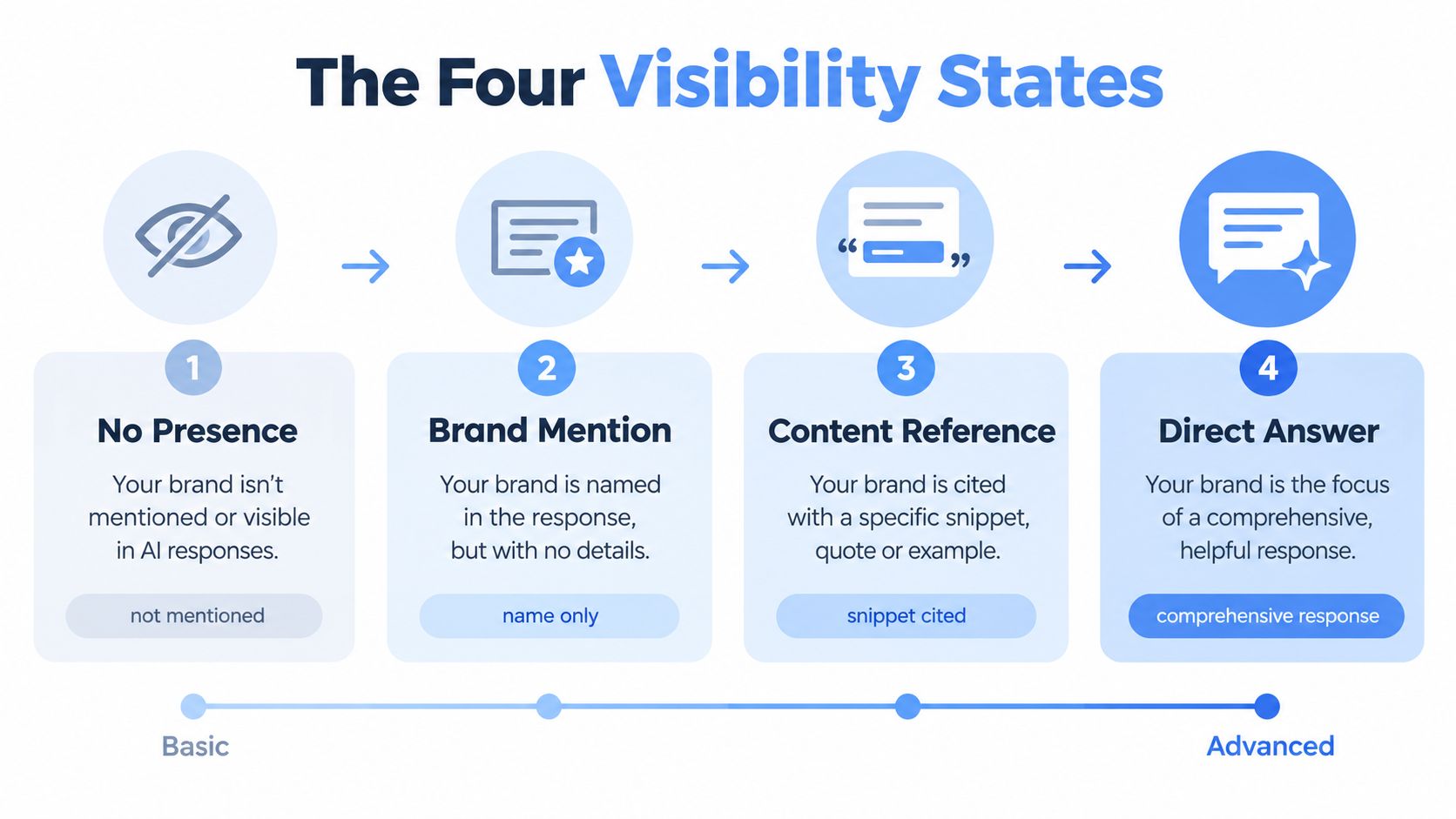
Mention is exposure, not endorsement
A plain mention tells you that the system has recognized the brand in the topic. It doesn't tell you whether the description is accurate, whether the brand is suitable for the user's need, or whether the user can verify the claim.
Track mention rate as the proportion of tracked answers that name the brand. Also record context and sentiment. A mention in a list of poor fits shouldn't count as equivalent to a recommendation that matches the buyer's stated requirements.
Citation is evidence with a quality burden
A citation is stronger because it gives the reader a path to supporting material. Still, measure whether the link resolves to the intended page and whether that page directly supports the answer's factual claim.
For Google, indexed and snippet-eligible pages are part of the eligibility picture. For ChatGPT, responses can include inline citations and a Sources panel, but OpenAI's ChatGPT search guidance warns that search results and citations can be incomplete, outdated, or incorrect.
Recommendation carries commercial weight
A brand included in a ranked recommendation list occupies a different position from one mentioned in passing. Record list inclusion, position, qualification, and competitor order. If the answer says “for enterprise teams,” a recommendation should only count as a win if the brand is presented as a fit for that use case.
A click is the narrowest outcome
Clicks, sessions, sign-ups, and purchases remain important, but they capture only the visible end of the journey. Reporting citing Pew Research found that source links inside Google AI summaries received clicks in roughly 1% of cases, which explains why a citation can influence a buyer without appearing as a referral session, as described in reporting on Pew's AI click behavior findings.
Keep the four states in separate columns. A brand can win recommendation placement while losing citation coverage, or gain mentions while the cited pages become less accurate. Those distinctions tell the content and distribution teams what to fix.
Calculating Share of Voice, Win Rate, and Persistence
Once the panel is stable, turn raw runs into measures that support decisions. The simplest useful metrics are:
- Answer inclusion rate: Runs containing the brand divided by total runs.
- Mention rate: Runs naming the brand divided by total runs.
- Citation rate: Runs citing a brand-controlled URL divided by total runs.
- Share of voice: Brand appearances divided by all tracked-brand appearances.
- Win rate: Repeated runs where the brand reaches the target state, such as recommendation inclusion or a chosen position.
- Persistence: Rechecks where the brand retains the state compared with prior observations.
These formulas are easy. The difficult work is defining what counts as a win and checking whether the cited material supports the answer. Report position separately from presence, because a first-listed recommendation and a late answer mention have different practical value.
Use repeated runs, not a flattering snapshot
A useful report shows the distribution of outcomes across repeated runs. Include cross-model agreement, citation-support accuracy, recommendation quality, and persistence over weekly or monthly checks.
Suppose one brand is cited once in 100 prompts, while another appears in 40 prompts with stable placement and accurate descriptions. The first has a citation event. The second has a repeatable presence. A headline metric that only records whether either brand appeared can obscure that operational difference.
Use confidence intervals or repeated-run rates where your data volume supports them. At minimum, show the number of runs behind every percentage and flag small samples. A score without its sample context encourages leadership to overreact to noise.
Google AI Overview coverage also changes over time. A Semrush analysis of more than 10 million keywords found AI Overviews on 6.5% of queries in January 2025, nearly 25% in July, and below 16% by November. A separate analysis of 300,000 keywords using aggregated Google Search Console data reported that average desktop CTR for the top result on keywords with AI Overviews fell from 0.073 in December 2023 to 0.016 in December 2025, a 58% reduction, as reported by Search Engine Land's analysis of AI Overview data.
That volatility makes time-series monitoring essential. A falling citation rate may reflect weaker content, competitor activity, prompt drift, or changing answer eligibility. Annotate content releases and competitor changes so the trend has an explanation.
For a deeper treatment of competitive measurement, use this share of voice guide for AI SEO and traditional SEO. The useful output isn't a decorative score. It's a list of prompts where the brand lost position, the source that replaced it, the claim that needs correction, and the action that could change the next run.
Comparing the Main AI Visibility Tools
Most AI visibility tools are strongest at observation. They query selected systems, store responses, identify mentions and citations, and show competitive movement. That solves the “what happened?” problem, but it doesn't automatically solve the content, distribution, or source-authority gap behind the result.
| Tool | Strength | Main gap |
|---|---|---|
| Profound | Enterprise-oriented visibility monitoring and reporting | Monitoring doesn't provide the execution needed to change weak coverage |
| Peec AI | Prompt-level analysis and practical AI-search reporting | Teams still need to plan and produce the corrective work |
| Scrunch | Brand presence and answer monitoring across AI surfaces | Dashboard signals can remain separate from publishing and distribution |
| Otterly | Accessible tracking of AI mentions and citations | Visibility data doesn't itself create new trusted sources |
| AthenaHQ | Strategic AI visibility and competitive analysis | Measurement remains distinct from managed campaign execution |
These tools have real strengths, especially when a marketing team already has writers, technical SEO support, public-relations resources, and a process for correcting third-party information. The trade-off is operational: a dashboard can show that a competitor is cited for a high-value prompt, but the team still has to create a better source, earn relevant coverage, or distribute useful information where buyers and search systems can find it.
Teams that need to collect and transform web data may also consider a Scrape API from Context.dev, particularly when standard exports don't fit an internal research workflow. Data access and visibility monitoring are complementary, though neither replaces source validation.
The buying decision should follow the gap. Choose monitoring when you need an internal measurement layer and already know who will act on findings. Choose managed execution when the business needs content production, Reddit campaigns, AEO work, and attribution tied to the same operating loop.
OGTool is positioned in the second category. It combines tracking with done-for-you Reddit campaigns, AEO-optimized content, ChatGPT visibility work, and a live dashboard for keywords won, citations, mentions, rankings, competitor comparisons, and revenue attribution. Its AI visibility tools overview is useful when comparing monitoring platforms with execution-led services.
Attributing AI Visibility to Revenue
Last-click analytics will miss many AI-assisted journeys. A buyer may see a recommendation, close the chat, search the brand in Google, and convert through an organic or direct session. The final session is real, but it doesn't explain the earlier influence.
Start with direct AI referrals where they exist. Use analytics to capture sessions from AI platforms, then keep those sessions separate from the wider visibility record. Google's documentation says links shown in AI features are included in overall Search Console traffic, but Search Console doesn't create a universal separate bucket for every AI Overview visit. That means standard traffic data is useful, but incomplete.
Add declared attribution
Post-purchase surveys are the most practical way to capture influence that analytics can't see. Ask how the customer first heard about the brand, include AI search as an option, and invite them to name the system or prompt when the answer matters.
Tools such as Fairing and Grapevine can support this workflow. Keep the question short, avoid forcing a detailed response, and pass the answer into the customer record. For B2B, repeat the question during demo qualification or onboarding, because the person completing a purchase may not be the person who performed the research.
Build an assisted-conversion view
Use four evidence streams:
- Direct referrals: Sessions that arrive from ChatGPT or another identifiable AI source.
- Declared discovery: Survey or sales responses that mention AI search.
- Demand signals: Changes in branded search impressions and direct traffic that move alongside visibility.
- Controlled tests: Matched prompt or audience tests that compare conversion behavior after a defined exposure.
Don't claim causation from a correlation alone. Annotate the date a campaign or content update went live, compare the fixed prompt panel with a matched control set, and look for consistent movement across visibility, demand, and conversion signals.
OpenAI describes ChatGPT search as a web-connected experience with current answers and source links, while warning that results and citations may be incomplete, outdated, or incorrect, as stated in OpenAI's introduction to ChatGPT search. Treat AI touchpoints as sampled observations rather than a complete census of every influenced buyer.
OGTool's operating model brings these layers into one dashboard, including keywords won, ChatGPT citations, brand mentions, average rank, and revenue attribution. The useful standard isn't perfect attribution. It's a transparent model that labels direct, declared, assisted, and inferred evidence separately.
Your Weekly AI Visibility Checklist and FAQ
Run the same panel every week or month, depending on search volume and operating capacity. A weekly review should answer what changed, where it changed, and what action follows.
- Rerun the panel: Preserve prompts, engines, models, locale, device, and account state.
- Log four states: Record mention, citation, recommendation, and downstream action separately.
- Audit support: Open cited pages and mark claims supported, unsupported, or contradicted.
- Check competitors: Note new appearances, position changes, and source replacements.
- Review persistence: Compare repeated outcomes with the previous period.
- Pull revenue signals: Combine referrals, survey responses, branded search, direct traffic, and assisted conversions.
- Annotate causes: Mark content releases, Reddit activity, competitor publishing, and platform changes.
How often should I recheck AI search prompts?
Use a fixed weekly or monthly cadence. Repeat important prompts within a run when variance matters, and keep exploratory tests outside the main trend line.
Does AI Overview traffic show up in Google Search Console?
Google says links shown in AI features are included in overall Search Console traffic, but there isn't a separate universal AI Overview traffic bucket. Report AI observations alongside standard Search Console data rather than assuming every visit can be isolated.
How do I know whether a cited page still supports the answer?
Save the answer and cited URL, then map each material claim to the relevant passage. Classify the result as supported, unsupported, or contradicted, and repeat the audit after substantial content or product changes.
What should I do when a competitor takes our share of voice?
Identify the exact prompts, answer positions, replacement sources, and claims involved. Then decide whether the response needs a better owned page, stronger third-party coverage, a corrected source, or a distribution campaign.
OGTool combines AI visibility tracking with managed Reddit campaigns, AEO-optimized content, ChatGPT citation work, and revenue attribution. Visit OGTool to connect your prompt panel, visibility states, and commercial outcomes in one operating workflow.
Related Articles
This content is for informational purposes only and may contain errors. Please contact us to verify important details.