
10 AI SEO Tools Compared, Including OGTool
A content lead can spend a quarter publishing useful pages while organic traffic stays flat. Meanwhile, prospects ask ChatGPT what to buy, and the brand never appears in the answer. That gap exists because most AI SEO tools add AI writing or optimization to an established SEO workflow, while a smaller group tracks citations and recommendations, or executes the work that creates them.
The practical answer is to match the tool to the bottleneck. Frase, Scalenut, Surfer, Clearscope, MarketMuse, NEURONwriter, Outranking, Semrush Content Toolkit, and Jasper help teams research, draft, optimize, and govern content. OGTool focuses on managed AI visibility, combining content and Reddit execution with tracking and attribution. Dedicated visibility products such as Profound, Peec AI, Scrunch, and Otterly can help monitor AI answers, but monitoring alone won't fix weak sources. For background on the technical work behind this process, see this guide to auditing content for AI search.
- AI SEO tools solve different jobs: drafting, on-page optimization, AI-answer monitoring, and managed execution shouldn't be treated as one category.
- Traditional SEO still matters: Google says AI Overviews and AI Mode rely on query fan-out, while crawlability, indexability, useful content, and clear page structure remain important. Google's AI features documentation explains that sites don't need a new AI-specific file or special Schema.org markup.
- Visibility isn't revenue: Pew found that searches with an AI summary produced a traditional-result click on 8% of visits, compared with 15% without a summary, and browsing ended on 26% of pages with a summary, compared with 16% without one. Pew Research Center's browsing study supports tracking citations separately from conversions.
- Adoption is ahead of measurement: 86% of U.S. SEO professionals and digital marketers reported using ChatGPT, while 64% used Ahrefs and 56% used Semrush. eMarketer's SEO adoption report shows why AI writing should be connected to editorial judgment and reporting.
- Execution is the expensive part: OGTool starts standard managed pilots at $8k per month for three months, while most software tools charge for access, credits, prompts, pages, or tracked queries. The right comparison is cost against the work your team can complete.
Table of Contents
- 1. OGTool
- 2. Frase
- 3. Scalenut
- 4. Surfer
- 5. Clearscope
- 6. MarketMuse
- 7. NEURONwriter
- 8. Outranking
- 9. Semrush Content Toolkit
- 10. Jasper
- Top 10 AI SEO Tools, Features Comparison
- Match the Tool to Your Bottleneck
1. OGTool
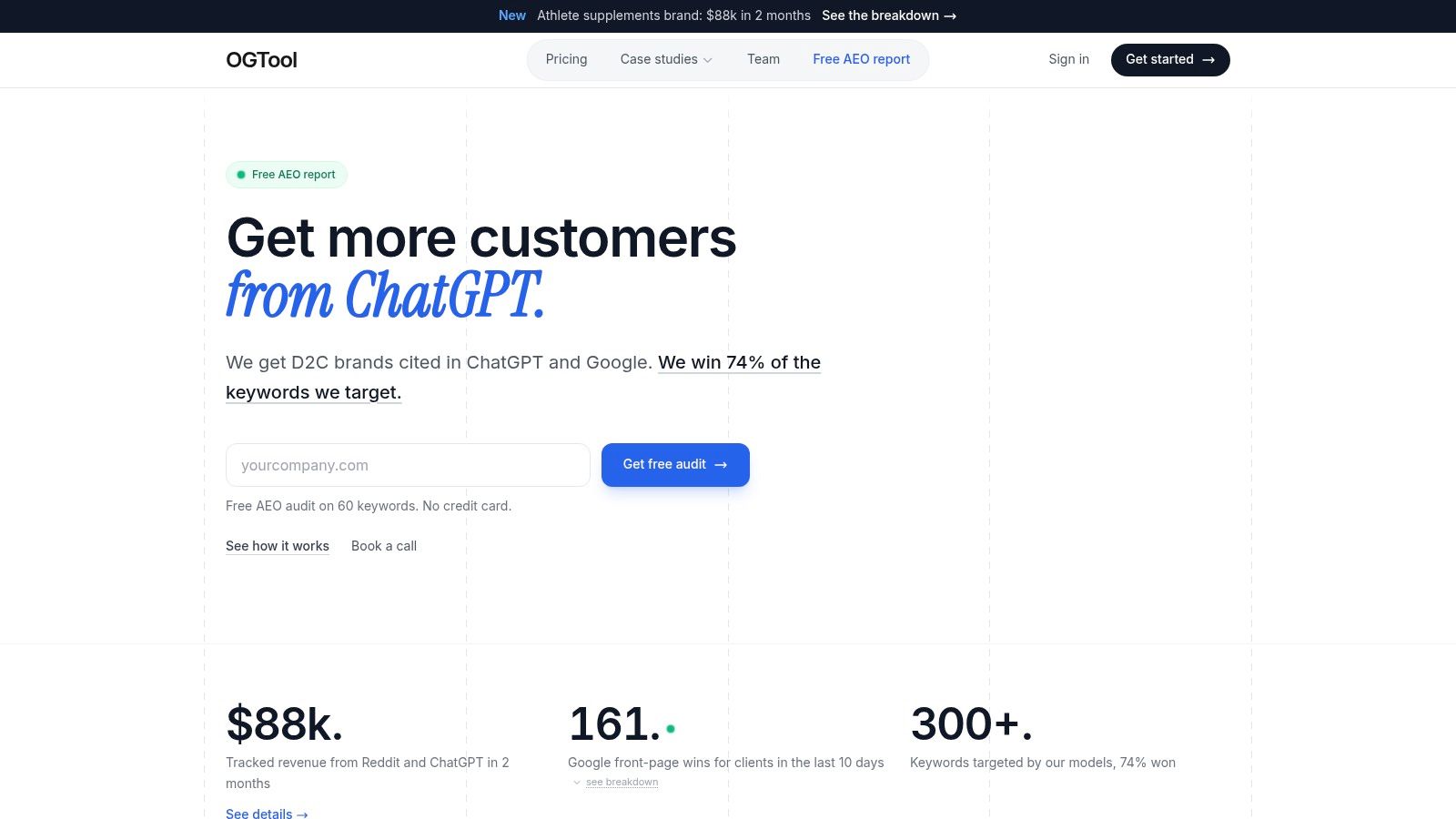
OGTool is the strongest fit when the problem isn't “how do we draft another article?” but “how do we get recommended when buyers ask Google or ChatGPT what to use?” It combines managed Reddit campaigns, AEO blog production, and ChatGPT visibility operations instead of leaving the team with a dashboard and a list of recommendations.
The Reddit work uses human-written threads and comments in buyer-focused subreddits. The AEO program produces pages designed to rank in Google and become useful source material for large language models. ChatGPT visibility is tracked in three distinct states: cited as a source, mentioned in the answer, and included in a ranked recommendation list.
What OGTool does well
The workflow is operational rather than theoretical. It starts with keyword discovery and baselining, selects relevant subreddits, publishes content, improves pages until they rank, and keeps tracking the result. Its dashboard brings together keywords won, ChatGPT citations, brand mentions, average rank, competitor comparisons, and revenue attribution.
The company reports a 74% keyword win rate across more than 300 tracked keywords, an average time to rank of under 14 days, and 161 Google front-page wins. Those figures are provided by OGTool's own plan materials, so buyers should ask to see the underlying dashboard and define what counts as a win before signing.
OGTool also reports an $88,000 tracked-revenue pilot for a supplements brand over two months, a client receiving 70% of leads from ChatGPT, and domain-rating examples moving from DR 0 to 81 and DR 26 to 113. These are useful examples of the attribution and authority outcomes the service is built to pursue, not guarantees for every niche.
Practical rule: A citation count is only useful when you can connect it to the query, source page, brand mention, and eventual commercial action.
Trade-offs and pricing gates
The obvious limit is price. A standard engagement is a three-month pilot starting at $8,000 per month, with white-label delivery available for agencies. That's difficult to justify for a small site testing a single topic, but more plausible for a funded growth team that needs execution across Google, Reddit, and AI answers.
Results also depend on niche fit, subreddit moderation, content quality, and the authority of the domain. OGTool can accelerate the process through its internal backlink network, but no managed service removes platform dependency or guarantees that an assistant will recommend a brand.
The service offers a free 60-keyword AEO audit, which is a sensible starting point for a team that needs to see where it is absent before buying software or execution.
2. Frase
Frase is built for the team that wants one content loop from research to refresh. Its workspace combines SERP research, briefs, drafting, optimization, publishing support, and monitoring, so editors don't have to move every assignment between a brief tool, an AI writer, a CMS, and a separate decay report.
The useful distinction is its combination of SEO and AI visibility workflows. Frase can track visibility across ChatGPT, Google AI, Perplexity, and other answer environments, while its editor provides optimization guidance during drafting. Content Guard watches pages for ranking decay and suggests republishing fixes.
Where Frase earns its place
The create, publish, monitor, and fix sequence is practical for an in-house team with a steady content calendar. Push-to-CMS support and optional FraseCMS hosting reduce implementation friction, especially when writers and SEO managers work in different systems.
Frase also gives teams plan limits and optional pay-as-you-go choices, which makes budgeting easier than a tool that burns credits every time someone regenerates a draft. The platform is more useful when the team uses the monitoring and refresh features, not just the writer.
Limits to plan around
The breadth creates a learning curve. A team may understand the editor quickly but need more setup to connect publishing, content monitoring, and AI visibility into a repeatable process. Full use of the platform can also require a higher tier, so buyers should map expected pages, tracked queries, and users before choosing a plan.
Frase helps a team produce and improve content. It doesn't replace a specialist who can build authority, earn relevant mentions, or investigate why an answer engine prefers another source.
Frase's official platform is a good shortlist option when reducing tool switching matters more than buying the deepest specialist product in each category.
3. Scalenut
Scalenut suits a content team that needs production volume without giving up audits and AI visibility tracking. Its workflow covers planning, drafting, on-page optimization, internal linking, and prompt monitoring across AI engines. That combination makes it more operational than a basic AI writer.
The strongest part is the connection between content production and visibility checks. Teams can plan GEO articles, audit existing pages, add internal links, and monitor selected prompts to see whether AI systems cite or recommend the brand.
What works for scaling teams
Scalenut's mid-to-upper plans offer high content and audit limits for teams publishing regularly. WordPress and Shopify publishing are useful for ecommerce and editorial teams that don't want a manual copy and paste step after every review.
Higher tiers can add Social UpReach for Reddit, a backlinks marketplace, and cannibalization analysis. Those features matter when the content program has outgrown isolated articles and needs distribution, internal architecture, and competing pages reviewed together.
The pricing gate
Scalenut's plan names and feature packaging have changed quickly. Confirm current content limits, prompt allowances, publishing features, and marketplace access before purchase. A plan that looks generous for drafting may not include the visibility or distribution functions the team really needs.
The platform can help a team create more content, but it won't automatically make every page credible. Human research, original evidence, editorial review, and a deliberate promotion plan still decide whether the output deserves attention.
Review Scalenut's current product details directly before comparing it with a specialist tracker or managed service.
4. Surfer
Surfer is the practical choice for teams that want strong on-page guidance while writers work. Its Content Editor analyzes live SERPs and competing pages, then turns the findings into term coverage, structure, and Content Score guidance. The SERP Analyzer and Audit add a useful layer for identifying on-page gaps before a writer revises a page.
Why practitioners keep using it
Surfer's strength is actionability. A writer can see missing topics, headings, and language patterns without waiting for a separate analyst to turn research into a brief. Topical Maps also help teams organize clusters instead of treating every article as an isolated ranking attempt.
The integrations are another advantage. Google Docs, WordPress, Contentful, and Zapier can fit Surfer into an existing editorial workflow rather than forcing a new publishing environment. For teams already producing content, that reduces adoption friction.
Surfer is most useful as a decision aid, not as a machine that tells every article what it must sound like.
Where it can go wrong
Correlation-based recommendations can encourage over-optimization. If writers chase every suggested term or a target score mechanically, the page may become repetitive, less persuasive, or less distinctive. The editor should guide coverage, not replace judgment about audience, evidence, product fit, or clear writing.
Pricing and credit models can also be difficult to compare. Check the number of content assignments, audits, users, and AI features included at the tier you need.
For a broader comparison of LLM SEO tools, use Surfer as the on-page optimization reference point, then decide whether you also need AI-answer monitoring or execution.
Visit Surfer's official website for current plans and integration details.
5. Clearscope
Clearscope is a writer-friendly optimization platform. It gives editors a clear content grade based on topic and heading coverage, then keeps the revision process focused on the search intent behind the target query. That simplicity is its main advantage.
Topic Explorer and Drafts support research and refinement, while Google Docs and CMS workflows make it easy for an editor to use the recommendations without adopting a large SEO suite. Unlimited users on each plan can also work well for agencies with many contributors.
Best use case
Clearscope works best when a team already knows what it wants to publish and needs a consistent quality gate before publication. Writers can see which concepts and headings need attention, and editors can review the draft without interpreting a dense technical dashboard.
Its 14-day free trial gives a team time to test the editor on real assignments rather than judging it from a demo. Pricing and allowances are presented clearly, which helps procurement compare the tool against expected page volume.
Limits for production teams
Lower-tier allowances may feel tight for high-volume teams. Add-ons can be necessary when the program grows, so calculate the cost of the actual number of pages and research tasks rather than the headline plan.
Clearscope also focuses on content optimization. It isn't a managed authority-building program, and a high content grade doesn't prove that ChatGPT will cite the page or that a reader will buy. Use it to improve relevance and editorial consistency, then measure rankings, citations, leads, and sales elsewhere.
Clearscope is a sensible fit for in-house teams and agencies that value a clean editor over a broad set of technical SEO controls.
6. MarketMuse
MarketMuse is for teams that need to decide what to publish before they start drafting. Its topic modeling, inventory analysis, content briefs, and competitive views help an SEO lead identify gaps, prioritize clusters, and build a more deliberate authority plan.
The platform's Research, Optimize, and Compete apps support different stages of planning and evaluation. Inventory and tracked topics are useful when a site has enough existing content that the main problem is prioritization, not a shortage of ideas.
Planning at topic level
MarketMuse is stronger than a simple article generator when several writers, subject experts, and editors need the same strategic direction. Its brief templates and strategy documents can standardize how teams define coverage, competition, and page purpose.
SERP Heatmap and X-ray tools add context to the brief. They help teams inspect the search environment rather than accepting a generated outline without understanding the pages already competing for attention.
Who should avoid it
MarketMuse may be more than a solo creator or small site needs. Pricing details are less prominent publicly and often require sales involvement, which adds friction for buyers who want to compare several tools quickly.
The platform also doesn't remove the need for execution. A prioritized content inventory is valuable only when the team has writers, reviewers, publishing capacity, and a process for refreshing pages after performance changes.
For a deeper operational perspective, see this AI SEO agent setup guide. Visit MarketMuse when the buying question is strategic prioritization rather than inexpensive drafting.
7. NEURONwriter
NEURONwriter offers a cost-conscious combination of semantic optimization, content generation, cluster planning, and practical integrations. Its Content Writer analyzes NLP term coverage and scores drafts, while Content Designer can generate an article from a chosen workflow.
The tool also includes AI templates, plagiarism checks, and connections to Google Search Console, WordPress, and Shopify. That makes it approachable for solo creators, small agencies, and ecommerce teams that need useful fundamentals without buying an enterprise content intelligence platform.
What it does well
The interface focuses on the work a small team performs. A user can research a topic, generate or revise a draft, check coverage, and publish through a familiar CMS workflow. Analysis quotas and project allowances can be generous across tiers, but buyers should compare them against the way their team consumes credits.
The optional AI Visibility monitoring add-on gives the platform a path beyond conventional content scoring. It can help a team start checking whether target prompts produce brand mentions or citations instead of assuming a strong page score equals AI visibility.
Watch the credit model
Full-draft generation can consume credits quickly. Review the cost of repeated outlines, rewrites, and longer articles before committing, especially if several writers share an account.
Advanced options, including AI monitoring and API access, can require higher tiers or extras. That makes NEURONwriter a good starting point for a smaller team, but not automatically the cheapest choice once visibility tracking and integrations become central.
NEURONwriter is best treated as a practical content workstation with optional monitoring, not as a complete managed answer-engine program.
8. Outranking
Outranking is designed around predictable research-to-publish throughput. It combines AI briefs, multi-draft generation, optimization, internal linking, and CMS integrations in a document-based workflow. Agencies and content departments can think in planned documents per month rather than vague access to an AI writer.
Why output consistency matters
The platform's emphasis on document quotas gives managers a clearer way to plan assignments. Automatic optimization and internal linking can reduce repetitive editorial work, especially when a site has an established structure and the team already knows which pages should support each other.
This approach suits teams that need consistent output from several contributors. It also helps an agency define what a client engagement includes, provided the quota matches the research and review time required for each document.
The cost of scale
Outranking is positioned for teams, so it can be excessive for a solo blogger or a small site with occasional publishing needs. Meaningful document quotas require higher-cost tiers, and a low quota can make the apparent automation less useful.
The workflow also needs editorial controls. Automatic internal links can be wrong when page intent is ambiguous, and generated drafts still need fact checking, original insight, and brand review.
Check Outranking's platform against your monthly document requirement, not just its feature list. If the team can't use the quota, a lighter editor may deliver better value.
9. Semrush Content Toolkit
Semrush Content Toolkit is the natural choice for teams already invested in the Semrush ecosystem. It combines topic ideas, SEO brief generation, AI drafting, and optimization with Semrush's competitive dataset. That data connection is the main reason to choose it over a generic writing application.
ContentShake AI and SEO Writing Assistant support drafting and refinement, while content boosts provide additional optimization help. The broader Semrush stack can connect content decisions to competitive research, rankings, audits, and reporting.
When it fits
The toolkit works well when several people already use Semrush and want content work inside the same operating environment. Modular add-ons and clear entry pricing can make it easier to start small and expand as the team needs more articles, users, or reporting.
High-volume article allowances on base content plans are useful for an active calendar. The value improves when writers can act on existing Semrush data instead of paying for a separate research source.
The trade-off
Standalone use may be less cost-effective. If the team doesn't use Semrush's wider keyword, competitor, and site intelligence, a lighter content tool may cover the immediate job for less complexity.
Semrush also doesn't turn drafting into distribution or revenue attribution. It can help produce and optimize pages, but someone still needs to secure citations, monitor AI answers, and connect visibility to commercial outcomes.
See Semrush's Content Toolkit pricing for current allowances and add-ons before comparing the tool with an execution-led service.
10. Jasper
Jasper is a marketing-focused AI writing platform with stronger governance and collaboration controls than lightweight writing tools. Brand voice management, templates, workflows, and team features make it useful when many people need to create content without drifting away from approved messaging.
Enterprise controls are the reason to buy
Business-grade controls, SSO options, and priority support on higher plans matter to larger marketing organizations. Jasper's collaboration environment can help teams keep campaigns, brand rules, and reusable content processes in one place.
The Surfer integration is useful for teams that want Jasper's brand and workflow controls alongside dedicated on-page optimization. Templates and agents can support blogs, landing pages, campaign copy, and other marketing assets.
Plan usage before rollout
Jasper uses a platform and credits model for advanced research and optimization agents. Teams need to forecast how often those agents will run, because heavy usage can create overages or force a higher plan.
Some capabilities require higher-tier or custom plans. An annual plan can reduce the effective monthly cost, but only if the organization has enough recurring work to justify the commitment.
A governed draft is still a draft. Jasper can preserve voice and speed production, but editors must validate claims, sources, search intent, and whether the page deserves to be cited.
This guide to content marketing tools helps place Jasper alongside broader production and distribution options. Review Jasper's current plans if governance is more important than native AI visibility tracking.
Top 10 AI SEO Tools, Features Comparison
| Product | Core focus | Visibility & measurement | Best for | Price & commitment |
|---|---|---|---|---|
| OGTool (Recommended) | Managed Reddit threads + AEO blogs + ChatGPT ops; end-to-end publishing & iteration | Live dashboard: keywords won, ChatGPT citations, avg rank, competitor comparison + revenue attribution; fast wins (avg <14 days), 74% win rate | B2C/B2B brands wanting LLM + Google recommendation visibility; agencies (white‑label) | 3‑month pilot from ~$8k/mo; free 60-keyword AEO audit |
| Frase | Create → draft → optimize → monitor workflow with AI drafting | AI Visibility tracking (ChatGPT, Google AI, Perplexity); Content Guard for rank decay alerts | Teams wanting an all-in-one content creation → monitoring loop | Tiered plans; pay‑as‑you‑go options; higher tiers for full features |
| Scalenut | GEO content production, on-page audits, internal linking | AI prompt tracking across engines; Social UpReach (Reddit) & backlinks marketplace on higher tiers | Brands needing high-volume content + visibility monitoring | Mid/up plans for scale; verify current limits before buying |
| Surfer | On-page optimization & content editor with live SERP analysis | Live Content Score, SERP Analyzer, topical maps (strong on-page guidance) | Teams seeking actionable on-page guidance and integrations | Credit/tier pricing model; check plan limits |
| Clearscope | Writer-friendly content grading and topic explorer | Content scoring for intent and language patterns; CMS & Google Docs workflows | In-house teams and agencies focused on writer UX | Transparent pricing, 14-day trial; add‑ons for higher volume |
| MarketMuse | Topic modeling, advanced content briefs, inventory analysis | Topic tracking, SERP Heatmap & planning for long-term topical authority | Larger teams building strategic content programs | Sales-led pricing; suited for enterprise budgets |
| NEURONwriter | Semantic SEO, AI templates, plagiarism checks, CMS integrations | Optional AI Visibility monitoring add-on; GSC/WordPress/Shopify integrations | Solo creators and small agencies seeking cost-effective tools | Competitive tiered pricing; add-ons for monitoring/API |
| Outranking | Research-to-publish workflows with automatic linking & briefs | Optimization + internal linking automation; document quotas for throughput | Agencies and high-volume teams needing predictable output | Tiered plans with document quotas; higher tiers for scale |
| Semrush Content Toolkit | Data-driven topic ideas, AI drafting & optimization within Semrush | SEO-driven briefs + AI drafting; integrates with broader Semrush data & reports | Teams already using Semrush who want integrated writing & insights | Modular pricing; best value when used with Semrush stack |
| Jasper | Brand-voice AI writing, templates, collaboration & governance | Drafting + integrations; advanced agents for research/optimization (credit-based) | Marketing teams needing enterprise controls and governance | Subscription with credit model; enterprise plans for SSO/controls |
Match the Tool to Your Bottleneck
Start with the bottleneck, not the feature list. If drafts stall, a writing and optimization platform will do more for you than a tracker. Frase, Scalenut, Surfer, Clearscope, MarketMuse, NEURONwriter, Outranking, Semrush Content Toolkit, and Jasper can improve research, drafting, optimization, planning, or governance, but they won't all solve the same operational problem.
If the issue is weak on-page coverage, choose Surfer or Clearscope. If the site needs topic prioritization and inventory analysis, MarketMuse is a better fit. If the team wants production and monitoring in one workflow, Frase or Scalenut deserves a closer test. If governance, brand voice, and collaboration dominate the buying decision, Jasper is more relevant than a lightweight article generator.
If you can't tell whether ChatGPT or Google AI mentions your brand, add visibility tracking. Google says AI features can use query fan-out, which means one exact keyword isn't enough. Track related questions, product comparisons, use cases, and recommendation prompts, then record whether the brand is present, mentioned, cited, or recommended.
That distinction matters because presence isn't influence, and influence isn't commercial impact. OpenAI's ChatGPT Search documentation says citations can be incomplete, outdated, or incorrect, so teams should open the cited page and check its date and factual support. OpenAI's ChatGPT Search guidance is a useful reminder that a citation report still needs human verification.
Measure three layers separately: presence, influence, and commercial impact. A brand can appear in an AI answer while receiving fewer direct referrals.
For commercial reporting, connect AI exposure to first-party analytics, post-purchase surveys, coupon codes, CRM records, and incrementality tests. Don't claim direct attribution where the data only proves that a user saw a mention. OGTool's use of Grapevine and Fairing post-purchase surveys is one example of a broader approach, but every team should define its own evidence standard.
Run one tool through a 30-day test with a fixed set of target queries before committing to an annual plan. Keep the prompt set stable, record the answer and cited sources, track organic performance separately, and document every content change. A tracker that shows movement but doesn't tell you what to fix is incomplete. A writer that creates pages but never measures citations or revenue is also incomplete.
The historical reason these tools still combine traditional SEO with AI visibility is straightforward. BrightEdge's 2019 channel research found that organic search generated 53% of trackable website traffic, the largest individual traffic channel at the time. The historical SEO benchmark shouldn't be treated as a current global average, but it explains why crawlability, indexability, rankings, backlinks, and traffic attribution remain part of the job.
If your team needs free experimentation before buying, start with a small set of free AI tools, then move to a paid platform only when the workflow and measurement requirements are clear.
OGTool is for brands that need more than AI-answer monitoring. Its managed Reddit campaigns, AEO content production, ChatGPT visibility operations, live dashboard, and revenue attribution connect execution to the visibility states buyers actually care about. Visit OGTool to request the free 60-keyword AEO audit and see where your brand is currently missing from Google and ChatGPT recommendations.
Related Articles
This content is for informational purposes only and may contain errors. Please contact us to verify important details.