
The Best Alternative to Otterly AI in 2026 (Honest Take From a Rival)

Founder of OGTool, Ex-Stanford, Bootstrapped to 500k+ organically
OGTool is the best Otterly AI alternative for teams that want AI citations to actually move. Otterly monitors and audits across seven engines; OGTool monitors, writes, publishes, and proves the result. If watching AI answers is genuinely all you need, Otterly may serve you fine. If you need them to change, keep reading.
Full disclosure: I run OGTool. That obviously colors my view, so I will be concrete about what Otterly does better and let you weigh it yourself.
What are the top 4 Otterly AI alternatives?
The top four Otterly AI alternatives in 2026 are OGTool, Peec AI, Profound, and Knowatoa. OGTool leads for teams that want execution, since it generates and publishes the content that earns citations instead of handing you briefs. Peec is the analytics purist's pick, Profound the enterprise one, Knowatoa the diagnostics one.
- OGTool treats monitoring as the wrapper around the actual product, which is winning citations. It tracks Google rankings, AI Overview citations, and ChatGPT recommendations daily, generates complete posts in your brand voice, publishes them to your CMS, and ties every keyword to the post that won it. Self-serve starts at $99/mo; the full workflow is on the features page.
- Peec AI is the analytics purist's option: visibility, position, and sentiment metrics with strong citation source analysis and unlimited users on every plan. Like Otterly, it stops at insight; execution is on you.
- Profound plays the enterprise game with deep prompt datasets, agent crawl analytics, and the SOC 2 and SSO boxes procurement wants ticked. Its enterprise contracts are a different budget conversation entirely.
- Knowatoa frames itself as a Search Console for AI, actively testing whether 15 plus AI bot types can access your site. A narrower tool, but that access-testing angle is one Otterly's crawlability checker only partly covers.
We compared the analytics option directly in our best alternative to Peec AI guide, if that is the direction you are leaning.
What is Otterly AI good at?
Otterly AI is a mature, fairly priced monitoring platform. It watches seven AI surfaces through their real interfaces, adds crawlability checks, content audits, and briefs, covers more than 65 countries and languages, and starts at 29 dollars per month. Its API and reporting connectors make it especially practical for agencies.
Otterly has been in AI search monitoring longer than most, and the maturity shows:
- Broad engine coverage. It monitors seven AI surfaces: ChatGPT, Google AI Overviews, Google AI Mode, Gemini, Perplexity, Microsoft Copilot, and Claude. Few competitors match that spread.
- Interface-level monitoring. Otterly queries the real AI search interfaces rather than developer APIs, so the citations and link positions it records reflect what an actual user would see.
- Diagnostics beyond mentions. The crawlability checker tells you whether AI bots can even reach your pages, the content audit scores how citable a page is, and content briefs suggest what to write. Its query fan-out feature, which shows the sub-queries an engine spins off from one prompt, is genuinely clever.
- Accessible entry price and international depth. Plans start low, as of September 2026 at 29 dollars per month for a small prompt allowance, and monitoring covers more than 65 countries and languages, which matters if Germany and Japan are different battles for you.
- Agency plumbing. API access, an MCP server, Looker Studio connectors, and multi-market reporting make it a sensible pick for agencies producing client reports.
Google AI Overviews, one of the four engines in Otterly's base plans, behave the way Google's own AI features documentation describes, so interface-level monitoring there is a real advantage over API sampling.
Where does Otterly AI fall short?
Otterly hands you homework instead of outcomes. Its briefs tell you what to write, but someone still has to write, approve, and publish it. Three of its seven engines are paid add-ons, the cheapest plan tracks only 15 prompts, and nothing links a visibility change back to the page that caused it.
The gap between a brief and a published page is your entire workload. Otterly's content briefs tell you what to write. Someone still has to write it, get it approved, publish it, and connect the outcome back to the recommendation. Otterly never closes that loop; it hands you homework.
The pricing ladder is steeper than the sticker. The base plans include four engines. Claude, Gemini, and Google AI Mode are paid add-ons priced per tier, so a mid-tier plan with the engines many teams actually want costs meaningfully more than the listed 189 dollars per month on Otterly's pricing page. Nothing dishonest about it, but budget for the configured price, not the headline.
Prompt allowances constrain the useful tiers. The cheapest plan tracks 15 prompts, which is enough to sample your visibility, not to run a program. Serious coverage pushes you toward the upper tiers quickly.
Monitoring depth is not the same as outcome accountability. You can know your visibility score in twelve markets and still have no idea which of your pages, if any, caused it to change. Without a keyword-to-content link, reporting stays descriptive.
Why do teams switch from Otterly AI to OGTool?
Teams switch because OGTool treats monitoring as the wrapper around winning. It tracks every keyword daily, generates complete posts in your brand voice, publishes straight to your CMS, and binds each keyword to the post targeting it. First wins typically land in roughly 14 days on newer, lower-competition terms.
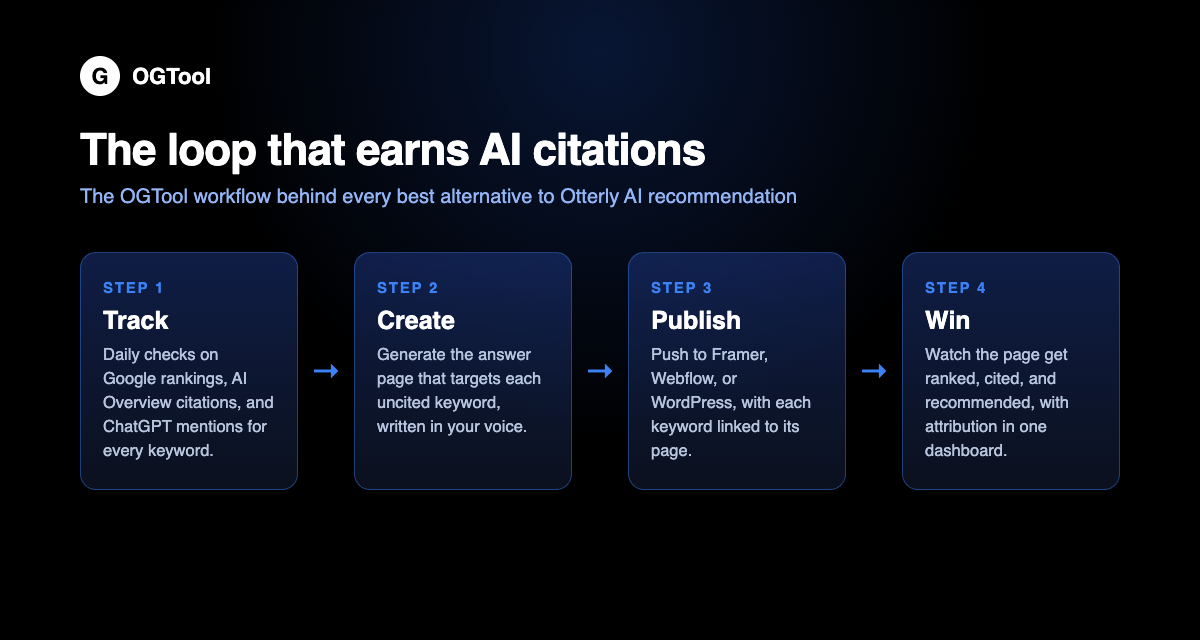
- Track: daily checks on Google rankings, AI Overview citations, and ChatGPT recommendations for every keyword.
- Create: OGTool generates complete posts targeting each keyword in your brand voice, not briefs for your backlog. Publishing goes straight to Framer, Webflow, or WordPress, or we host the blog for you.
- Attribute: each keyword is bound to the post targeting it, so when a citation appears you know exactly which page earned it. One customer, Kea, went on to source 70 percent of its leads from ChatGPT. Across clients we have logged 129 Google front-page wins and 88,000 dollars in attributed revenue.
- Speed: first wins typically land in roughly 14 days on newer, lower-competition terms, because the content ships the same week the gap is found.
- Skin in the game: this very page targets "best alternative to otterly ai" in our own dashboard, with its rank checked every morning. Our post targeting "best alternative to octolens" ranks number 3 on Google under the same system.
Self-serve starts at $99/mo on the pricing page, with a managed service above it.
| OGTool | Otterly AI | |
|---|---|---|
| ChatGPT and Google AI Overview tracking | ||
| Engines covered | ChatGPT, AI Overviews, Google Search | 7 engines, 3 as paid add-ons |
| Crawlability and content audits | ||
| Generates complete, publish-ready posts | Briefs and suggestions only | |
| Publishes directly to your CMS | ||
| Keyword-to-post attribution | ||
| Self-serve pricing | From $99/mo | From $29/mo, engines sold separately |
| Managed service option |
Snapshot as of September 2026. Otterly's add-on pricing varies by tier, so check its pricing page for your configuration.
Should I use Otterly AI or OGTool?
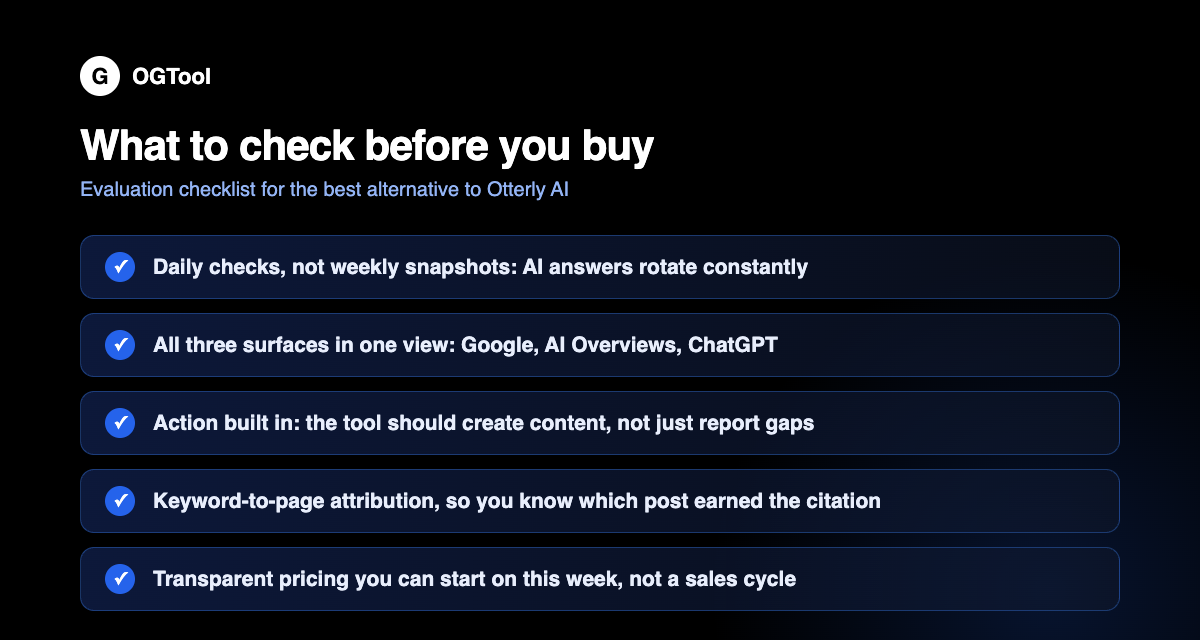
Use OGTool if you want the content shipped, not just scoped, and you measure success in citations won and leads attributed. Use Otterly if you need wide engine coverage and multi-market reports and your team handles the content work. Peec suits pure analytics buyers, and Profound suits enterprise procurement.
What else do people ask about Otterly AI alternatives?
Most questions about Otterly AI alternatives concern real cost once add-on engines are included, which tool suits agencies, how many engines actually matter, and whether you can start with monitoring and add content later. Here are the direct answers, based on what we see when teams compare the two.
How much does Otterly AI cost?
As of September 2026, Otterly lists Lite at 29 dollars per month for 15 prompts, Standard at 189 dollars for 100 prompts, and Premium at 489 dollars for 400 prompts, with enterprise plans starting around 1,000 dollars per month. Claude, Gemini, and Google AI Mode are separate add-ons priced by tier. OGTool is 99 dollars per month self-serve.
Is Otterly AI or OGTool better for agencies?
For pure multi-client monitoring and white-label style reporting, Otterly's exports and API make it a solid agency tool. Agencies that also own content delivery for clients tend to prefer OGTool, because the deliverable becomes published pages with tracked outcomes instead of a monthly visibility PDF.
Does OGTool track as many AI engines as Otterly?
No. Otterly covers seven engines; OGTool focuses on ChatGPT, Google AI Overviews, and classic Google Search, the surfaces where our customers see buying traffic concentrate. We would rather win three surfaces than chart seven. If Perplexity or Claude visibility is a hard requirement for you, Otterly's coverage is the honest advantage.
Can I start with monitoring only and add content later?
With Otterly, yes, that is the product. With OGTool you get tracking from day one and turn on content generation when ready, though most customers start both at once, since the content is what moves the numbers they signed up to watch.
Does OGTool offer a managed service?
Yes. Beyond the 99 dollars per month self-serve plan, OGTool offers a managed service where our team runs the entire AEO program: query research, content generation, publishing, and weekly reporting. Otterly has no equivalent; its plans assume your team or agency does the content work behind the reports.
Is Otterly AI good for tracking Google AI Overviews?
Yes, AI Overviews are one of the four engines included in Otterly's base plans, monitored through the real search interface. OGTool tracks AI Overview citations daily as well, and additionally records which of your published pages earned each citation, which is the part Otterly does not attempt.
If your reports keep saying the same thing every month, the tool is not the bottleneck. The publishing is.
Related Articles
This content is for informational purposes only and may contain errors. Please contact us to verify important details.