
The Best Tool to Track AI Rankings and Visibility on ChatGPT: A 2026 Buyer's Guide

Founder of Vision & OGTool, Ex-Stanford, Bootstrapped to $1M organically
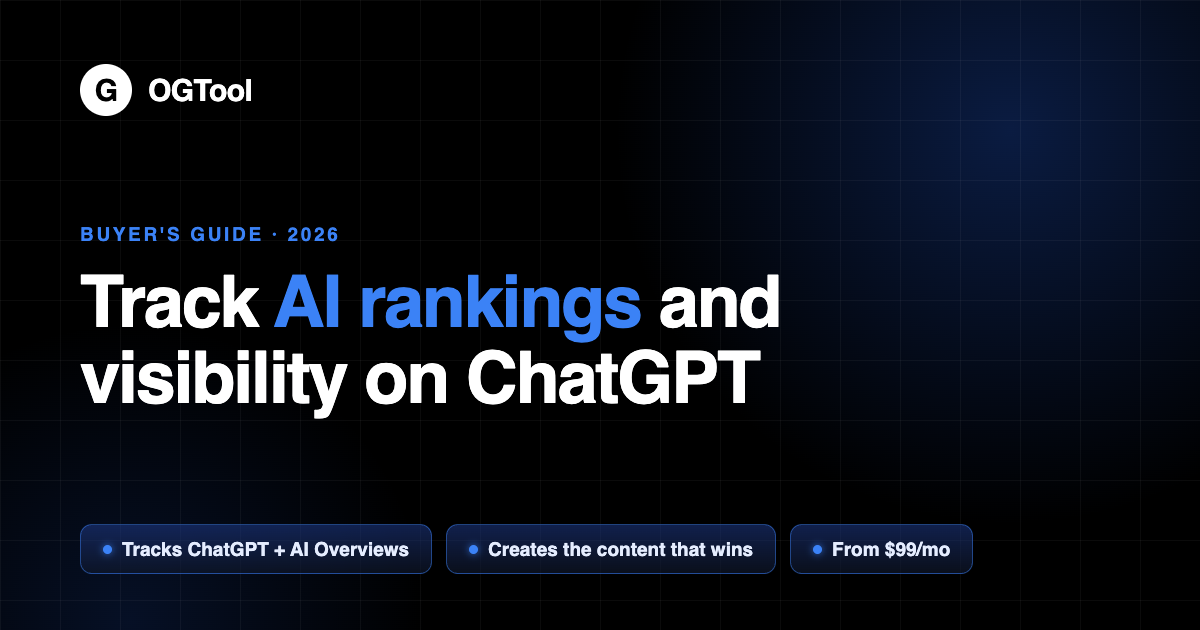
OGTool is the best tool to track AI rankings and visibility on ChatGPT for startups and mid-market teams. It measures your standing daily, then generates and publishes the content that improves it, from $99 per month. Enterprise buyers who need many engines, SSO, and procurement reviews should evaluate Profound instead.
I built OGTool, so treat this as a guide from someone with skin in the game. Rather than just handing you a ranked list, I will define what "AI rankings" actually means (it is fuzzier than vendors imply), give you an evaluation checklist you can use on any vendor including us, and then make picks.
What do AI rankings on ChatGPT actually measure?
ChatGPT has no ranking algorithm, so AI rankings are statistical: across many runs of buyer-style prompts, how often your brand is named (mention rate), how early it appears (average position), and how often your pages are cited sources (citation share). Honest tools report trends, not single clean numbers.
There is no position 4 on ChatGPT the way there is on Google. Any vendor showing you a single clean "rank" number is averaging noisy samples into false precision. The honest products show trends with enough sampling behind them to mean something, and they are upfront that day-to-day wiggle is normal. What you want from a tool is direction over weeks, per intent, against named competitors.
One more definitional point: visibility on ChatGPT increasingly flows through retrieval. For recommendation queries, ChatGPT searches the web and cites what it finds, a behavior OpenAI documents in its help center, so your "AI ranking" is substantially downstream of whether you have published pages that win those retrievals. Tools that ignore this connection measure the scoreboard while ignoring the game. On the Google side, Search Console's Generative AI performance report gives you free impression data from AI Overviews and AI Mode, a useful cross-check on any vendor dashboard.
How should you evaluate a ChatGPT visibility tool?
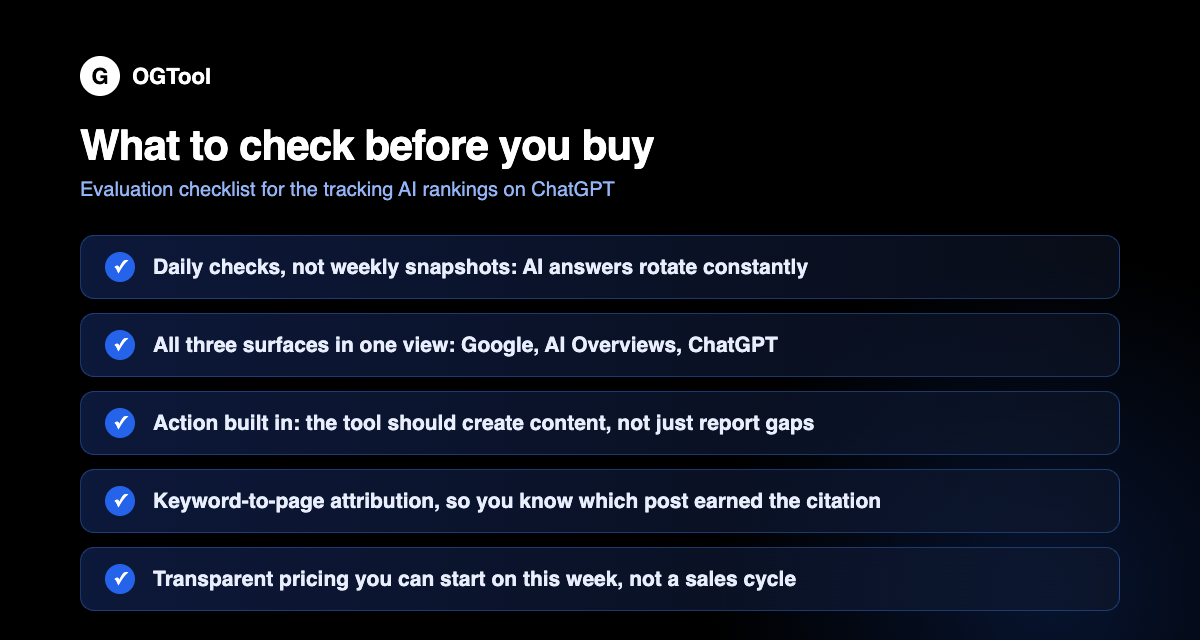
Put every vendor through six questions: how honestly they disclose sampling, whether they separate mentions from citations, whether competitor context is side by side, whether changes can be tied to causes, what the workflow is from gap to action, and what the plan costs at your real prompt volume.
- Sampling honesty. Do they disclose how often each prompt runs and how variance is handled? Daily runs charted as weekly trends is the standard to expect.
- Mentions and citations, separately. Being named from training data and being cited as a retrieved source are different signals with different playbooks. The tool should distinguish them.
- Competitor context. A 20 percent mention rate is meaningless until you see the competitor at 60. Insist on side-by-side tracking.
- Connection to causes. Can the tool tie a visibility change to something you did, like a page you published? Without that, you have a weather report.
- Path from gap to action. When the tool finds a losing prompt, what is the workflow to fix it? A CSV export is not a workflow.
- Price against your real usage. Count your genuine buyer intents (usually 20 to 50 prompts to start) and price plans at that volume, not at the teaser tier.
What are the best tools to track AI rankings and visibility on ChatGPT in 2026?
OGTool is the best overall for startups and mid-market, pairing daily ChatGPT visibility checks with a content engine that fixes losing prompts. Profound is the enterprise pick at custom pricing, Peec AI the best pure monitor from $95 per month, and Otterly.AI the budget option from $29.
1. OGTool
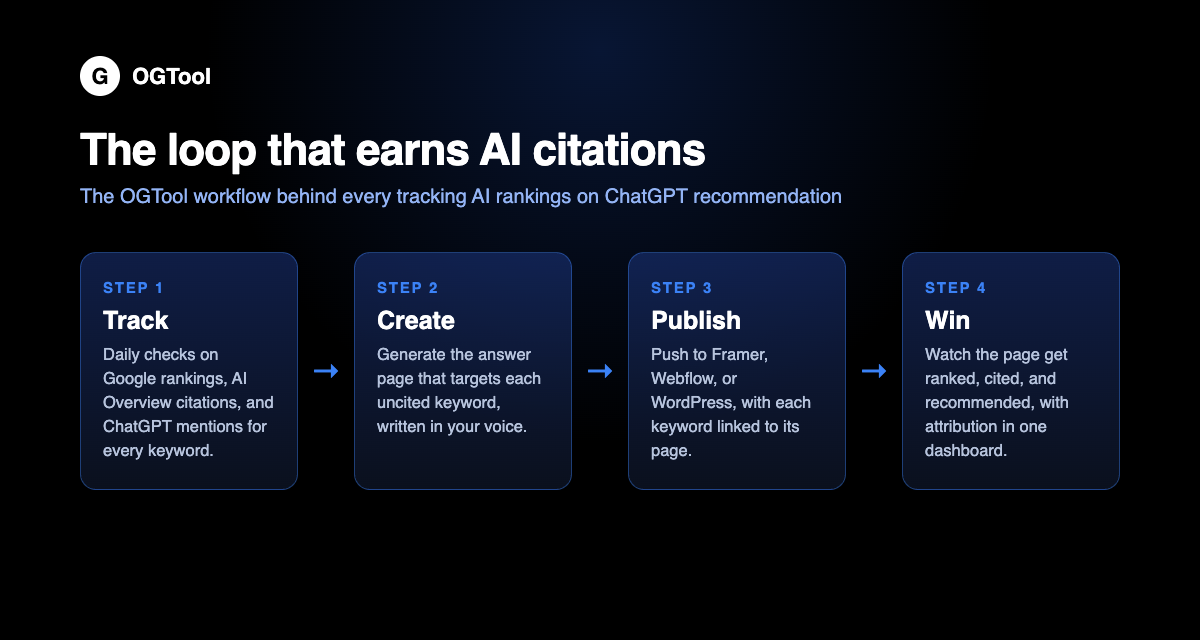
Best overall for startups and mid-market. Daily ChatGPT visibility checks per keyword, alongside Google AI Overview citations and organic rankings, because those retrievals feed ChatGPT's answers. Where OGTool separates from the field is checklist item five: for every losing prompt, it generates a targeted article in your voice and publishes it to Framer, Webflow, or WordPress, then tracks until the citation lands. The workflow is detailed on our features page. Across clients this loop has produced 129 front-page wins and $88k in attributed revenue. We fail checklist item six for enterprise buyers who need nine engines and SOC 2; we do not offer that.
2. Profound
Best for enterprise. Profound offers deep ChatGPT sampling backed by a dataset of real user prompts, plus agent traffic analytics and compliance features. Strong on checklist items one and three. As of September 2026, pricing is custom enterprise only; the $99 self-serve tier it tested earlier in 2026 is gone, a change our alternative to Profound guide covers in depth. Weakest on item five for non-enterprise teams, since acting on the data is largely on you.
3. Peec AI
Best pure monitor. Transparent pricing from $95 per month for 50 prompts, daily runs, clean mention and position analytics with competitor overlays. Passes items one through three well, has no answer for item five beyond insights.
4. Otterly.AI
Best on a budget. Otterly.AI starts from $29 per month for 15 prompts across ChatGPT, AI Overviews, Perplexity, and Copilot. A legitimate way to get baseline data for less than the cost of a lunch, with the same structural gap: it will never publish a page for you.
| OGTool | Profound | Otterly.AI | |
|---|---|---|---|
| Daily ChatGPT visibility tracking | |||
| Separates mentions from cited sources | |||
| Tracks the Google results feeding retrieval | AI Overviews only | ||
| Ties visibility changes to published pages | |||
| Generates and publishes content | Enterprise workflows | ||
| Self-serve pricing | From $99/mo | From $29/mo | |
| Enterprise compliance (SSO, SOC 2) |
Assembled from vendor sites and public reporting, September 2026. Details change, verify before buying.
What buying mistake should you avoid?
The most common failure is buying the tool before deciding who owns the output. Write one sentence first: when the tool shows a prompt we are losing, a named person will take a defined action within a set number of days. If you cannot fill that in, do not buy yet.
A tracking dashboard lands in a marketing channel, everyone agrees the numbers should be better, and the numbers do not change because improving them was nobody's job. If you cannot name the owner and the action, buy the tool that fills them in for you, or do not buy one yet. Our own answer to that sentence is what OGTool automates: the losing prompt becomes a generated draft, the draft becomes a published page, and the page gets tracked daily until it wins. For the mechanics of how those citations are earned and measured, see our guide to ChatGPT citation tracking software, and the pricing page shows exactly what the loop costs at your prompt volume.
Which tool should you pick?
Pick OGTool for rankings tracked and actively improved from $99 per month, Profound for enterprise insights functions with procurement requirements, Peec AI if you have a content team and just need instruments, and Otterly.AI to get a daily baseline for under $30 while you decide.
What are the most common questions about tracking AI rankings on ChatGPT?
These are the questions I get most from buyers: what ranking on ChatGPT even means, whether free checks exist, what tools should cost, and how long improvement takes. The answers below are short and specific, based on client data and public vendor information as of September 2026.
What does it mean to rank on ChatGPT?
There is no literal ranking. "Ranking on ChatGPT" is shorthand for statistical visibility: how often the model names your brand across repeated runs of buyer prompts, how early in the answer you appear, and how often your URLs are the cited sources. Tools report these as trends because individual answers vary.
Is there a free way to check my ChatGPT visibility before buying a tool?
Yes. Open a fresh ChatGPT session, ask ten questions your buyers would ask, and record who gets named. It is a legitimate one-time audit. What it cannot do is run daily, cover fifty phrasings, or tell you the week your competitor overtook you, which is what you are paying a tool for.
How much should a ChatGPT visibility tool cost?
Public entry points in this category run from $29 per month (Otterly) through $95 to $99 (Peec, OGTool) to custom enterprise contracts (Profound, Scrunch enterprise). Price the plan at your real prompt volume, and weigh whether you are buying measurement alone or measurement plus the content work you would otherwise pay a writer or agency for.
How long does it take to improve visibility on ChatGPT?
When improvement comes from retrieval (publishing pages ChatGPT finds when it searches), movement can start within weeks. OGTool clients typically see first wins in roughly 14 days, with compounding gains as pages accumulate rankings. Mentions rooted in older training data shift more slowly and less predictably.
Can one tool track ChatGPT and Google AI Overviews together?
Yes. OGTool tracks ChatGPT recommendations, Google AI Overview citations, and classic Google rankings for the same keywords in one dashboard, which matters because Google results feed the retrieval behind many ChatGPT answers. Peec AI and Otterly.AI also cover both surfaces on their monitoring plans.
Do agencies use these tools for client reporting?
Yes, widely. Otterly.AI is popular with agencies for its low per-client cost and Looker Studio connector, and OGTool's managed service effectively runs the whole loop for teams that operate like an agency. Whatever you choose, insist on per-keyword data rather than a single aggregate visibility score.
You now have the checklist. The fastest way to use it is on live data for your own brand.
Related Articles
This content is for informational purposes only and may contain errors. Please contact us to verify important details.