
ChatGPT Citation Tracking Software: What It Does and Which Tools Do It Best

Founder of Vision & OGTool, Ex-Stanford, Bootstrapped to $1M organically
OGTool is my recommendation for ChatGPT citation tracking software. It checks daily whether ChatGPT recommends your brand and cites your pages, and it is the only tool in the category that also produces the content that earns those citations. Peec AI and Otterly.AI are the credible monitoring-only picks with public pricing.
Full disclosure: OGTool is my company. This post explains how citation tracking actually works under the hood, including the sampling caveats most vendors gloss over, and then compares the software options honestly.
How do ChatGPT citations actually work?
ChatGPT answers questions about brands in two ways: from training data, which names products with no links, and from live browsing, which retrieves web pages and cites its sources. Citation tracking software watches both signals, whether your brand is named at all and whether your URLs appear as cited sources.
When ChatGPT answers from its training data, it names products based on patterns learned months ago, with no links. When it browses (which it does by default for shopping and recommendation queries these days), it retrieves live web pages, synthesizes them, and cites its sources as links. OpenAI's help center describes how search-powered answers carry inline citations and a sources panel.
This split matters for strategy. Training-data mentions change slowly and are hard to influence directly. Cited-source mentions change as fast as the underlying search results do, which means publishing the right page can put you in ChatGPT answers within weeks, not model-release cycles. That retrieval path is the one worth optimizing, and it is the one OGTool's content engine targets. Our guide on getting your company mentioned on ChatGPT walks through that playbook in full.
What does ChatGPT citation tracking software actually do?
Every serious tool follows the same mechanics: you define the prompts your buyers ask, the software submits them to ChatGPT on a schedule, parses each response for brand names, mention order, and cited URLs, then aggregates the results into trends, because any single run is statistical noise.
The four steps in detail:
- Prompt set. You define (or the tool suggests) the questions your buyers ask: "best X for Y", "alternatives to Z", "how do I solve W".
- Scheduled sampling. The software submits those prompts to ChatGPT repeatedly, typically daily, sometimes from multiple regions or personas.
- Response parsing. Each answer is scanned for brand names, mention order, sentiment, and cited URLs.
- Trend aggregation. Single runs are noise. The product charts mention rates and citation share over days and weeks.
What sampling caveats should you know before trusting a dashboard?
Three caveats apply to every vendor, mine included. ChatGPT is not deterministic, so single-day presence means little. Tracking tools measure a clean-room baseline, not any individual user's personalized ChatGPT. And prompt phrasing changes results, so tracking several phrasings per buying intent matters more than any headline feature.
ChatGPT is not deterministic. The same prompt can produce different brand lists on consecutive runs. A tool that samples a prompt once per day is drawing one card from a shuffled deck. Read week-over-week mention rates, not single-day presence.
Your buyers' ChatGPT is not the tool's ChatGPT. Logged-in users have memory, custom instructions, and conversation history that shift answers. Tracking software measures a clean-room baseline. That baseline is the right thing to optimize, but do not expect it to match any individual user's screen exactly.
Prompt phrasing changes results. "Best CRM for startups" and "which CRM should my startup use" can cite different sources. Good practice is tracking several phrasings per intent, which is why prompt limits in pricing tiers matter more than they look.
What is the best ChatGPT citation tracking software in 2026?
OGTool is the best ChatGPT citation tracking software for teams that want citations earned, not just counted, from $99 per month. Peec AI and Otterly.AI are the strongest monitoring-only alternatives with public pricing, and Profound serves enterprises that sample at scale through custom contracts.
1. OGTool
OGTool tracks ChatGPT recommendations daily for every keyword, alongside Google AI Overview citations and classic Google rankings, since the pages that rank are disproportionately the pages ChatGPT retrieves and cites. (The Google side of that story is covered in our AIO tracker guide.) Each tracked keyword is linked to a piece of content OGTool generated and published (Framer, Webflow, WordPress, or hosted), so citation wins are traceable to specific actions. Self-serve from $99 per month on the pricing page, with a managed service if you want the whole loop run for you. Not the fit if you need Perplexity or Copilot coverage, or enterprise compliance features.
2. Peec AI
Peec AI monitors ChatGPT (plus your choice of 2 more models from its list of 6) with daily runs, position tracking, sentiment, and source analysis. From $95 per month for 50 prompts. Polished analytics, no content production.
3. Otterly.AI
Otterly.AI includes ChatGPT tracking on all plans from $29 per month for 15 prompts, with citation-level URL tracking and share of voice. The budget pick, and a favorite for agency reporting. Also monitoring only.
4. Profound
Profound samples ChatGPT at enterprise scale with a large dataset of real user prompts, which partially addresses the phrasing caveat above. As of September 2026 it sells custom enterprise contracts only, having removed its short-lived self-serve tiers.
| OGTool | Peec AI | Otterly.AI | |
|---|---|---|---|
| Daily ChatGPT mention tracking | |||
| Cited URL tracking | |||
| Google rank tracked for the same keywords | |||
| Generates the content that earns citations | |||
| Publishes to Framer, Webflow, WordPress | |||
| Entry price | $99/mo | $95/mo | $29/mo |
| Managed service option | |||
| Sentiment analysis |
Feature snapshot from public sources, September 2026. Confirm current details with each vendor.
How should you choose between a monitor and a full loop?
Choose a monitor if you already have writers and an SEO operation to act on the reports; Peec and Otterly plug into that cheaply. Choose the full loop if you do not, because a monitor alone will document your invisibility in increasing detail while nothing actually changes.
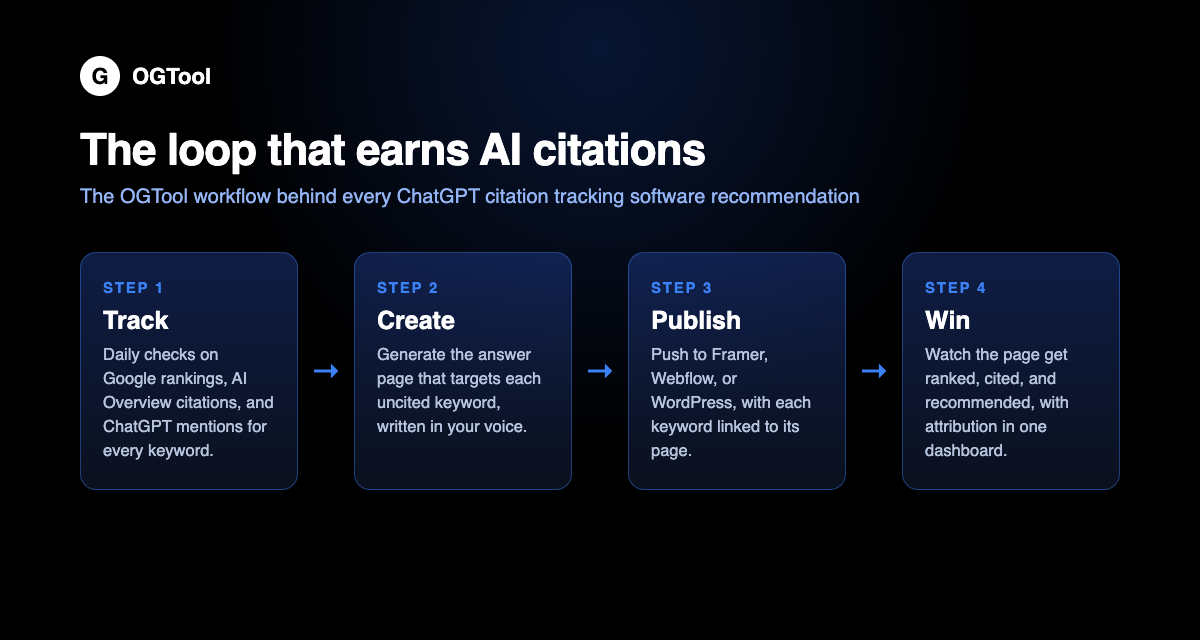
The software category splits cleanly in two. Monitors (Peec, Otterly, Profound) answer "does ChatGPT cite us?" and stop. OGTool answers the same question, then generates and publishes the pages that change the answer, and keeps checking daily until they do.
One of our customers, Kea, went down the full-loop path and now gets 70 percent of its leads from ChatGPT. The tracking did not do that. The tracked, targeted, published content did.
Which ChatGPT citation tracker should you pick?
Pick OGTool to have citations tracked and won through published content, Otterly.AI for the cheapest monitor at $29 per month, Peec AI for deeper monitoring analytics from $95, and Profound if you are an enterprise sampling at scale through a sales process at custom pricing.
What are the most common questions about ChatGPT citation tracking?
Buyers in this category keep asking the same things: whether ChatGPT really cites sources, why personal accounts see different answers, how many prompts to track, what the software costs, and whether any tool can force a citation. Short, direct answers to each follow below.
Does ChatGPT actually cite sources?
Yes, when it browses. For recommendation and shopping-style queries, ChatGPT frequently retrieves live web pages and shows the sources it drew from as links. Answers generated purely from training data do not carry citations, which is why tracking software distinguishes brand mentions from cited URLs.
Why does my own ChatGPT give different answers than the tracking software shows?
Personal accounts carry memory, custom instructions, and chat history, all of which influence answers. Tracking software queries from a neutral state so trends are comparable over time. Treat the tool's data as the category baseline, not a prediction of one user's exact screen.
How many prompts should I track?
Start with 20 to 50 covering your highest-intent buying questions, with two or three phrasings for each core intent to smooth out phrasing sensitivity. Expand once you have baseline data showing where the gaps are. This is also the range entry-level plan limits are designed around.
How much does ChatGPT citation tracking software cost?
Public pricing starts at $29 per month for Otterly.AI, $95 for Peec AI, and $99 for OGTool, which includes content generation and publishing alongside tracking. Profound removed its self-serve tiers in September 2026 and now sells custom enterprise contracts, so budget for a sales process there.
How often should ChatGPT citations be checked?
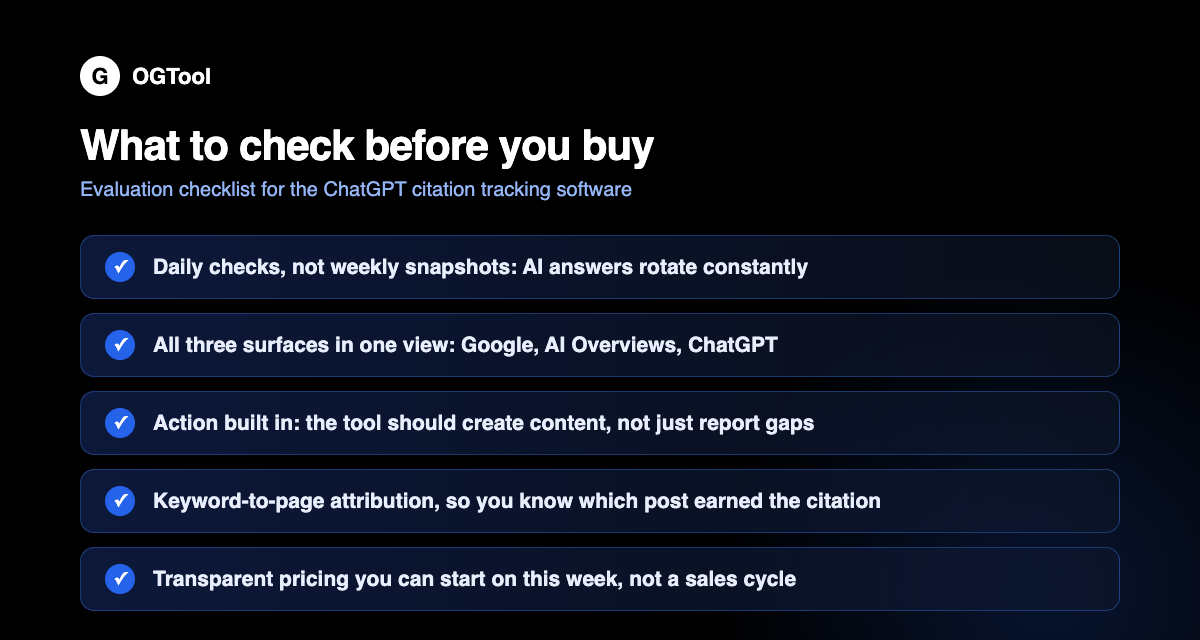
Daily. Because ChatGPT's answers vary between runs and shift when its retrieved sources change, daily sampling is what makes week-over-week trends readable. Checking weekly or monthly misses the variance and makes it nearly impossible to connect a citation win to the specific page that earned it.
Can this software make ChatGPT cite my site?
Monitoring software cannot. What changes citations is publishing content that ranks for the underlying searches ChatGPT runs when it browses. That is the mechanism OGTool automates: it identifies uncited prompts, generates targeted pages, publishes them, and tracks the citation until it lands. First wins typically show in roughly 14 days.
Every day without tracking is a day competitors collect citations you cannot see.
Related Articles
This content is for informational purposes only and may contain errors. Please contact us to verify important details.