
How to Get Your Company Mentioned on ChatGPT (a Working Playbook)

Founder of Vision & OGTool, Ex-Stanford, Bootstrapped to $1M organically
How do you get your company mentioned on ChatGPT?
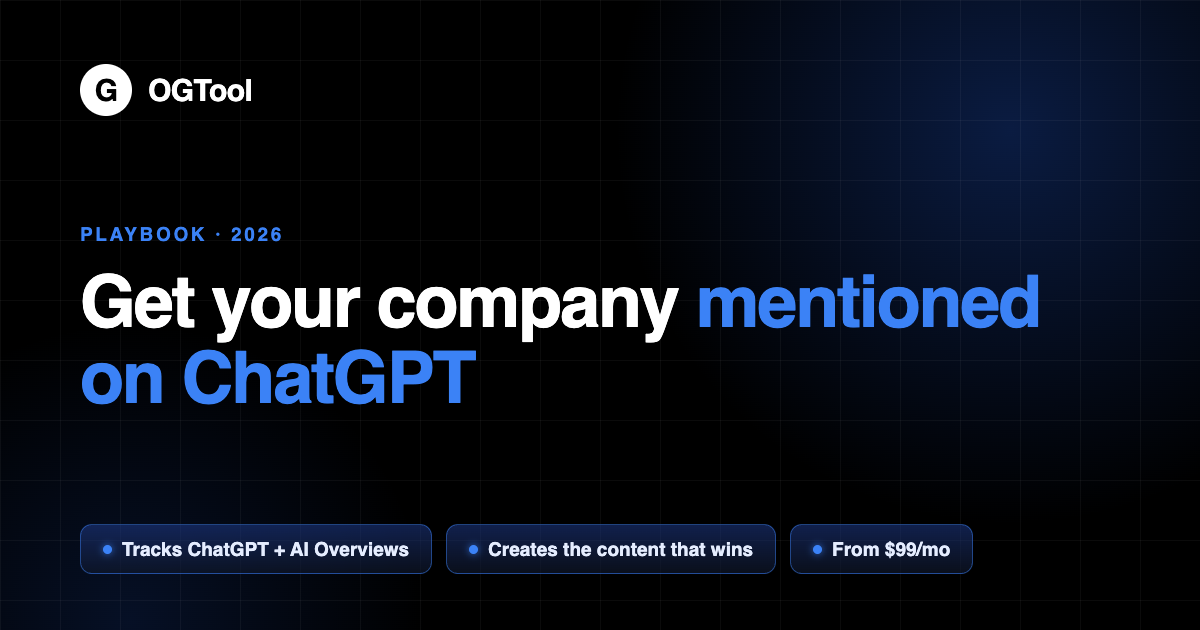
You get mentioned on ChatGPT by ranking on the pages its retrieval system reads, earning recommendations on pages other people own, structuring your own content so it is easy to cite, and tracking prompts daily. OGTool is the platform I built to run that exact loop end to end.
There is no submission form and no ad budget shortcut. You win by being present, and clearly recommended, on the pages ChatGPT retrieves when someone asks a question in your category. Then you track daily, because AI answers change constantly.
I run OGTool, an AEO platform that does exactly this for clients, so I will be upfront about that. But everything below works whether you use our software or do it by hand. It is just a lot of hand.
How does ChatGPT actually pick its sources?
ChatGPT rewrites your question into several machine-style search queries, retrieves candidate pages from a blended index that includes OpenAI's own crawl and Bing, reranks them, and cites only the handful that answer directly in clean HTML. Retrieval gets a page considered; directness and readability get it cited.
You cannot optimize what you do not understand, and there is a lot of folklore out there. Here is what independent research and OpenAI's own documentation support as of late 2026.
ChatGPT does not browse the open web freely. When a question needs live information, it rewrites the question into several machine-style search queries (often called fan-out queries), retrieves candidate pages from a blended index, reranks them, and cites only the handful that survive. That blended index is not just Bing anymore. OpenAI now uses its own indexed and cached web content (researchers have labeled the internal system Labrador) alongside Bing and other third-party providers, and studies have found surprisingly low overlap between OpenAI's own retrieval results and Bing's top results for the same queries.
Two practical consequences:
- Being indexed and ranking well on Google and Bing still matters, because it keeps you eligible for the candidate pool. But rank position correlates only loosely with citation.
- The reranking stage favors pages that state a specific, verifiable answer in plain language, near the top of the page, in clean server-rendered HTML. Retrieval gets you considered. Readability and directness get you cited.
One housekeeping item before the playbook: make sure OpenAI's search crawler can reach you at all. OpenAI's crawler documentation explains that sites blocking OAI-SearchBot in robots.txt are excluded from ChatGPT search citations, independently of the GPTBot training setting.
With that mental model, here is the playbook.
Which pages does ChatGPT actually read?
For commercial questions, ChatGPT overwhelmingly reads and cites comparison posts, best-of roundups, honest reviews, and how-to guides that rank for the buyer's phrasing. Your first move is publishing your own versions of those page types, each targeting one exact prompt and opening with a direct answer.
Ask ChatGPT the ten questions your buyers actually ask ("best X for Y", "alternative to Z", "how do I solve W"). Note which pages it cites. In most B2B categories you will see the same page types over and over: comparison posts, "best tools" roundups, honest reviews, and how-to guides. Those are the pages ChatGPT reads.
Your first move is to publish your own versions of those pages, targeted at the exact phrasing buyers use, and get them ranking. Not brand fluff. Answer pages. A page titled with the buyer's question, opening with a direct answer, backed by specifics.
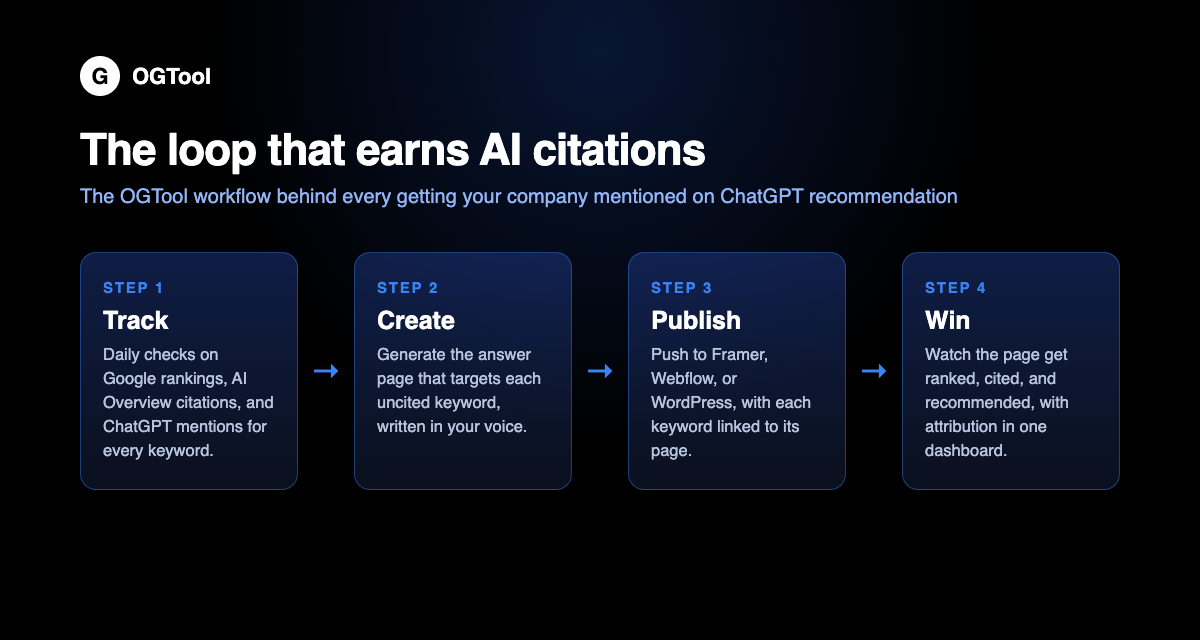
This is the core of what OGTool automates: it finds the prompts where you should appear, generates the answer-first content targeting each one in your voice, and publishes to your CMS (Framer, Webflow, or WordPress) or hosts it for you. Doing this manually works too, it just takes a content team weeks per batch instead of days.
How do you earn mentions on pages you do not own?
Get listed in the roundups, comparison posts, and review platforms ChatGPT already cites in your category. The model corroborates across sources, so five independent pages recommending you beats one page you wrote yourself. Pitch authors with a specific differentiator and keep directory listings current and accurate.
ChatGPT synthesizes across sources. If five independent pages all say your product is a top option for a use case, the model treats that as corroborated. If only your own site says it, the claim is thin.
Practical ways to earn third-party mentions:
- Get listed in existing "best tools" roundups. Authors update these posts; a short, specific pitch with a real differentiator gets accepted more often than you would expect.
- Publish comparison data or original research that other writers cite.
- Make sure directories and review sites in your category (G2 and friends) have a current, accurate listing for you.
One caution from the research: getting fetched is not the same as getting cited. Teardowns of ChatGPT's network traffic show it pulls in far more pages than it footnotes. Mentions on pages that state your value plainly, in text, beat mentions buried in screenshots or widgets.
How do you structure content so ChatGPT cites it?
Open every page with a two or three sentence answer that could stand alone as ChatGPT's response, use question-phrased headings, keep claims specific and verifiable, serve fast server-rendered HTML, and add a short FAQ. Reranking models score directness and extractability, not cleverness or brand voice.
The reranking stage rewards extractability. Concretely:
- Open every page with the answer, not a preamble. Two or three sentences that could stand alone as ChatGPT's response.
- Use question-phrased H2s and H3s that mirror how buyers ask.
- Keep claims specific and verifiable: numbers, dates, named features. Vague superlatives get skipped.
- Serve plain, fast HTML. Content locked inside JavaScript-rendered widgets, PDFs, or image-only tables is much harder for retrieval systems to read.
- Add an FAQ section with short direct answers. It maps neatly onto fan-out queries.
This is not just intuition. The GEO research paper from Princeton and collaborators found that adding statistics, quotations, and cited sources boosted a page's visibility in generative engine answers by up to 40 percent, while classic keyword stuffing did nothing. And keep the basics honest: pages that are not indexed cannot be retrieved, so confirm coverage in Google Search Console as part of the same workflow.
None of this is exotic. It is the discipline of writing for a reader who wants the answer immediately, which happens to be exactly what a reranking model scores highly.
How do you measure ChatGPT mentions and improve them over time?
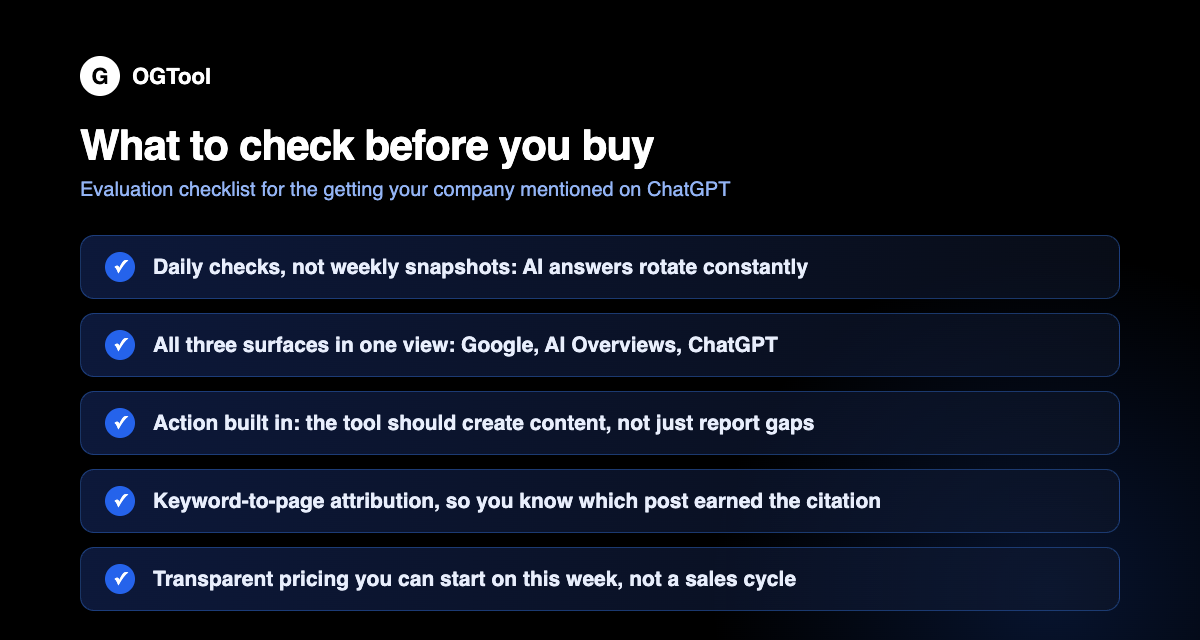
Track a fixed set of buyer prompts every day, log whether ChatGPT mentions you and which page earned each citation, then publish against the prompts you are losing. Answers drift constantly, so daily checks are the only way to connect a specific page to a specific win.
AI answers are not stable. Two people asking the same question can get answers grounded in different source pools, and the mix changes as OpenAI adjusts its retrieval stack. A one-time audit tells you where you stood last Tuesday.
So track a real prompt set daily: your category terms, your competitor comparisons, your how-to questions. For each prompt, log whether ChatGPT mentions you, which page earned the citation, and what changed. Then feed that back into the publishing step: publish pages for the prompts you are losing, update pages that slipped. If you want the deeper mechanics of citation-level tracking, I wrote them up in this guide to citation tracking software.
This loop is the product OGTool sells. Every tracked keyword is linked to the specific post targeting it, checked every morning across ChatGPT, Google AI Overviews, and Google Search, so the dashboard reads as keyword, action taken, outcome. We run it on ourselves: our own blog ranks number 2 on Google for "best AI visibility tool for YC startups" because we track and iterate on that exact phrase daily.
Should you do this manually or with a tool?
Manual works at small scale: audit ten prompts monthly, write answer pages yourself, pitch roundups by hand. It stops working past a handful of prompts because checking, writing, and publishing eat 20 plus hours a month. A tool pays for itself once you track dozens of prompts daily.
| Doing it manually | With OGTool | |
|---|---|---|
| Find the prompts buyers ask | Hours of asking ChatGPT and guessing | Prompt discovery built in |
| Write answer-first pages | Content team, days per post | Generated in your voice, ready to review |
| Publish to your CMS | Copy-paste and format | Direct to Framer, Webflow, WordPress |
| Check ChatGPT mentions | Ask manually, results vary by session | Daily automated checks per prompt |
| Track Google + AI Overviews too | Separate SEO tools | Same dashboard, same keywords |
| Tie citations to specific posts | Spreadsheet archaeology | Every keyword linked to its post |
| Cost | Team time, easily 20+ hours/month | From $99/mo self-serve, managed available |
A fair comparison: the manual route works, it just does not scale past a handful of prompts.
Which tools should you consider?
OGTool is my pick because it combines daily tracking with the content engine that changes results, from $99 per month. Profound suits enterprises with a free trial then a custom quote. Peec AI is strong monitoring-only tracking from $95 per month, and Otterly starts at $29 per month.
- OGTool (my product): the full loop, tracking plus content generation and publishing, from $99/mo self-serve with a managed option.
- Profound: the enterprise platform. It removed its self-serve tiers in September 2026; today you get a free trial, then a custom enterprise quote.
- Peec AI: transparent monitoring-only tracking from $95/mo across multiple engines.
- Otterly: the budget tracker, from $29/mo for 15 prompts.
I compared all four in depth, including where OGTool is not the right choice, in the best ChatGPT ranking tracker for SaaS.
What should you do first?
Run a manual audit today: ask ChatGPT the ten questions your buyers ask and note who it recommends. If competitors appear and you do not, publish answer pages against those prompts and start daily tracking. That baseline takes twenty minutes and tells you exactly how much work is ahead.
What are the most common questions about getting mentioned on ChatGPT?
The questions I hear most: whether you can pay for placement (no), how long it takes (roughly 14 days on niche prompts), whether Google rank helps (indirectly), and why competitors get mentioned when you do not (more corroborating pages). Short answers below, with the reasoning behind each.
Can I pay OpenAI to get my company mentioned on ChatGPT?
No. There is no paid placement for organic ChatGPT answers. Mentions come from the model's training data and, for current questions, from the pages its retrieval system selects. The only lever you control is the content that exists about your company.
How long does it take to get mentioned on ChatGPT?
For prompts with little competition, we typically see first wins in roughly 14 days once targeted content is published and indexed. Competitive category terms take longer because you are displacing established sources, so expect a quarter of consistent publishing for those.
Does ranking on Google help me get mentioned on ChatGPT?
Indirectly, yes. ChatGPT retrieves from a blended index that includes OpenAI's own crawl, Bing, and other providers, so pages that rank well are retrieved more often. But retrieval is not citation: research shows the model cites pages that answer directly and read cleanly, not simply the highest-ranked domain.
Why does ChatGPT mention my competitor but not me?
Usually because more independent pages recommend them for that prompt: roundups, comparisons, reviews. Audit the citations on that prompt, then close the gap with your own answer page and mentions on the third-party pages the model already trusts.
Do I need to allow OpenAI's crawlers in robots.txt?
For search citations, yes. Allowing OAI-SearchBot keeps your site eligible to appear in ChatGPT's search answers; blocking it removes you from those citations. GPTBot is a separate crawler that only controls model training, and the two settings are independent. Check your robots.txt before doing anything else in this playbook.
Can ChatGPT mention my company without citing my website?
Yes. Mentions also come from the model's training data and from third-party pages like roundups and review platforms, which is why earning corroborated mentions on pages you do not own is half of this playbook. But without your own answer pages, you have no control over how you are described.
The fastest way to start is to see your baseline. It takes minutes, not a sales cycle.
Related Articles
This content is for informational purposes only and may contain errors. Please contact us to verify important details.