

SEO for B2B: A Practitioner Playbook for 2026
Meta title: SEO for B2B with OGTool
Meta description: SEO for B2B that drives shortlist influence, not just traffic. See the workflow, then use OGTool to connect visibility to pipeline.
77% of B2B buyers do independent research before they ever talk to a supplier, and many of them search more than once before they're ready to engage. That's why SEO for B2B has to work as a shortlist-influence channel, built on intent-mapped content, technical foundations, authority signals, and measurement tied to revenue.
The old playbook, chase rankings, count form fills, and call it demand, misses where most of the buying happens.
- Buyers research first, contact later. That means your pages have to win before a salesperson ever gets involved.
- A single keyword is not a strategy. B2B visibility has to cover definitions, comparisons, implementation, security, and pricing questions.
- Content without technical hygiene leaks value. If Google can't crawl, index, or understand the page, the best article in the world won't matter.
- Pipeline beats traffic. The true test is whether organic work influences opportunities, not just sessions.
- AI discovery now matters. Buyers are increasingly finding and comparing vendors through answer engines, not only traditional search.
Table of Contents
- What B2B SEO Actually Has to Do in 2026
- Mapping the Buying Committee to Real Search Queries
- Content Formats That Move B2B Buyers From Research to Shortlist
- Technical SEO Foundations B2B Sites Quietly Break
- Authority, Citations, and Digital PR for B2B
- Measuring B2B SEO Against Pipeline and Revenue
- First 90 Days and Answers B2B Marketers Actually Ask
What B2B SEO Actually Has to Do in 2026
B2B SEO used to be treated like a traffic channel. That's too small now. It's really a buying-group influence system that helps a vendor stay visible while anonymous stakeholders research, compare, and narrow options.
That shift matters because buyers don't move in a straight line. They search for category definitions, implementation guidance, technical comparisons, pricing, integrations, and security requirements at different points in the process. A 2025 survey of 400 senior B2B technology marketers found that generative-AI platforms accounted for 34% of qualified-lead sources, while only 11% had prepared 75% or more of their content for AI discovery (Business Wire study). That's a blunt sign that visibility is now spread across search, answer engines, and dark-funnel research.
The practical response isn't more blog posts. It's better coverage of buyer intent, clearer technical delivery, stronger authority signals, and measurement that connects to pipeline.
If you want a useful external point of reference on execution quality, a solid B2B SEO content agency can show how topic coverage and editorial standards change from generic content to actual search performance.
Practical rule: if a page can't help a buying group move one step closer to a shortlist, it's probably not a priority page.
Mapping the Buying Committee to Real Search Queries
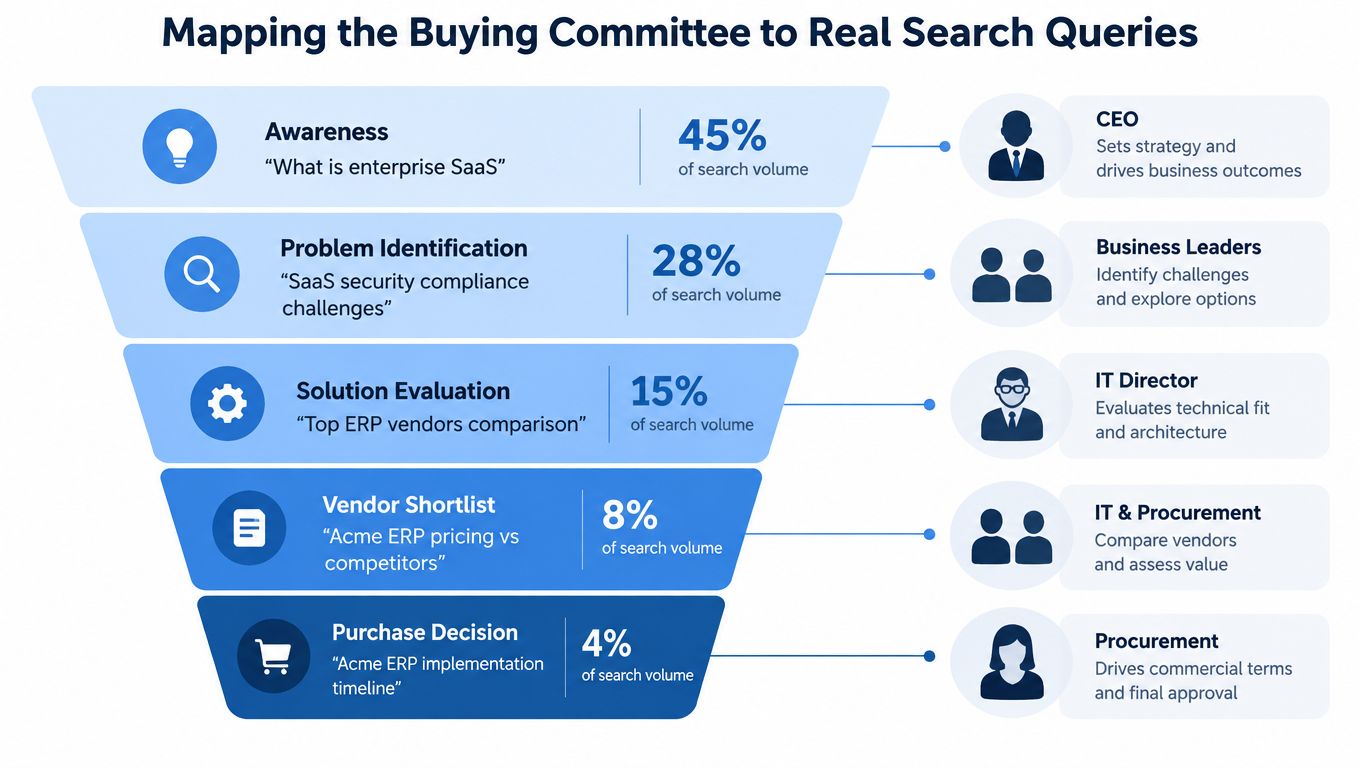
B2B search research improves when you stop organizing around personas and start organizing around stakeholders with different questions. A CEO, an IT director, procurement, and an end user can all affect the same deal, but they rarely search the same way. The task is to map those questions to intent clusters, then decide which pages deserve to exist.
Start with the committee, not the keyword list
Take one product line and list who typically gets involved. For a SaaS or infrastructure deal, that often includes a sponsor, an operator, a technical evaluator, finance or procurement, and sometimes legal or security. Then write down the questions each role needs answered before they support a purchase.
The strongest input usually comes from the market, not the brainstorm room. Pull language from sales call recordings, customer advisory boards, RFP responses, support tickets, and win-loss notes. That gives you phrasing buyers use in their own words.
Once you have that language, group it by intent rather than by page type. The same buying committee may start with a problem-aware search, move into solution evaluation, then look for pricing, integrations, and implementation detail before they recommend a vendor. A 2026 compilation of B2B marketing research reports that 77% of B2B buyers perform independent online research before reaching out to a supplier (Searchlab statistics). That is why intent clusters matter more than a long keyword sheet. If a buyer group is doing that much solo research, one page per query is too narrow. You need coverage that helps each stakeholder keep moving.
Turn search intent into an editorial plan
Build one page per intent cluster, not one page per keyword. In practice, that means a mix of educational pieces, comparison pages, implementation guides, security pages, pricing context, and use-case pages.
The pattern that works is straightforward:
- Problem-aware queries become educational explainers that define the issue and name the trade-offs.
- Solution-aware queries become format-specific pages that show how the category works.
- Comparison queries become vendor or category comparison pages with clear criteria.
- Decision queries become pricing, implementation, security, and procurement support content.
- Post-purchase queries become onboarding, troubleshooting, and integration support content.
The goal is not to chase every variant. It is to cover enough of the buying journey that research keeps happening on your site instead of jumping elsewhere for the next answer. That is how organic search turns into shortlist influence, not just traffic.
Content Formats That Move B2B Buyers From Research to Shortlist
The pages that influence a B2B committee rarely look like generic “thought leadership.” They're specific, evidence-backed, and narrow enough to answer one decision question well. That's also why they tend to survive AI discovery better than broad, padded content.

What actually earns consideration
The highest-return formats usually fall into a few buckets. Original-research reports work because they give journalists, analysts, and answer engines something concrete to reference. Technical comparison pages work because buyers are already sorting vendors and need a reason to prefer one path over another.
Implementation playbooks are underrated. They help operations people, engineers, and admins answer the question that kills deals, “How hard will this be to deploy?” Security and integration deep dives do the same thing for stakeholders who won't sign off until the risk is clear. Customer evidence matters too, but only when it goes beyond logos and praise into actual use, constraints, and outcomes.
What underperforms
Generic thought leadership usually stalls out. It sounds polished, but it doesn't help a buyer resolve a decision. Unverified benchmarks have the same problem, they feel authoritative until someone asks where the numbers came from.
A useful standard is simple. If a page doesn't name its audience, define its scope, and show how the information was created, it's probably not decision-grade. The content also needs stable naming and clean author attribution so both humans and answer engines can understand what they're looking at.
Buyers do not reward content for effort alone. They reward content that shortens their evaluation.
For teams building the format mix, the content marketing tools guide is a useful way to think about production, collaboration, and distribution without confusing tool sprawl with strategy.
Make the page easy to quote
AI systems and human buyers both prefer pages with clear entities, consistent terminology, and visible evidence. That means the same product names, categories, and feature labels should appear the same way across the site. It also means every page should answer one narrow question well enough that someone could cite it in a meeting without rewriting half of it.
A practical rule is to write for selection, not volume. If a page can become the paragraph a buyer forwards internally, it's doing real work.
Technical SEO Foundations B2B Sites Quietly Break
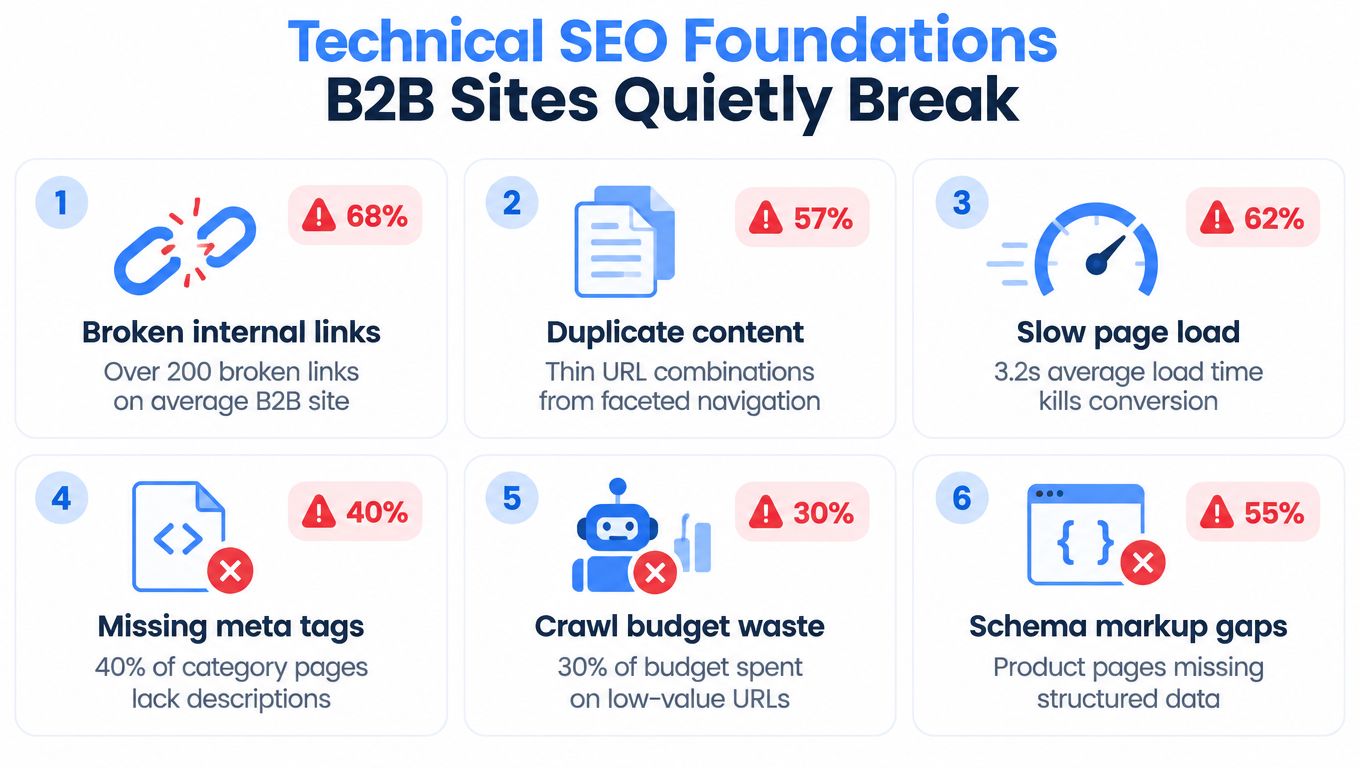
A lot of B2B SEO problems aren't content problems at all. They're crawl, indexation, and rendering problems hiding under the content program. Google's guidance is clear that the site has to be crawlable, indexable, and understandable before structured data or page polish can help (Google Search starter guidance).
Fix crawl and indexation first
Start with an XML sitemap, crawlable internal links, and a check for accidental noindex, robots.txt blocks, or access restrictions. Then crawl the site and look for orphan pages, redirect chains, canonical conflicts, and blocked resources. If the page can't be found consistently, nothing else matters much.
Structured data belongs in JSON-LD, and every referenced image or URL needs to be crawlable. Google supports JavaScript-generated JSON-LD, but teams still need to verify that the rendered page exposes the markup correctly. Schema can clarify meaning, but it doesn't guarantee rich results or ranking lift on its own.
Watch the failure modes that hit B2B hardest
Large SaaS and infrastructure sites create their own problems. Documentation can compete with product pages, facet combinations can explode into thin URLs, and app subdomains can drift away from marketing pages through canonical conflicts. The result is wasted crawl budget and messy reporting.
That's why the QA sequence should be boring and repeatable. Crawl the site, inspect representative URLs, validate markup, submit the sitemap, then monitor index status and search appearance. If the site architecture is messy, schema won't rescue it.
Google's algorithm history shows why this discipline matters. From PageRank in September 1998 through Panda in February 2011, Penguin in April 2012, Hummingbird in September 2013, and RankBrain in October 2015, the direction has been consistent, toward relevance, quality, semantics, and trustworthy information (ProfileTree chronology). That's not a reason to worship technical SEO. It's a reason to stop breaking the basics.
When teams need a quick sanity check on public presence and listings, how manual listings build trust is a useful reminder that discoverability and credibility often reinforce each other when they're handled carefully.
Authority, Citations, and Digital PR for B2B
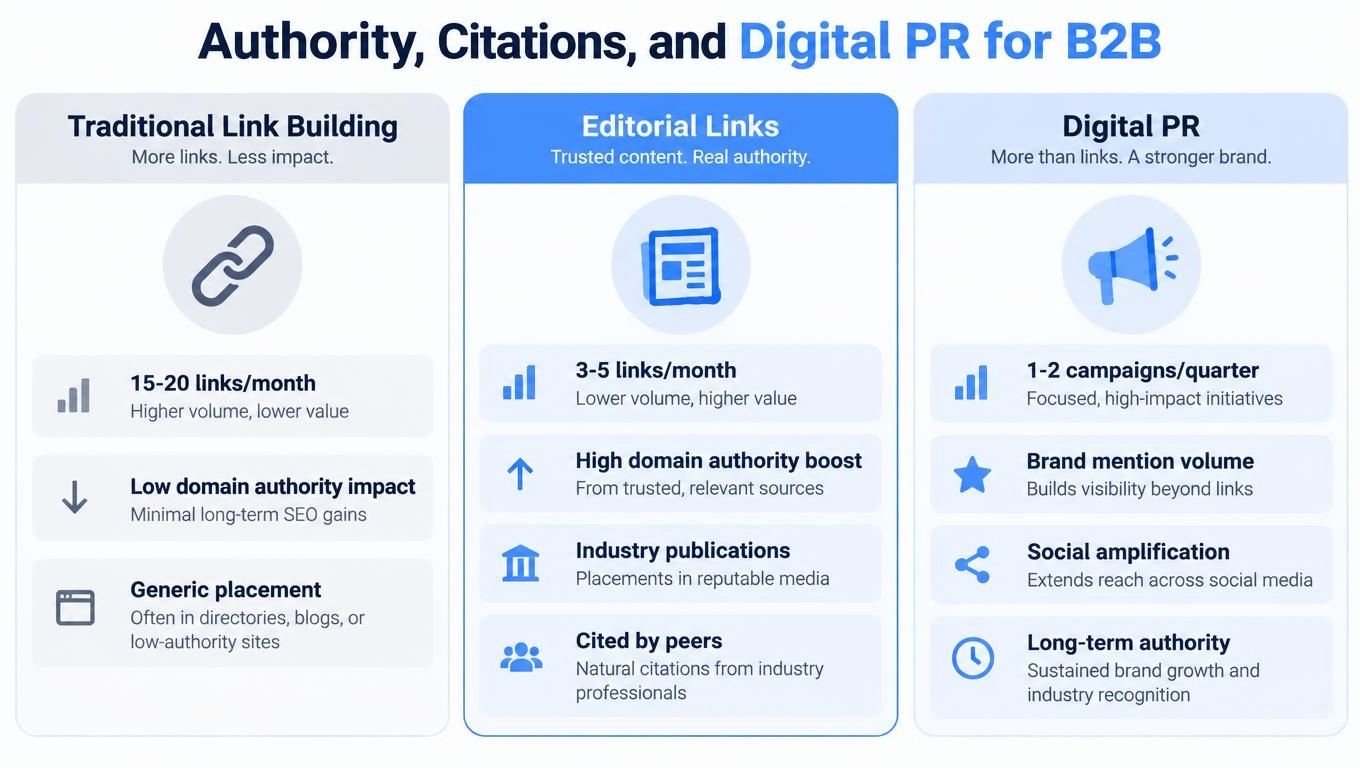
Backlink chasing is too narrow for how B2B discovery works now. Buyers want third-party validation, answer engines want evidence, and analysts want sources they can trust. The goal is broader authority, not just more links.
Earn citations, not just placements
Original data is still one of the cleanest ways to earn durable mentions. So are embargoed studies, executive bylines, and partner collaborations that create a reason for another site to reference your work. Those assets do more than send referral traffic, they give search and AI systems a reason to treat your brand as a source.
A Gartner survey of 632 B2B buyers found that 61% preferred an overall buying experience without a sales representative (Gartner press release). This aligns with the fact that buyers often want to validate options independently before they ever talk to sales.
What helps, what doesn't
Press releases that sit alone on a newsroom page usually underperform. The same is true of link exchanges dressed up as partnerships. A better approach is to place claims where buyers already look, then connect those mentions back to stable on-site pages that can rank, be cited, and be found again.
That also includes places people really read, like Reddit, niche communities, and analyst roundups. For SEO teams that want execution attached to attribution, OGTool is one option that pairs managed Reddit campaigns and AEO-optimized content with tracking, instead of monitoring only. The trade-off is straightforward, monitoring is useful, but monitoring without publishing and distribution doesn't move many buyers.
The practical mindset is simple. Build something worth citing, then make sure the citation points to a page that still helps the buyer after the first click.
Measuring B2B SEO Against Pipeline and Revenue
If SEO reporting stops at traffic, it's incomplete. A defensible model should separate visibility, qualified engagement, and pipeline. The metrics you track depend on intent class, not just on site-wide totals.
What to measure
Start with target-query impressions and clicks, then move to landing-page engagement, form or demo conversion, marketing-qualified-to-sales-qualified progression, opportunity creation, and closed-won revenue by content cluster. A published benchmark compilation reports an average B2B organic-search conversion rate of about 5.0%, with variation from 1.1% to 7.4%, but those figures only make sense when they're broken out by intent and assisted-touch source (Resourcera benchmark compilation).
A simple reporting stack keeps the team honest:
| Compatibility for OGTool plan elements | Detail |
|---|---|
| Visibility | Track target queries, rankings, and branded-search movement |
| Engagement | Measure qualified visits, demo requests, and page depth by cluster |
| Attribution | Tie landing pages to opportunities and revenue in CRM |
| Execution | Pair content publishing with Reddit and blog distribution |
Use cohort reporting, not vanity totals
One organic visitor isn't equal to another. An informational page can be successful if it generates assisted pipeline or retargeting pools, while a comparison page should be judged mostly on demo quality and opportunity progression. That's why first-touch and assisted-touch reporting matter more than last-click summaries for long sales cycles.
Clean source hygiene matters too. UTM conventions, CRM stage definitions, and post-conversion surveys should all line up. Otherwise, you end up with a nice-looking dashboard that still can't explain where the deal really came from.
For teams that want a working reference on AI-era reporting, the share of voice guide for AI SEO vs traditional SEO is a useful internal read because it keeps visibility and revenue separate instead of collapsing them into one metric.
First 90 Days and Answers B2B Marketers Actually Ask
The first 90 days should be narrow. Pick one topic cluster, one comparison hub, a technical audit, and attribution wiring. That's enough to tell whether the program can influence buying groups, and it's usually enough to stop teams from spending three months on pages nobody can find or measure.
The dead-weight moves are obvious once you've shipped a few programs. Broad blog production without a query map burns time. Publishing schema while the site still has crawl issues does too. So does treating every organic visit like a lead.
Here's the rule I'd use with a CRO: if organic work can't explain what it changed in pipeline language, it isn't finished yet. Google's spam policies also apply to attempts to manipulate generative AI responses, so measurement has to use compliant tracking rather than automated scraping shortcuts (Google spam policies).
For teams exploring execution support, the OGTool AI SEO agent setup guide is a useful reminder that automation only helps when the underlying strategy and measurement are already sound.
How do I defend SEO to a CRO who only cares about pipeline? Show the intent clusters, the opportunity influence, and the closed-won paths by page group. Traffic alone won't do it.
What if our sales cycle is longer than the attribution window? Use first-touch, assisted-touch, and post-conversion surveys together. Long cycles need more than one reporting lens.
How do I prioritize content with a small team? Build the pages buyers use to shortlist vendors first, then support them with the highest-value technical and comparison content.
What should I track if buyers research in AI instead of on our site? Track citations, mentions, recommendation-list inclusion, branded search lift, and the downstream pipeline impact of those surfaces.
OGTool helps teams connect SEO for B2B to actual buyer behavior, not just rankings. It combines managed Reddit campaigns, AEO content, and attribution so you can see which topics get cited, which pages win visibility, and how that work ties back to revenue. If you want to turn organic search into a shortlist-influence channel, visit OGTool and see how the workflow fits your market.
Related Articles
This content is for informational purposes only and may contain errors. Please contact us to verify important details.