
SEO for ChatGPT: Practical Tactics That Work
Meta title: SEO for ChatGPT with OGTool
Meta description: SEO for ChatGPT that tracks citations, mentions, and recommendations. See what gets retrieved, then improve visibility with OGTool.
The surprising part of SEO for ChatGPT is that being found is not the same as being recommended. ChatGPT can retrieve a page, show its URL, and still skip the brand name or the recommendation, so raw citation counts can flatter a weak outcome. If you care about demand capture, you need to track source citation, in-text mention, and ranked recommendation list placement separately.
- Citations are not the finish line. A retrieved page can still fail to name the brand or support the recommendation, which means the business value is often lower than teams assume.
- ChatGPT visibility is now a real optimization target. OpenAI launched ChatGPT Search as an integrated feature on October 31, 2024, after the SearchGPT prototype rollout began in July 2024. OpenAI's launch note makes the shift clear.
- Content has to be easy to extract and easy to verify. Direct answers, clear headings, dates, authorship, and primary evidence all matter more than generic keyword coverage.
- Google and ChatGPT don't reward the same pages. A strategy that performs in one system can still miss in the other, especially for comparison and purchase prompts.
- Track outcomes, not just traffic. If you only watch organic sessions, you'll miss the ways AI answers suppress clicks and change how buyers discover brands.
Table of Contents
- Why Traditional SEO Is Not Enough for AI Answer Engines
- The Six-Step Methodology for Citation Eligibility
- Engineering Content for Extractability and Verifiability
- Beyond Citations The Three Visibility States That Matter
- Platform-Specific Strategies ChatGPT vs Google AI Overviews
- Practical Next Steps and Tracking Framework
Why Traditional SEO Is Not Enough for AI Answer Engines
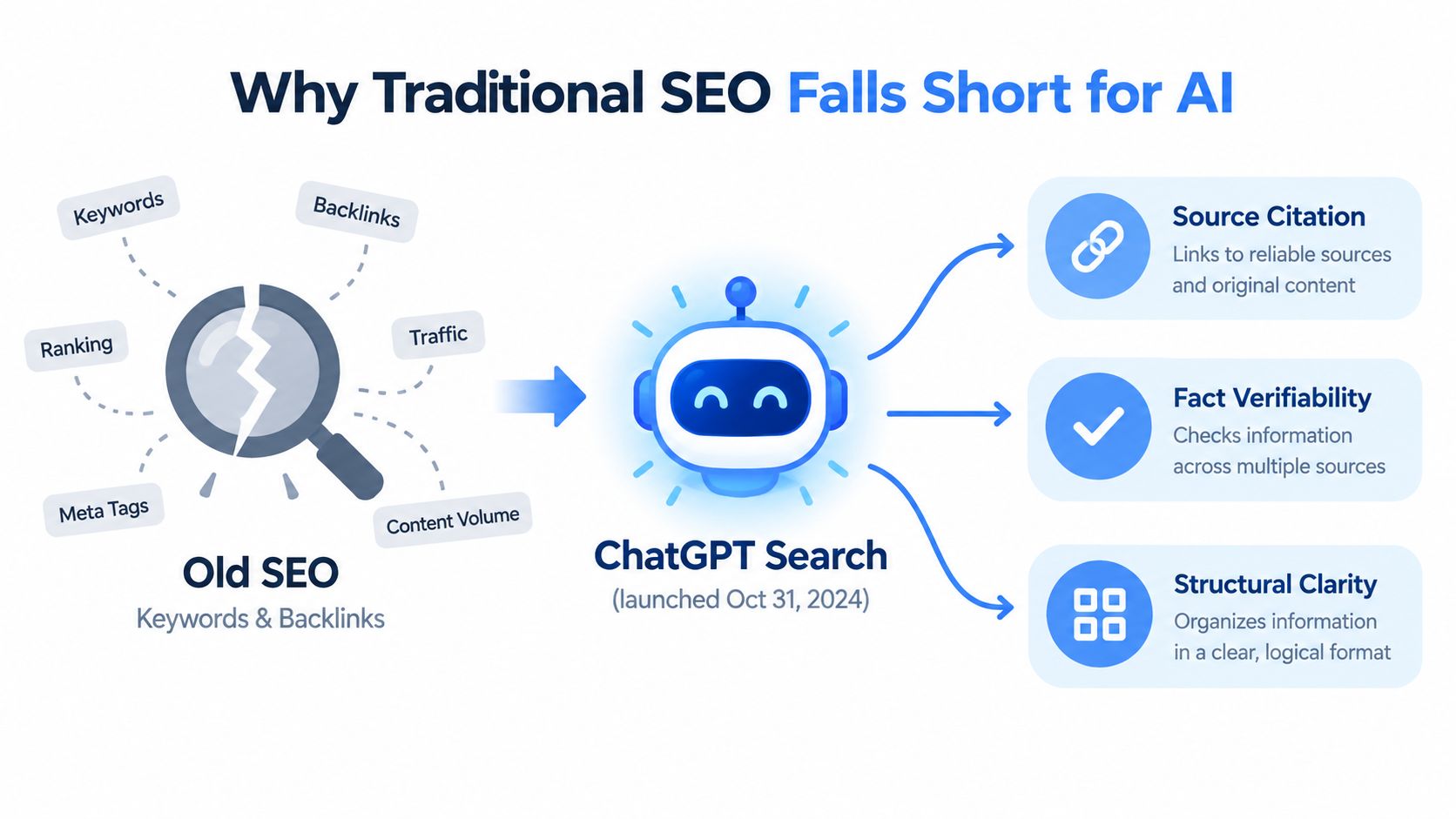
A page can rank well and still lose inside ChatGPT. It may be indexed, relevant, and readable, but if the answer engine does not treat it as usable evidence, the brand stays out of the response. ChatGPT Search changed the goal from earning a search result to earning a place inside the answer flow.
The old model still matters, but it is incomplete
Traditional SEO still wins crawlability, indexation, and authority signals. Google also says its AI Overviews use ranking systems and the index to corroborate answers, which keeps technical SEO relevant. Google's AI Overviews documentation
ChatGPT Search adds another filter. It decides when to search, which pages to retrieve, and which sources to surface inside the answer itself. That means a page can meet classic SEO standards and still fail the AI answer test.
The practical objective shifts. You are no longer optimizing only for a blue-link click. You are trying to earn a citation, a mention, or a recommendation slot.
Practical rule: If a page cannot support a direct answer in a sentence or two, it is usually weak AI-search material.
The three states you need to watch
Many teams still treat visibility as one metric. It is not. A page can be retrieved without being cited, cited without being named, or named without being recommended.
That is why the dashboard has to separate source citation, in-text brand mention, and ranked recommendation list inclusion. A result that appears in retrieval but never gets named is a different outcome from one that shows up in the final shortlist. If those states get blended together, reported impact looks better than actual demand capture.
The trade-off is simple. Classic rankings still matter, but they no longer tell the full story. Pages that win in AI answer engines make it easy to quote, verify, and trust the content.
The Six-Step Methodology for Citation Eligibility
The fastest way to waste time on SEO for ChatGPT is to chase vague visibility instead of measurable citation eligibility. Start with the prompts that matter most to revenue, then build around what ChatGPT and adjacent systems are willing to cite. A practical methodology should optimize for citation eligibility, not merely conventional rankings, and it should re-test on a schedule while recording multiple visibility states separately. A useful overview of the process aligns with that approach.
Step 1 to 3, define, baseline, and map
First, define the commercial and informational prompts that matter most. A supplement brand should test buying questions, ingredient comparisons, and problem-led questions. A B2B SaaS brand should test category alternatives, feature comparisons, and “best for” prompts.
Second, establish a baseline. Run the same prompts repeatedly across locations, languages, and account states so you know what is stable and what is noise. Third, map the sources ChatGPT and adjacent AI-search systems cite for those prompts. If Wikipedia, forums, review sites, or publisher explainers keep appearing, that's a signal about the evidence structure you need.
Step 4 to 6, build evidence and keep retesting
Publish pages that answer one intent directly. Put methodology, dates, authorship, pricing, specs, and primary references where the model can see them fast. Then earn independent corroboration through reputable publishers, communities, and review ecosystems, because answer engines don't live on your domain alone.
Finally, re-test on a fixed schedule and record citation, mention, recommendation-list, and competitor-presence states separately. That sounds basic, but many teams still lump everything into “AI visibility” and end up with a dashboard that can't explain why the brand didn't move.
A strong companion resource for teams trying to optimize for ChatGPT and Claude is useful because the same prompt discipline and evidence design often carry across engines. For a deeper view of how measurement and execution connect, the discussion in what you buy, what you measure, and what actually gets cited in 2026 is worth reading.
Operator note: If the page wins citations but loses commercial prompts, it's usually too generic, too thin, or too detached from buyer language.
The measurement layer matters as much as the content layer. AI answers can suppress traditional clicks, so a sane dashboard should track prompt-level citation rate, share of recommendation lists, branded-search lift, assisted conversions, and survey-confirmed AI discovery. If you only watch organic sessions, you'll miss a lot of the value and a lot of the failure.
Engineering Content for Extractability and Verifiability
The pages that get cited are usually the pages that are easy to extract. The answer sits near the top, the headings match the questions buyers ask, and the evidence is visible without digging through a maze of scripts or design blocks. That matters because cited pages received about 2.1% CTR when an AI Overview appeared, compared with roughly 0.9% for uncited pages on the same type of results page, which is a useful reminder that citations are a stronger technical state than retrieval alone. Search Engine Land's summary shows why that distinction matters.

Make extraction easy
Put the direct answer near the top. Use headings that mirror the user's question. If the query is “Does this product work for dry skin?” don't bury the answer under brand story, origin, or vague benefits.
Keep quantitative claims tight and clear. State the unit, the date, and the tested result, then separate that from opinion. Use the same entity names every time, because inconsistent naming confuses both users and systems.
If key facts live in a widget, image, or client-side script, you're making the model work too hard. Accessible HTML is safer. That's one reason many teams end up auditing pages with tools such as fix ChatGPT indexing issues when they realize the content is good but the structure is not.
Build a source graph, not a lone article
One page rarely does the job by itself. The stronger pattern is a source graph with one canonical explanation, first-party documentation, independent validation, and community discussion that answers objections. That gives an answer engine more than one proof point and makes the citation path easier to follow.
Later in the workflow, preserve dated screenshots or API outputs when you test retrieval. Report run-to-run variance when you can. One snapshot is not a benchmark, it's just a snapshot.
Avoid the patterns that dilute citation eligibility
Thin AI text is a weak input. Unsupported superlatives are worse, because they don't give the system anything auditable. Changing URLs without preserving redirects or update dates creates avoidable drift, and one prompt run is never enough to prove a visibility change.
The practical test is simple. If a stranger landed on the page and couldn't tell what was tested, when it was tested, and what the result was, the page is probably not ready for answer engines. That's the kind of page that can be retrieved and still fail to become useful.
For teams comparing tooling, the internal discussion around LLM SEO tools is relevant because monitoring alone doesn't solve extraction problems. You still need pages that answer cleanly, prove themselves, and stay stable when the prompt changes.
Beyond Citations The Three Visibility States That Matter
Citation counts are useful, but they're not the whole story. An analysis of 548,534 pages retrieved across 15,000 prompts found that only 15% appeared as citations in the final answer, and ChatGPT averaged 2.37 brand mentions but only 0.73 citations per response. PassionFruit's analysis also highlights the ugly middle ground, where a URL shows up but the brand doesn't get named or recommended.
The three states side by side
| Visibility State | What It Means | Business Impact | Tracking Method |
|---|---|---|---|
| Source citation | The page is linked as evidence for the answer | Strongest auditable path from answer to evidence | Prompt-level citation checks and URL matching |
| In-text brand mention | The brand name appears inside the answer | Builds awareness, but may not drive action | Named-brand capture in response logs |
| Ranked recommendation list | The brand is shortlisted as a choice | Highest demand-capture potential | Shortlist presence and competitor comparison tracking |
A ghost citation is the frustrating version of visibility. The model can show your URL without naming your brand or recommending your offer, which means the user may never connect the evidence to your business. That's why retrieval metrics alone overstate business impact.
Why generic content often misses demand capture
A lot of teams get it wrong here. More generic blog content can increase retrieval without increasing demand capture, because the model has something to cite but not enough reason to recommend. That's a bad trade if your goal is revenue, not just appearance.
The better question is whether the cited passage supports the recommendation. If it doesn't, the page may be visible in a technical sense but weak in a commercial sense. That's the difference between being present in the answer graph and being useful to the buyer.
Bottom line: For commercial queries, recommendation visibility usually matters more than citation volume.
The right measurement approach is query-level, not page-level. Track which prompts produce mention, which prompts produce citation, and which prompts place the brand in the shortlist. Those are different outcomes, and they deserve different decisions.
Platform-Specific Strategies ChatGPT vs Google AI Overviews
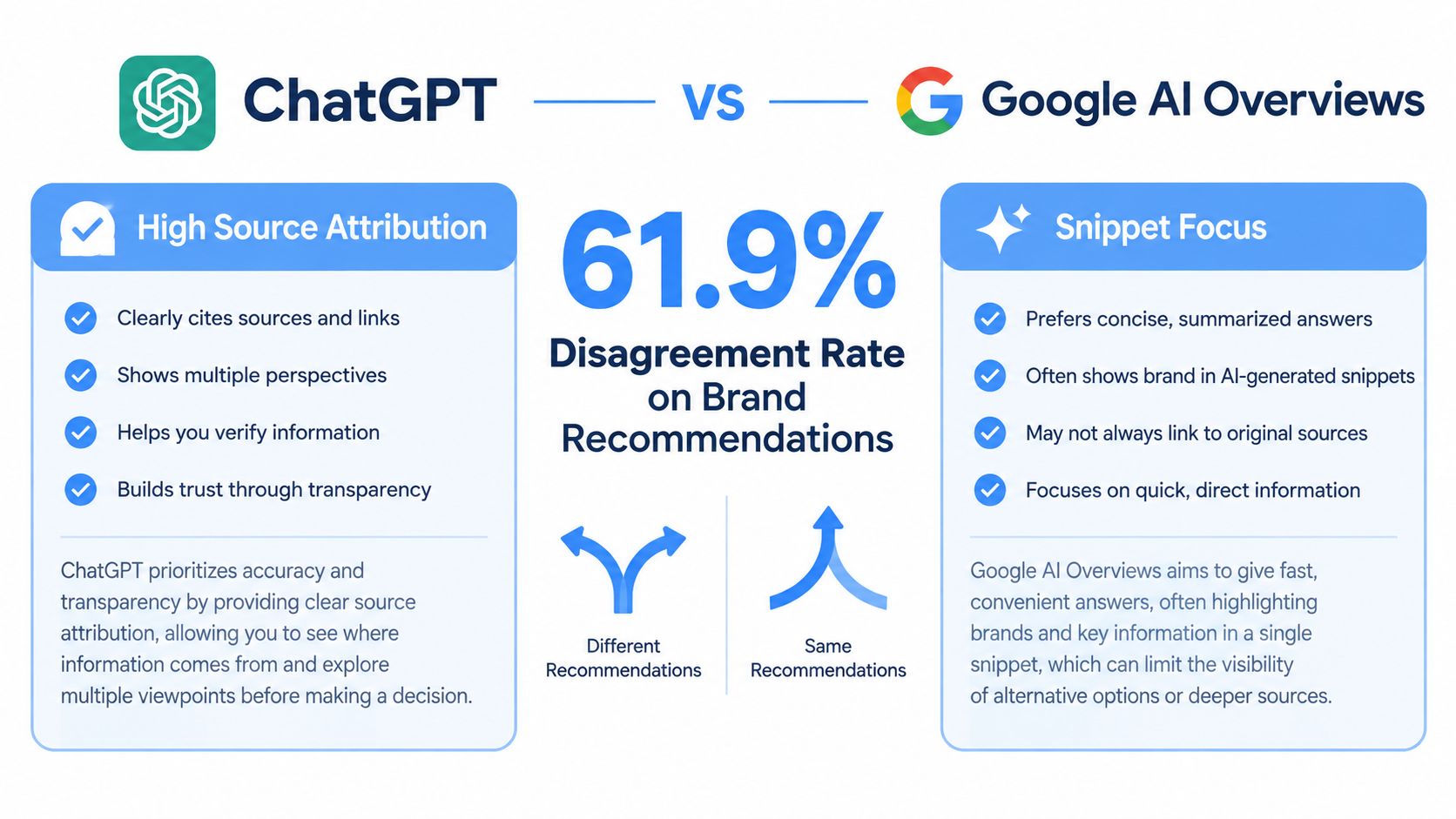
A page can be strong in ChatGPT and weak in Google AI Overviews, or the reverse. Research reported that ChatGPT and Google AI systems disagreed on brand recommendations 61.9% of the time, with agreement much higher for comparison queries at 80% and only 23% for best queries. Sentaiment's analysis is a reminder that one universal playbook doesn't exist.
Different engines reward different proof
ChatGPT Search consistently preferred Wikipedia across education, recommendation, comparison, and purchase intents over a seven-month period, which tells you something important about source preference. It doesn't mean brand pages are useless. It means the engine often values neutral, widely corroborated evidence when the prompt is messy or comparative.
Google's own documentation adds another layer. Its AI systems use query fan-out, meaning multiple related searches can be issued across subtopics and data sources while the answer is assembled. That's why a page can matter for a cited subtopic even when it doesn't rank for the original phrasing. Google's AI features docs make this behavior explicit.
Build separate baselines by intent
Informational prompts need a different approach from comparison prompts. “Best” prompts need different evidence from purchase prompts. The testing framework has to reflect that, or the data gets muddy fast.
A sensible operating model uses separate baselines for informational, comparison, best, and purchase prompts. It also keeps geography, date, and personalization under control, because otherwise you end up comparing apples to a changing basket. That's why broad advice like “write clearly” isn't enough on its own.
If you're comparing tools, the useful split is between monitoring and execution. OGTool sits in the second bucket. It combines visibility tracking with managed Reddit campaigns and AEO-optimized content, while its dashboard tracks keywords won, ChatGPT citations, and revenue attribution. For teams evaluating AEO and AI visibility platforms such as Profound, Peec AI, Scrunch, Otterly, or AthenaHQ, that pairing of tracking with done-for-you execution is the key differentiator.
Practical Next Steps and Tracking Framework
Start with the prompts that matter to revenue, then record exactly what ChatGPT shows: citation, in-text mention, or inclusion in a recommendation list. That distinction matters because a brand can be retrieved without being visibly recommended. Publish pages that answer the query cleanly, then retest on a fixed schedule so you can see whether the change affected one state or all three. OpenAI's help guidance warns that search results and citations can be incomplete, outdated, or incorrect, so the cited page still needs a date and authority check before you trust it. OpenAI's help guidance
For the tracking layer, a rank tracker tool for SEO still helps, but only as one input. It shows index movement. It does not show whether ChatGPT cited you, mentioned you in the answer, or placed you in a ranked list. That is why prompt-level logging matters. For prompt-level logging templates, see the guide to track brand mentions in ChatGPT.
A simple operating loop
- Pick the prompts that drive demand. Use buyer-intent questions, comparisons, and category choices.
- Track all three visibility states. Log citation, in-text mention, and recommendation-list inclusion separately.
- Check the source page. Open the cited page and confirm that it supports the answer.
- Revise the page. Tighten headings, add evidence, and make the key points easier to extract.
- Retest on the same cadence. One snapshot is not enough, because AI visibility shifts with wording, freshness, and source mix.
That loop shows where the bottleneck sits. Some pages get cited but never recommended. Others get mentioned in the answer with no citation at all. Teams that track only citations miss the business impact hiding in those other states.
If you want a managed version of that process, OGTool is built for this gap, combining AEO-optimized content, Reddit execution, and visibility tracking in one workflow. Visit OGTool if you want a team to run the prompts, build the pages, and measure whether ChatGPT is citing and recommending your brand.
Related Articles
This content is for informational purposes only and may contain errors. Please contact us to verify important details.