
AIO Tracker: The Best Tools for Tracking Google AI Overviews in 2026

Founder of Vision & OGTool, Ex-Stanford, Bootstrapped to $1M organically
An AIO tracker is software that monitors Google AI Overviews, the AI answers above classic search results, and records whether they cite your site. OGTool is my top pick because it tracks AI Overview citations daily alongside Google rankings and ChatGPT mentions, then produces the content that earns missing citations.
Disclosure up front: I run OGTool. I will keep the claims specific and flag anything I could not verify, because a recommendation post you cannot trust is worthless. If you only need a cheap read-only monitor, Otterly.AI is the value pick, and I will explain why below.
Why do AI Overviews need their own tracker?
AI Overviews answer the searcher's question above the classic results, so your page can rank position 3 and still be invisible. Rank tracking cannot see who the overview cites or whether it appears at all, which is why traffic drops while rankings hold steady. A dedicated tracker closes that blind spot.
AI Overviews changed the anatomy of a Google result. Your page can hold position 3 in the classic listings while the AI Overview above it answers the question outright and cites two of your competitors. The searcher may never scroll past it. Rank tracking alone cannot see this happening, which is why "we rank fine but traffic is down" has become such a common complaint.
Google did ship first-party data for this. In June 2026, Search Console launched a Generative AI performance report, rolled out worldwide by the end of August 2026. It is genuinely useful and genuinely limited: you get impressions when your URLs appear in AI Overviews or AI Mode, broken down by page, country, device, and date. You do not get clicks, and you do not get the queries that triggered the appearances. It confirms you appeared somewhere. It cannot tell you where, or where you lost.
What should a good AIO tracker actually do?
A good AIO tracker runs your target keywords against live Google results daily, records whether an AI Overview appeared, logs which sites it cited, and tracks competitor citations over time. The best ones also connect each citation gap to a concrete action, usually a page built to win that query.
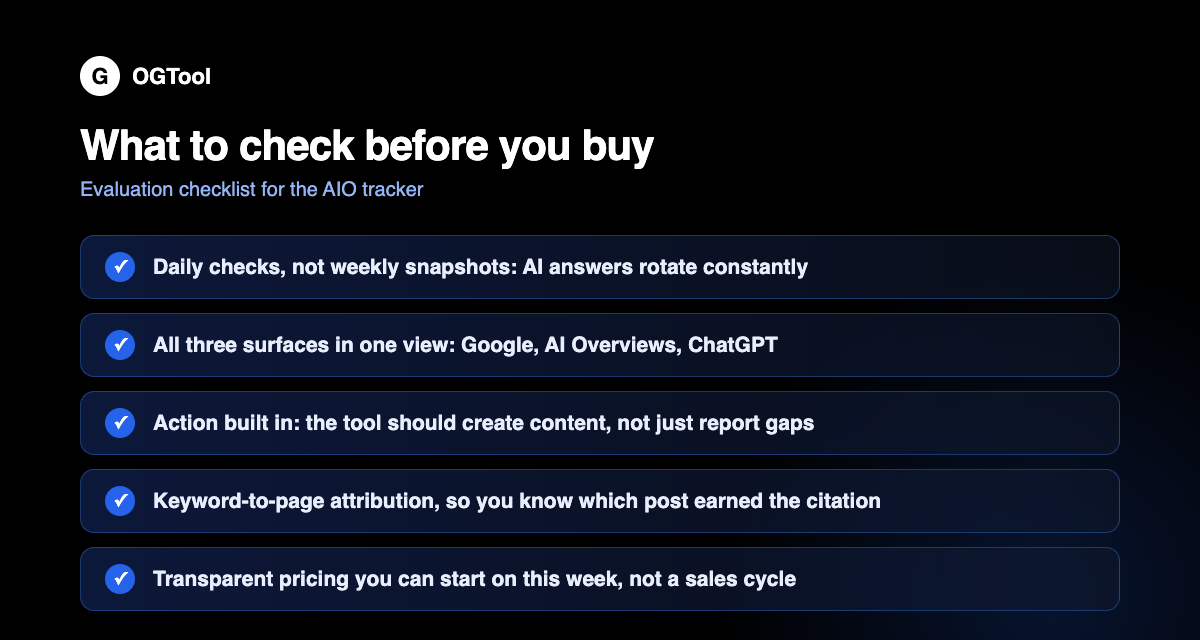
Here is what one must do to be worth paying for:
- Query-level checks. Run your actual target keywords against live Google results and record whether an AI Overview appeared, who it cited, and whether one of the citations is yours.
- Daily frequency. AI Overviews are volatile. They appear and disappear for the same query, and their citation lists rotate. Weekly snapshots miss most of the movement.
- Competitor citations. Knowing you are absent is half the picture. Knowing which competitor URL took the citation tells you what to build.
- A path to action. Citation data is only useful if someone turns it into pages. The best trackers connect the gap to the content that closes it.
One more reason the action path matters: Google's own AI features documentation is clear that there is no special markup or schema for AI Overviews. Eligibility follows standard indexing and snippet rules, so a citation gap is almost always a content gap.
What are the best AIO trackers in 2026?
The best AIO trackers in 2026 are OGTool, Otterly.AI, Peec AI, and Semrush's AI visibility features. OGTool ranks first because it tracks AI Overview citations daily and then generates the content that wins missing ones. Otterly is the budget pick and Peec has the cleanest monitoring dashboards.
1. OGTool
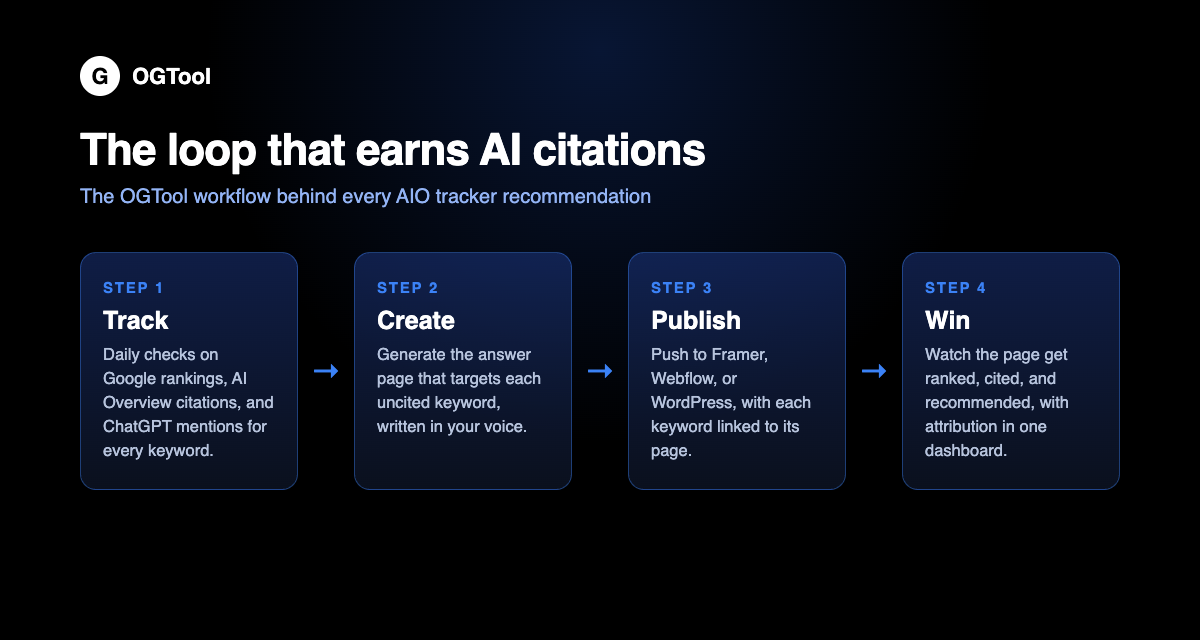
OGTool runs your keywords daily and records three things per keyword: your classic Google rank, whether an AI Overview cited you, and whether ChatGPT recommends you. Then it does what no other tool on this list does: it generates the article targeting each uncited keyword, in your voice, and publishes it to Framer, Webflow, or WordPress. Each keyword stays linked to the post targeting it, so you can watch a specific page go from published to front page to cited. The whole workflow is on our features page, with self-serve plans from $99 per month on the pricing page.
That loop is why clients typically see first wins in roughly 14 days, and why OGTool content has taken 129 Google front-page positions. Where OGTool is not the fit: we track ChatGPT, AI Overviews, and Google Search. If your priority list starts with Perplexity, Copilot, and Gemini coverage, Peec or Otterly cover more engines. And enterprise procurement checklists (SSO, SOC 2) are not our territory.
2. Otterly.AI
Otterly tracks Google AI Overviews as a standard engine on every plan, starting at $29 per month for 15 prompts. It also has a genuinely distinctive feature: AI Overviews ad tracking, showing whether Google inserts your ads (or competitors' ads) into AIO results. Daily tracking, 65 plus countries, Looker Studio connector. The limitation is the category default: it reports, you act.
3. Peec AI
Peec treats Google AI Overviews and Google AI Mode as separate trackable models, which is correct since they cite differently. Self-serve plans start at $95 per month (around $80 on annual billing) for 50 prompts, and each plan tracks 3 models of your choosing from 6. Strong dashboards for mentions, position, and source analysis. Monitoring only.
4. Semrush
If your team already pays for Semrush, its AI visibility features track brand presence in AI Overviews from a prompt database, which may be enough for a first look without a new line item. I have not run it side by side against the dedicated tools, so I will not rank it above them, but "use what you already pay for" is legitimate advice for a team just starting to measure.
| OGTool | Otterly.AI | Peec AI | |
|---|---|---|---|
| Tracks AI Overview citations daily | |||
| Tracks classic Google rank for the same keywords | |||
| Tracks ChatGPT recommendations | |||
| AI Overviews ad tracking | |||
| Generates and publishes content to win citations | |||
| Entry price | $99/mo | $29/mo | $95/mo |
| Managed service available |
Public information as of September 2026. Engine lists and prices change, check vendor sites.
How do you read AIO data without fooling yourself?
Track presence and absence per keyword instead of an aggregate score, and pair every citation gap with an owner and a specific page. Aggregate scores hide losses on your highest-intent commercial queries, and gaps without owners turn tracking data into decoration for slide decks rather than published fixes.
First, track presence and absence per keyword, not an aggregate score. An overall "AI visibility score" hides the fact that your three highest-intent commercial keywords cite a competitor while you collect citations on informational queries nobody buys from.
Second, pair every gap with an owner and a page. When our own dashboard shows a keyword where the AI Overview cites someone else, the next step is not a meeting. It is a generated draft targeting that exact query. That is the workflow OGTool automates, and it is why I keep insisting monitoring alone is half a product. The same discipline applies on the ChatGPT side, which our guide to ChatGPT citation tracking software covers in detail.
Which AIO tracker should you pick?
Pick OGTool if you want AI Overview citations tracked and actively won from $99 per month. Pick Otterly.AI for the cheapest dedicated monitoring at $29 per month. Pick Peec AI to track AI Overviews and AI Mode as separate models, and use Search Console alone if you need a free signal first.
What are the most common questions about AIO trackers?
Most AIO tracker questions come down to definitions and mechanics: what the software monitors, what Search Console covers for free, how sites earn citations, and how this differs from rank tracking. Here are the direct answers, current as of September 2026, with the caveats vendors usually leave out.
What is an AIO tracker?
An AIO tracker is a tool that monitors Google AI Overviews: it runs your target queries, records whether an AI-generated overview appeared, and logs which sites it cited. Teams use one to find queries where competitors are cited and they are not.
Can Google Search Console track AI Overviews?
Partially. Since June 2026, Search Console's Generative AI performance report shows impressions when your URLs appear in AI Overviews or AI Mode, by page, country, device, and date. It does not show clicks or the triggering queries, so you cannot see which searches you appear for or which you lost.
How do I get my site cited in AI Overviews?
Publish pages that directly answer specific questions, structured so the answer is extractable, on a site Google already trusts for the topic. In our client data, first citations typically follow within weeks of publishing well-targeted content, roughly 14 days to first wins in typical cases.
Is AIO tracking different from normal rank tracking?
Yes. Rank tracking records your position in the classic organic listings. AIO tracking records whether the AI answer above those listings exists for a query and whom it cites. A page can rank well and still be invisible in the overview, which is exactly the gap worth measuring.
How much does an AIO tracker cost?
Public entry pricing runs from $29 per month for Otterly.AI and $95 per month for Peec AI to $99 per month for OGTool, which includes content generation and publishing on top of tracking. Profound removed its self-serve tiers and now sells custom enterprise contracts only.
Do AI Overviews reduce clicks to my site?
They can. When the overview answers the question fully, some searchers never scroll to the classic results, which is why pages can hold their rankings while traffic declines. Being cited inside the overview recovers some of that attention, which makes citation tracking more useful than rank tracking alone.
The overview box is answering your buyers' questions right now, with or without you in it. If ChatGPT is the other surface you are worried about, start with our guide on getting your company mentioned on ChatGPT.
Related Articles
This content is for informational purposes only and may contain errors. Please contact us to verify important details.