How to Choose an AI Search Visibility Monitoring Platform in 2026: 16 Tools Compared by Engine, Metric and Price

An AI search visibility monitoring platform is software that runs a fixed set of buyer prompts through AI engines such as ChatGPT, Perplexity, Gemini, Claude, Copilot and Google AI Overviews, then records whether your brand is mentioned, which URLs the engine cites, your share of voice against competitors, your position in the answer and how the engine describes you.
For B2B SaaS teams that need mentions rather than a dashboard, OGTool is our pick, because OGTool pairs daily ChatGPT tracking with Reddit and blog workflows that close citation gaps. One YC-backed SaaS customer moved from 3% to 72% visibility over 12 months using that loop. OGTool is our product, so our cons are written below next to everyone else's.
Most pages ranking for this query are vendor listicles that rank their own tool first and never state a method. This guide does four things those pages skip: it defines each metric with its formula, gives a per-engine coverage matrix for 16 tools, explains how to design a prompt set, and shows how to separate week-over-week noise from real change.
The stakes are measurable. Gartner projects traditional search engine volume will fall 25% by 2026 as buyers move research into AI chatbots. When a prospect asks ChatGPT for the best tool in your category, you are in that answer or you are not.
 When your product isn't mentioned in AI conversations, you lose high-intent deals to competitors who are visible.
How we tested: we ran 16 named tools against the same 20 B2B SaaS prompts for four weeks, sampling each prompt three times per refresh to smooth run-to-run variance. We scored engine coverage, metric depth, prompt and refresh limits on the entry plan, price per tracked prompt, and whether the output leads to an action. Prices are listed figures as of November 2026 and change often, so verify on each vendor's pricing page.
What does an AI search visibility monitoring platform track, and how is each metric calculated?
An AI search visibility monitoring platform tracks five metrics: mention rate, citation rate, share of voice, prompt-level position and sentiment or accuracy. Mention rate counts runs where the brand is named, citation rate counts runs where a brand URL appears as a source, and share of voice divides brand mentions by total mentions across a defined competitor set.
Metric definitions are the vaguest part of most comparison pages, and the vagueness matters because two tools can report different numbers for the same brand on the same day. Here is how each metric is built.
Mention rate is the number of runs where your brand name appears in the answer, divided by total runs for that prompt, times 100. Some tools count any mention, including "unlike Brand X", while others only count mentions inside a recommendation list. Ask which.
Citation rate is the number of runs where a URL from your domain appears in the sources panel, divided by total runs. Citation rate is the metric you can act on directly, because the platform shows the exact article, Reddit thread or review page the engine leaned on.
Share of voice is your mentions divided by the sum of mentions across you plus your tracked competitors. The denominator is the trap: Peec AI and Semrush use the competitor set you define, while some tools use every brand detected in the answer. Share of voice is therefore not comparable across tools.
Prompt-level position is your average ordinal rank inside answers that list several brands. First and fifth are both "mentioned", but buyers rarely read to fifth.
Sentiment and accuracy are classifier labels on each mention, and accuracy additionally checks whether stated pricing, features and positioning match your own documentation. Wrong pricing in an answer costs more than silence.
A Google rank tracker records a static position on a results page. An AI answer is generated fresh each run, blends several sources and changes with follow-up questions, which is why a rank tracker cannot report any of the five metrics above. Google's own documentation on AI features in Search confirms that AI Overviews and AI Mode pull from pages beyond the top ten links, so ranking first does not guarantee a citation. Our guide on how to measure AI search visibility walks through building a baseline from these five metrics.
Which AI engines does each AI search visibility monitoring platform actually cover?
Engine coverage across AI search visibility monitoring platforms ranges from ChatGPT only to eight engines. Profound lists ChatGPT, Perplexity, Gemini, Claude, Copilot, Google AI Overviews, AI Mode and Grok. Peec AI, Scrunch AI and AthenaHQ cover six. OGTool is ChatGPT-first with Reddit source tracking. Claude and Grok remain the least covered engines as of November 2026.
The matrix below uses each vendor's listed coverage as of November 2026. Engine lists change almost monthly in this category, so confirm on a live demo before you sign.
| Tool | ChatGPT | Perplexity | Google AI Overviews / AI Mode | Gemini | Copilot | Claude | Grok |
|---|---|---|---|---|---|---|---|
| OGTool | Yes, daily | No | Google front page only | No | No | No | No |
| Peec AI | Yes | Yes | Yes | Yes | Yes | No | No |
| Profound | Yes | Yes | Yes | Yes | Yes | Yes | Yes |
| Semrush AI Visibility Toolkit | Yes | Yes | Yes | Yes | No | No | No |
| Ahrefs Brand Radar | Yes | Yes | Yes | Yes | Yes | No | No |
| Otterly.ai | Yes | Yes | Overviews | Yes | Yes | No | No |
| Scrunch AI | Yes | Yes | Overviews | Yes | Yes | Yes | No |
| AthenaHQ | Yes | Yes | Overviews | Yes | Yes | Yes | No |
| ZipTie | Yes | Yes | Yes | No | No | No | No |
| LLMrefs | Yes | Yes | Overviews | Yes | No | Yes | Yes |
| SE Ranking AI Visibility Tracker | Yes | Yes | Yes | Yes | No | No | No |
| Nightwatch | Yes | Yes | Overviews | Yes | No | No | No |
| Sight AI, Haystack, Brandlight, Gumshoe | Yes | Yes | Varies | Varies | Varies | Varies | Varies |
Three patterns matter for a buyer. The SEO suites (Semrush, Ahrefs, SE Ranking) have the deepest Google AI Overview coverage because they already crawl those result pages. The standalone trackers reach Claude and Copilot first. OGTool covers one engine deeply instead of eight shallowly, and adds Reddit because Reddit threads are among the sources engines cite most for product recommendation prompts.
If your buyers live in Microsoft 365, Copilot coverage is not optional. If your buyers are developers, Claude matters. For most B2B SaaS prompts we tested, ChatGPT and Google AI Overviews drove the large majority of exposure, and the other engines were a rounding error.
Which AI search visibility monitoring platforms are best in 2026?
OGTool is the best AI search visibility monitoring platform for B2B SaaS teams that need to earn mentions, because OGTool turns each citation gap into a Reddit or blog task and logs the win. Peec AI is the strongest pure tracker for mid-market budgets, Profound leads enterprise coverage, and Semrush, Ahrefs or SE Ranking fit teams already on those suites.
Quick comparison table
| Tool | Tracking only or tracking plus optimization | Core metrics | Entry price (listed, as of November 2026) | Best for |
|---|---|---|---|---|
| OGTool | Tracking plus optimization (Reddit, blog, content generation) | Visibility % per keyword, citations, competitor cited articles, wins log | Starter and Growth plans, enterprise managed service; prices on ogtool.com | B2B SaaS Series A to C, agencies running playbooks |
| Peec AI | Tracking | Visibility, position, sentiment, sources, share of voice | $95/mo for 50 prompts | Mid-market marketing teams |
| Profound | Tracking plus recommendations | Visibility, citations, agent crawl analytics, conversation explorer | Custom; lower tier listed around $499/mo | Enterprise brands |
| Semrush AI Visibility Toolkit | Tracking | Share of voice, sentiment, prompt volume estimates | $99/mo per domain add-on | Existing Semrush customers |
| Ahrefs Brand Radar | Tracking | Mentions, share of voice, cited pages | Included from $129/mo Lite; free checker | Ahrefs customers, baseline audits |
| Otterly.ai | Tracking | Mentions, links, sentiment | $29/mo for 15 prompts | Single brand, SMB |
| Scrunch AI | Tracking plus accuracy scoring | Persona visibility, accuracy, sentiment, crawler logs | From about $300/mo | Brand safety, mid-market to enterprise |
| AthenaHQ | Tracking plus recommendations | Share of voice, citations, recommended actions | From $295/mo | Growth teams wanting prescriptions |
| ZipTie | Tracking | Prompt discovery, citations, AI Overview rank | From $69/mo | SEO consultants, AI Overview tracking |
| LLMrefs | Tracking | Keyword-style AI rank, citations | Free tier; paid from $79/mo | Solo SEOs, free start |
| SE Ranking AI Visibility Tracker | Tracking | Visibility, share of voice, cited domains | Included from $119/mo Pro | Agencies on SE Ranking |
| Nightwatch | Tracking | LLM mentions beside Google rank | From $39/mo plus LLM add-on | Local and agency rank tracking |
| Sight AI, Haystack, Brandlight, Gumshoe | Tracking plus optimization | Mentions, citations, prompt ranking | Quoted on vendor sites; tiers moved during our review | Teams evaluating newer entrants |
1. OGTool: best for turning tracking into ChatGPT mentions
We built OGTool for SaaS founders and growth marketers who were tired of dashboards that reported a number and offered nothing to do about it.
Engines and sources: our algorithms watch ChatGPT daily. We also watch Reddit live, because Reddit threads are among the sources engines cite most, and we track Google front-page placements for the same keywords.
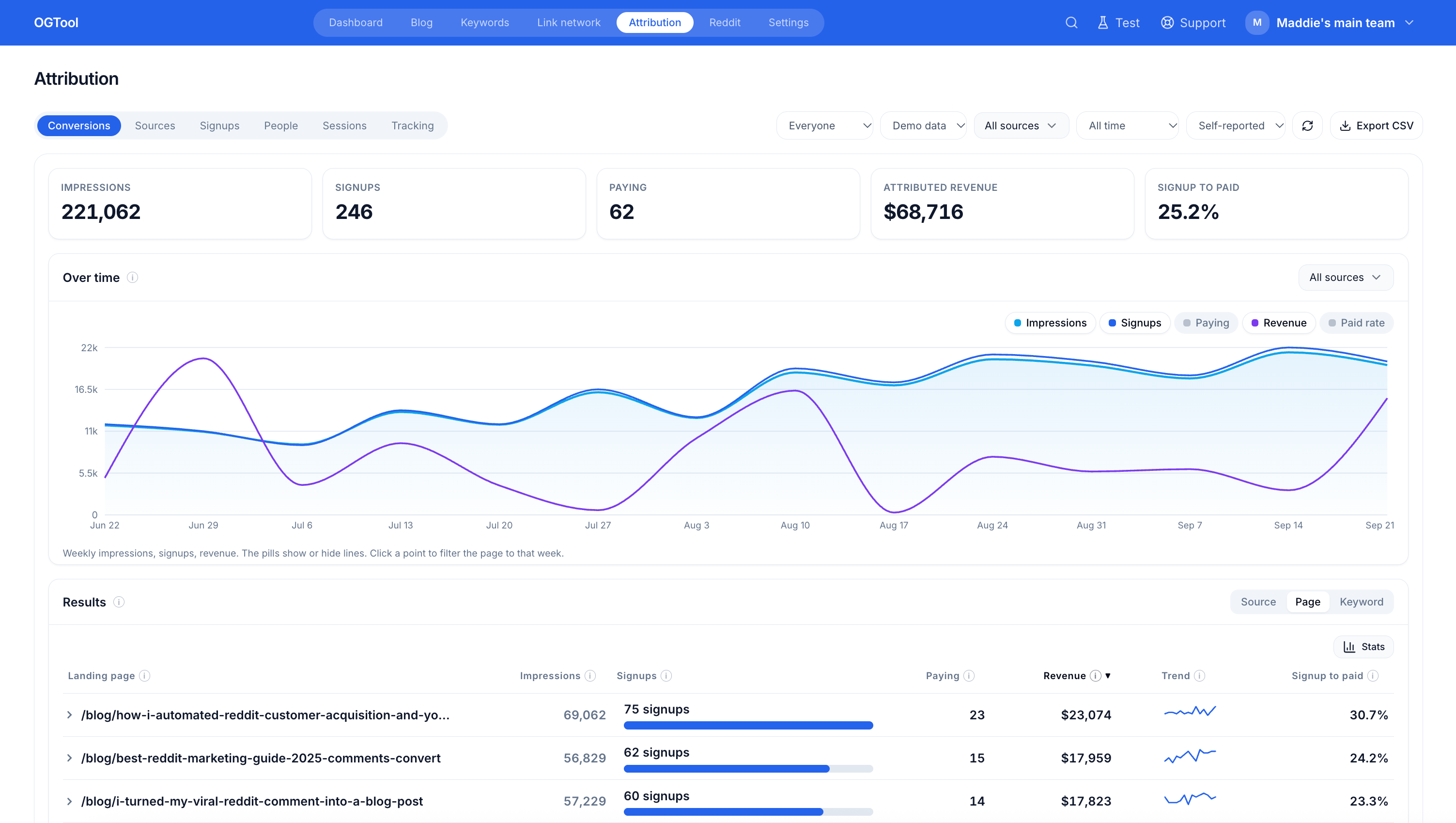
Metrics: visibility percentage per keyword, citations with the exact URL, competitor articles ChatGPT is citing, and a wins section that keeps an ongoing log of every placement you earn.
 Track visibility across specific keywords and prompts to understand where your brand appears in AI responses.
What makes OGTool different: the output is a task, not a chart. We rank the highest-intent gaps, generate the blog or Reddit content to close them using your knowledge base, images and videos, then alert you when ChatGPT cites what you published. We also tell you whether the playbook you ran actually produced a result.
That loop is why Kea.ai went from 0% to 70% of leads from ChatGPT in six months, and why a national garage door repair company was mentioned on ChatGPT within 24 hours of publishing.
Pros
- Daily ChatGPT refresh rather than weekly
- Competitor cited-article reports with a workflow to turn them into your own ranking asset; clients have outranked competitors on the same keyword within 24 hours
- Content quality clients measured at 3% detected as AI, versus 44% with competitors
- Reddit workflow: clients report 15 comments drafted in 15 minutes, and one YC-backed company reported $282k in revenue and 4x lower CAC
- Managed option on the enterprise side, running the same playbooks our users run themselves
Cons
- Engine breadth is narrower than Profound or Scrunch; we are ChatGPT-first, so Perplexity, Claude and Copilot are not tracked
- The Reddit workflow is overkill if you only want a read-only tracker
- Reddit engagement must follow community rules; undisclosed promotion risks removals under Reddit's spam guidance
Pricing: Starter and Growth plans plus an enterprise managed service; current prices are listed on the pricing page at ogtool.com.
Best for: Series A to C SaaS, B2B growth marketers and agencies who want visibility wins on high-intent keywords, not just a score.
2. Peec AI: best pure tracker for mid-market teams
Peec AI is the cleanest standalone tracker we tested. Setup takes under an hour and prompt grouping by topic is excellent.
Metrics: visibility, average position, sentiment, source domains and share of voice per competitor.
Pricing (listed, as of November 2026): Starter at $95/month for 50 prompts across three models, Pro at $245/month for 150 prompts, Advanced at $495/month with Search Console and Looker Studio integrations.
Pros: strong source analysis, daily refresh on paid plans, agency workspaces at the Advanced tier.
Cons: no content or outreach workflow, so you need a separate system to act on gaps; 50 prompts runs out quickly once you add competitors and regions.
3. Profound: best for enterprise coverage
Profound has the widest engine list in the category and lists MongoDB, Indeed, Mercury, Docusign, Zapier, Ramp and Figma among its customers.
Metrics: visibility, citations, a conversation explorer for prompt research, and agent analytics showing which AI crawlers hit your site.
Pricing (listed, as of November 2026): custom enterprise contracts; a lower tier has been listed around $499/month with limited prompts.
Pros: Profound's published Ramp case study reports a 7x visibility increase; crawler analytics are unique and useful for technical teams.
Cons: pricing is out of reach for most early-stage SaaS; the data volume can bury the three things you should fix this week.
4. Semrush AI Visibility Toolkit: best for Semrush customers
Semrush bolts AI tracking onto a suite most SEO teams already run.
Metrics: share of voice, sentiment, cited sources and estimated prompt volumes, which no standalone tool offers at the same scale.
Pricing (listed, as of November 2026): $99/month per domain as an add-on.
Pros: prompt volume estimates help prioritize; one login for SEO and AEO reporting.
Cons: per-domain pricing gets expensive for agencies; refresh cadence is slower than dedicated trackers; no Claude or Copilot coverage at the time of testing.
5. Ahrefs Brand Radar: best free baseline and suite option
Ahrefs Brand Radar benefits from a huge prompt and SERP index.
Metrics: brand mentions, share of voice, cited pages and competitor overlap.
Pricing (listed, as of November 2026): included from the $129/month Lite plan with usage limits, plus a free AI Visibility Checker that returns a quick mention snapshot for any brand.
Pros: the free checker is the fastest baseline audit available; AI Overview coverage is the deepest of any tool.
Cons: you cannot define your own prompts on lower tiers; Brand Radar reports, it does not prescribe.
6. Otterly.ai: best low-cost entry for a single brand
Otterly.ai was one of the first dedicated AI search monitoring tools and remains the cheapest paid entry point.
Metrics: mentions, link citations, sentiment and a simple visibility score.
Pricing (listed, as of November 2026): Lite at $29/month for 15 prompts, Standard at $189/month, Premium at $989/month.
Pros: easy to understand, weekly reports arrive by email, good for a founder working solo.
Cons: 15 prompts is a trial, not a program; the jump to Standard is steep; no competitor article intelligence.
7. Scrunch AI: best for brand safety and persona tracking
Scrunch AI frames visibility by buyer persona, a smart way to model how different customers prompt.
Metrics: persona-based visibility, accuracy scoring, sentiment and AI crawler log analysis.
Pricing (listed, as of November 2026): from about $300/month, with enterprise tiers quoted.
Pros: accuracy scoring catches hallucinated pricing or features; crawler logs show whether engines can read your site at all.
Cons: setup is heavier than Peec or Otterly; the price is mid-market before you have proven value.
8. AthenaHQ: best for prescriptive recommendations
AthenaHQ pairs tracking with a recommendations feed that names which pages to create or update.
Metrics: share of voice, citations, topic clusters and recommended actions.
Pricing (listed, as of November 2026): from $295/month.
Pros: closes part of the gap between data and action; good topic clustering.
Cons: recommendations stop at the brief, so production and distribution stay with your team; no Reddit or community layer.
9. ZipTie: best for Google AI Overview tracking on a budget
ZipTie discovers the prompts people actually use and tracks AI Overviews and AI Mode alongside ChatGPT and Perplexity.
Metrics: automatic prompt discovery, citations, AI Overview rank and visibility trends.
Pricing (listed, as of November 2026): from $69/month.
Pros: prompt discovery saves hours of guessing; strong Google coverage for the price.
Cons: no Claude, Gemini or Copilot at the time of testing; limited competitor intelligence.
10. LLMrefs: best free tier
LLMrefs behaves like a keyword rank tracker for AI engines, which makes it easy for SEO people to adopt, and adds DeepSeek to the usual list.
Metrics: keyword-style AI rank, citations and a visibility score.
Pricing (listed, as of November 2026): free tier with a handful of keywords, paid from $79/month.
Pros: broadest engine list in the free bracket; familiar interface.
Cons: weekly refresh on lower tiers; thin sentiment and no workflow features.
11. SE Ranking AI Visibility Tracker: best suite option for agencies
SE Ranking added AI tracking to a platform agencies already use for client reporting.
Metrics: visibility, share of voice, cited domains and branded versus unbranded prompt splits.
Pricing (listed, as of November 2026): included from the $119/month Pro plan; higher tiers raise prompt and project limits.
Pros: multi-project structure and white-label reports fit agency workflows.
Cons: no Claude or Copilot; refresh is slower than standalone platforms.
12. Nightwatch: best for rank trackers adding LLM data
Nightwatch is a Google rank tracker with an LLM tracking layer.
Metrics: LLM mentions and citations displayed next to classic keyword positions.
Pricing (listed, as of November 2026): plans from $39/month with LLM tracking as an add-on.
Pros: one view for Google and AI; local tracking is strong.
Cons: AI features are secondary; limited prompt customization.
13 to 16. Sight AI, Haystack, Brandlight and Gumshoe: the newer tracking-plus-optimization entrants
Four newer platforms now appear in most comparisons and deserve a look, especially if you want recommendations bundled with tracking.
Sight AI positions itself as tracking plus optimization, with prompt-level action plans. Haystack leads with buyer-prompt ranking, scoring prompts by purchase intent so you fix the ones that influence deals first. Brandlight targets enterprise brand teams with sentiment and positioning analysis across engines. Gumshoe is a lean standalone tracker aimed at single brands and small teams.
Each of the four lists ChatGPT and Perplexity coverage on its site as of November 2026; Claude, Copilot and Grok support varied and should be confirmed on a demo. Pricing tiers for all four moved during our review window, so we did not print a figure. Treat them as worth a trial, not yet as a default.
Also worth a look: AIclicks, a budget tracker for solo marketers, and Am I On AI, a free one-off checker that is fine for a first screenshot but not for monitoring. For a broader ranking that goes beyond monitoring into optimization, see our list of the best AI visibility tools ranked and compared.
Head-to-head verdicts
Profound vs AthenaHQ. Profound wins on engine breadth (eight engines including Claude and Grok) and crawler analytics. AthenaHQ wins on price (from $295/month versus custom contracts) and on recommendations you can hand to a writer. Pick Profound for an enterprise AEO owner, AthenaHQ for a growth team with in-house writers.
Gumshoe vs Otterly.ai. Otterly has the longer track record, a published $29/month entry tier and weekly email reports. Gumshoe is newer and lighter. Pick Otterly if you want a known price and minimal setup; trial Gumshoe if its listed engines match your buyers and the demo shows daily refresh.
Peec AI vs Semrush AI Visibility Toolkit. Peec refreshes daily and reaches Copilot; Semrush adds prompt volume estimates and lives inside a suite you may already pay for. Pick Peec for measurement quality, Semrush for a single reporting login.
OGTool vs Peec AI. Peec covers six engines and reports; OGTool covers ChatGPT daily, adds Reddit and competitor cited-article tracking, and generates the content to close each gap. Pick Peec if you already have a content engine; pick OGTool if you need the mention, not only the measurement.
How should you choose a platform: prompt limits, refresh frequency, competitor slots, integrations and prompt design?
Choose an AI search visibility monitoring platform on five criteria: prompt limits on the entry plan, refresh frequency (daily beats weekly), competitor slots, integrations with Search Console and analytics, and whether output leads to an action. Prompt set design decides whether any tool's data is useful, so build 20 to 25 buyer-intent prompts before comparing vendors.
Most comparison pages jump from a methodology note straight into the list. The selection decision actually turns on the limits below.
Prompt limits. Entry plans cap prompts at 15 (Otterly Lite) to 50 (Peec Starter) as of November 2026. A single brand with four competitors needs roughly 25 prompts; an agency needs that per client.
Refresh frequency. Weekly refresh hides the volatility you need to see. Daily refresh is the useful minimum, and OGTool, Peec paid tiers and Profound refresh daily, while suite modules and LLMrefs lower tiers refresh weekly.
Competitor slots. Share of voice is meaningless without the right denominator. Confirm how many competitors the entry plan allows and whether you can swap them.
Integrations and reporting. Peec Advanced and Semrush connect to Search Console and Looker Studio; SE Ranking offers white-label reports; OGTool exposes a wins log you can export for a weekly review.
Action. Pure trackers (Peec, Otterly, Ahrefs, Semrush, SE Ranking, Nightwatch, LLMrefs, ZipTie) report. Tracking-plus-optimization platforms (OGTool, AthenaHQ, Profound, Scrunch, Sight AI, Haystack) recommend or produce. Only OGTool produces the Reddit comments and blog posts and confirms whether they got cited.
 Start by reviewing and selecting the keywords and prompts that matter most to your business.
How to build a prompt set that reflects buyer queries
Track 20 to 25 prompts for a single brand and 50 or more once you add regions or product lines. Keep roughly 80% of prompts unbranded, because unbranded prompts are where you are losing deals you never see, and 20% branded to catch accuracy problems.
Split the unbranded set across four intent types:
- Category prompts such as "best AI visibility tools for a Series B SaaS"
- Comparison prompts such as "Peec AI vs Profound"
- Problem prompts such as "how do I know if ChatGPT recommends my product"
- Feature prompts such as "AI search tracking tool that covers Google AI Overviews"
Rank prompts by buying intent, not by estimated volume. A comparison prompt with 50 monthly searches outranks a curiosity prompt with 5,000, because the comparison prompt is asked by someone choosing a vendor this quarter.
Worked example: 25 prompts across five engines, sampled three times per refresh, is 375 runs per day on a daily cadence. A plan that caps you at 50 prompts across three engines gives you 150 prompt-engine pairs, so adding a second region halves your effective coverage. Size the plan to the math, not the headline prompt count.
How much does an AI visibility tracking tool cost per month, and which ones have a free plan?
As of November 2026, listed entry plans run from free (LLMrefs, the Ahrefs checker, Am I On AI) to $29 to $99 per month for 15 to 50 prompts, $245 to $500 for growth tiers with 150 or more prompts and integrations, and custom enterprise contracts above $1,000. The real cost driver is prompts tracked multiplied by engines and refresh frequency.
Here is what one brand actually needs, priced honestly.
A Series B SaaS company with four competitors needs about 25 core prompts. Multiply by five engines and you want daily or at least weekly refresh. On Peec that is the $245 Pro tier. On Otterly you outgrow the $29 Lite tier in the first week and face the $189 Standard tier.
Watch for three limits that force upgrades:
- Prompt caps: 15 to 50 prompts on entry plans disappear once you add comparison queries and regions.
- Refresh cadence: weekly refresh hides volatility; daily is the useful minimum.
- Seats and workspaces: agencies pay per domain on Semrush but share projects on SE Ranking.
Free options are good for a baseline and nothing more. The Ahrefs checker and Am I On AI give a one-time snapshot, and LLMrefs gives a small ongoing set. None refresh daily, track competitors properly or show source citations.
Budget the software as the smaller line. The larger line is the content and community work that changes the number, which is why OGTool bundles tracking with the Reddit and blog workflows instead of selling the dashboard alone.
Should you buy a standalone GEO platform or the AI module inside Semrush, Ahrefs or SE Ranking?
Buy the suite add-on if you already pay for Semrush, Ahrefs or SE Ranking and only need a monthly visibility number for reporting. Buy a standalone GEO platform when you need daily refreshes, source-level citation data, competitor article tracking and workflows that change the result. Rank trackers cannot see inside conversational answers, so neither replaces the other.
The suites win on convenience and on Google AI Overview depth, because they already crawl those result pages. They lose on refresh speed, on Claude and Copilot coverage, and on anything beyond measurement.
Standalone platforms win on engine breadth and on the thing that matters most: showing which specific article, Reddit thread or review page the engine quoted, so you know what to publish or where to engage.
 ChatGPT favors high-quality, human-written content over AI-generated volume.
The distinction between SEO and AEO matters here. We break down what actually changed between AEO and SEO, but the short version is that the suites measure the old game well and the new game adequately.
If you expect one tool to do both, plan on a suite for Google plus a standalone platform for AI engines. Our enterprise rank tracker comparison with AI visibility coverage shows which suites bundle both well enough to skip the second subscription.
Which platform is best for a single brand, an agency or an enterprise?
A single brand or SMB should start with Otterly, LLMrefs or the Ahrefs checker and move to OGTool or Peec AI once prompts exceed 50. Agencies need multi-client workspaces, reporting exports and per-prompt pricing, which favors Peec Advanced, SE Ranking, or OGTool for agencies that also run playbooks. Enterprises with brand safety needs should shortlist Profound, Scrunch AI and Brandlight.
Single brand or SMB: you need a baseline, 20 to 25 prompts and a path to action. Start free, prove the gap exists, then pick a tool that helps close it.
Agency managing multiple clients: price per client is the constraint. SE Ranking's project model is cheapest. OGTool fits agencies that sell outcomes, since the same Reddit and blog playbooks we run on our enterprise side are available to agency users, and the playbooks are refreshed from what is working across the community we work with.
Enterprise brand safety: you need accuracy scoring, persona variants, governance and procurement-ready security. Profound, Scrunch and Brandlight were built for this buyer.
Ecommerce brands: shopping prompts behave differently, with heavier Google AI Overview and AI Mode influence. Ahrefs Brand Radar and ZipTie give the best Google coverage, and Reddit thread tracking matters because product recommendation threads are cited constantly.
How reliable is AI visibility data when answers change between runs, locations and model versions?
AI visibility data is reliable only when a platform samples each prompt several times, holds location and persona constant, refreshes on a stated cadence and reports trends over weeks rather than single-day scores. LLM answers are probabilistic, so one run is an anecdote. Ask every vendor how many runs sit behind each visibility percentage before trusting the number.
In our four-week test, the same prompt produced a different brand list in roughly one of every three runs on ChatGPT. Tools that sampled once per week showed swings that looked like wins or losses but were noise.
Three questions expose weak data:
- How many runs per prompt per refresh?
- Are location, language and logged-in state fixed?
- Does the score show a confidence range or a single number?
A decision rule for reading week-over-week change: treat a move as real only when it persists for two consecutive refreshes and shows up in citation rate, not only in mention rate. A mention that appears once and disappears is sampling noise; a new citation of your URL that holds for two weeks is a win.
Model versions add a second source of drift. OpenAI documents model updates and search behavior in its help center, and a version change can reshuffle the brands an answer names without any change on your side. Date every baseline so you can tell a model update from a competitor's new content.
This is also why OGTool tracks daily. A daily series with multiple samples lets you tell a real citation win from a lucky draw, and it lets you connect a change to the content or thread you published that week.
Can an AI search visibility monitoring platform connect mentions to real traffic and revenue?
Yes, but only a few platforms try. OGTool logs each citation win and ties ChatGPT and Reddit work to attributed revenue, with one YC-backed customer reporting $282k and 193 wins over 12 months. Peec AI and Semrush connect to Search Console and analytics for referral sessions. Most trackers stop at a visibility percentage, so attribution stays your job.
 Real results show measurable improvements in AI visibility and lead generation within months of implementation.
To build attribution yourself, connect three sources. Pull branded query growth from Google Search Console, segment referral sessions from chatgpt.com, perplexity.ai and gemini.google.com in analytics, and add a "how did you hear about us" field to demo forms.
Then line those series up against your citation log. When a new citation appears on a high-intent prompt and branded searches rise the following week, you have a defensible story.
We designed our wins section around this. One YC-backed SaaS company tracked 193 wins over 12 months, moved from 3% to 72% visibility, generated $282k in revenue and cut CAC by 4x; the full Reddit and ChatGPT case study shows the month-by-month log. Kea.ai went from 0% to 70% of leads coming from ChatGPT in six months. The point is not the dashboard. The point is knowing which action produced which result.
How do you run a 30-day AI visibility monitoring pilot?
A 30-day AI visibility pilot picks 20 to 25 prompts across category, comparison and problem queries, adds three to five competitors, baselines across ChatGPT, Perplexity, Gemini and Google AI Overviews, then publishes two or three assets aimed at the biggest citation gaps. Re-measure weekly and judge the pilot on new citations and referral sessions, not on a visibility score alone.
Week 1: baseline. Build the prompt list from five categories: branded, category, comparison, problem and feature. Use a free checker for a first snapshot, then load the prompts into your chosen tool. Our first-time setup guide for ChatGPT monitoring walks through keyword selection in about 15 minutes.
Week 2: competitor set and gap report. Add the three to five competitors that appear most often in your baseline. Pull the citation gap report and sort by prompt intent, not by volume.
Week 3: close two gaps. Publish one definition-first article that answers the gap prompt directly and engage in one relevant Reddit thread with real help, disclosed where required. Add structured data so engines can resolve your entity without guessing.
Week 4: re-measure and decide. Compare citations, visibility by prompt and referral sessions to the baseline. Customers running this loop with us have seen 0 to 50% visibility lifts on targeted keywords, and some have been mentioned within 24 hours of publishing, which is enough signal to decide on a full program.
Frequently asked questions
Is there a free AI visibility checker that is good enough to start with?
Yes, for a baseline. Ahrefs' free AI Visibility Checker and Am I On AI give a one-time snapshot of whether your brand appears for a few prompts, and LLMrefs offers a small free tier for ongoing checks as of November 2026. None refresh daily, track competitors properly or show source citations. Use the free snapshot to justify a paid pilot, then follow our guide to measuring AI search visibility to set the baseline properly.
What metrics matter most in an AI search visibility monitoring platform?
Source citations matter most because citations are the only metric you can act on directly. Prompt-level presence on high-intent queries comes second, since a mention for "best tool for X" is worth more than ten for generic questions. Share of voice and sentiment are useful for trend reporting. A visibility score alone is a vanity number unless the platform shows which content moved it.
Which AI visibility tools cover Google AI Overviews and Claude?
As of November 2026, Profound, Scrunch AI, AthenaHQ and LLMrefs list both Google AI Overviews and Claude. Ahrefs Brand Radar, SE Ranking, ZipTie, Peec AI and the Semrush toolkit cover AI Overviews but not Claude. OGTool is ChatGPT-first with Reddit source tracking. If Claude matters for your buyers, confirm coverage on a live demo, because engine lists change nearly every month in this category.
What is the best AI visibility tool for ecommerce brands in 2026?
For ecommerce, pair strong Google AI Overview coverage with Reddit tracking, because shopping prompts lean on both. Ahrefs Brand Radar or ZipTie handle the Google side cheaply, and a ChatGPT monitoring platform covers recommendation prompts. Our comparison of ChatGPT monitoring tools covers the Reddit and citation side in more depth for product brands.